
I was watching the Sara Duterte impeachment trial yesterday, Day 2, when the defense lawyer kept standing up and saying "Objection" during the NBI (National Bureau of Investigation) agent's testimony. Over and over.
The comments section exploded. "Harang lang yan." "Ayaw nilang lumabas ang katotohanan." Some people started counting how many times it happened.
I get it. When you're not a lawyer, an objection looks like delay. Like someone trying to stop the truth from coming out.
I'm not a lawyer either. But I got curious enough to look it up. And what I found is that most of what happens in a courtroom actually follows a logic that, once you see it, makes a lot of sense.
So here's me trying to understand it, in plain language, for anyone else who was also watching and wondering.
SO WHAT EXACTLY IS AN OBJECTION?
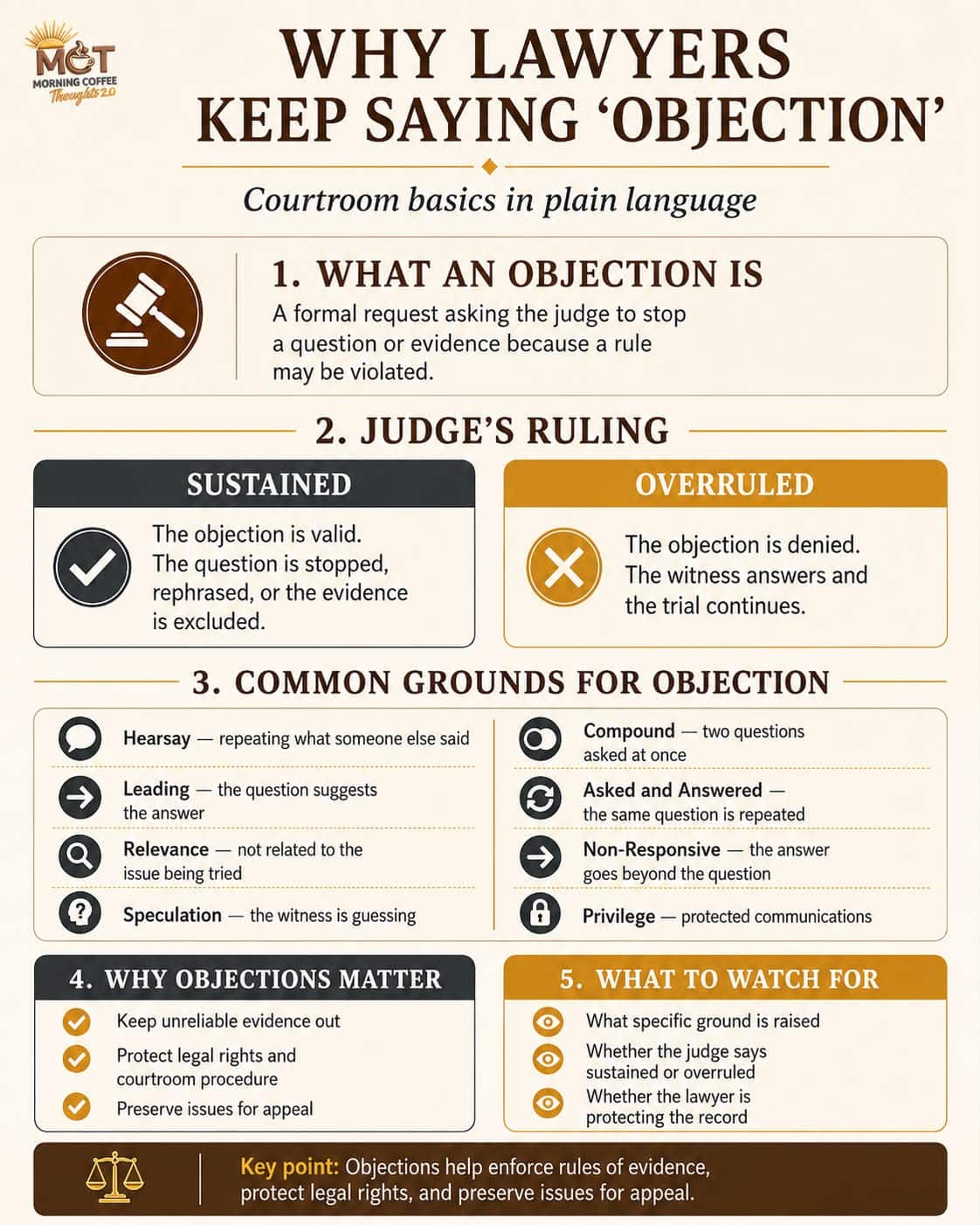
An objection is a formal request from a lawyer asking the judge to stop something from happening. The lawyer stands up, says "Objection," and the judge either agrees ("Sustained") or disagrees ("Overruled").
When sustained, the evidence gets thrown out or the question gets rephrased. When overruled, the trial continues as if nothing happened.
There are two kinds: objections to questions being asked, and objections to evidence being presented.
Both have specific legal reasons behind them.
A lawyer can't just stand up and say "objection" because they don't like what's being said.
There has to be a ground, a specific rule being broken.
THE MOST COMMON REASONS LAWYERS OBJECT
Hearsay is the big one. "Objection, hearsay, your Honor." You hear this a lot.
Hearsay means the witness is repeating what someone else told them, not what they personally saw or heard.
So if a witness says, "My friend told me he saw the accused at the crime scene," that's hearsay.
The friend isn't in court. Nobody can cross-examine the friend. So the statement doesn't count.
Leading questions come next. When a lawyer asks a question that already has the answer baked in, like "You saw him leave at midnight, didn't you?", that's leading.
The lawyer is basically feeding the answer to the witness.
Courts don't allow this during direct examination (the part where your own lawyer questions you) because the witness should be the one telling the story, not the lawyer.
Relevance is another one. If a prosecutor in a theft case suddenly starts asking about the accused's old traffic violations from 2015, the defense can object.
The question has nothing to do with the current case. Judges can be distracted or biased by information that has no bearing on the actual charge.
Speculation is when the witness is asked to guess. "What do you think the accused was feeling when he left?"
A witness can only testify about facts they personally observed, not about what someone else was thinking or feeling.
If the question can only be answered through guessing, it gets objected to.
Compound questions happen when two separate questions are crammed into one. "Did you see him there, and were you afraid?" That's two questions.
The witness might answer one and not the other. The record becomes confusing. So lawyers object.
Asked and answered is when the opposing lawyer keeps asking the same question, maybe with slightly different words, hoping to get a different answer.
Courts allow one go at a question. After it's been answered, you move on.
Non-responsive is when the witness goes off on a tangent. The lawyer asked a yes-or-no question, but the witness delivers a speech.
The objecting lawyer can ask the judge to strike the extra parts from the record.
WHAT ABOUT THE RIGHTS ANGLE?
There's also privilege. Some information is legally protected and cannot be forced into court.
A conversation between a lawyer and their client stays private. What you told your doctor stays private. What you confessed to your priest stays private.
These are called privileges, and they exist for a reason: people would stop talking honestly to their doctors, lawyers, and priests if they knew everything could end up in court.
When a lawyer objects on the basis of privilege, they're not hiding something dirty. They're protecting a legal right that exists in the system.
DOES OBJECTING MEAN SOMEONE IS LYING?
No. That's the part that surprised me most when I looked this up.
An objection doesn't mean the truth is being hidden. It means a rule is being violated.
Courts follow rules of evidence not to protect the guilty, but to protect the process.
Unreliable testimony, second-hand stories, and guesswork can mislead a judge. The objection system is there to filter those out.
Think of it this way: if someone accuses you in your barangay (village) and the barangay captain just accepts everything the accuser says without letting you question anything, you’d call that unfair.
The courtroom works on the same idea. Both sides have to follow the same rules. An objection is just one side saying, “Wait, that’s not how this is supposed to work.”
Now, yes, some lawyers do abuse objections.
Some use them to break the rhythm of a damaging testimony, to give their witness time to collect themselves, or just to frustrate the other side. That's a real thing.
Experienced trial lawyers know how to use objections strategically, not just technically.
But the existence of abuse doesn't mean the system itself is wrong.
WHAT HAPPENS AFTER AN OBJECTION?
The judge rules. Two words: Sustained or Overruled.
Sustained means the objection is valid. The question gets thrown out, or the evidence is excluded. The witness doesn't answer.
Overruled means the judge disagrees with the objection. The trial continues. The witness answers.
And here's something I didn't know before I looked this up: objections also serve a future purpose.
If a lawyer fails to object during trial, they generally lose the right to raise the same issue on appeal.
So even when an objection seems futile in the moment, the lawyer might be doing it just to preserve the record, to keep the option open if the case eventually goes to a higher court.
WHAT SHOULD YOU ACTUALLY WATCH FOR
If you're watching the impeachment trial, pay attention to what kind of objection is being raised.
Hearsay and leading questions are almost always about procedure.
Relevance objections are about what the case is actually supposed to be about.
Privilege objections are about protected relationships.
When a lawyer objects a lot, it usually means the opposing counsel is pushing the boundaries of what's allowed. It can also mean the case is tight and every question is heavy.
The courtroom is not a talk show. The rules exist because bad evidence leads to bad verdicts. And bad verdicts, as we've seen too many times in this country, can put innocent people away while guilty ones walk free.
I'm still not a lawyer. But at least now I know why they keep standing up.
A note before you go: I deliberately left out the discussion on pre-trial proceedings, specifically how a properly conducted pre-trial can narrow down the issues, mark evidence in advance, and significantly reduce the number of objections during actual trial. That deserves its own piece. This one was only ever meant to answer the basic question: what does “objection” mean in the first place.
SOURCES
- WomensLaw.org, What are some common objections?, https://www.womenslaw.org/laws/preparing-court-yourself/hearing/objecting-evidence/what-are-some-common-objections
- Scribd, Grounds for Objection During Direct Examination and Cross Exam, https://www.scribd.com/document/204103716/Grounds-for-Objection-DURING-DIRECT-EXAMINATION-AND-CROSS-EXAM
- Scribd, Common Objections at Trial, https://www.scribd.com/document/341564488/Common-Objections-at-Trial
- Criminal Defense Lawyer, Different Types of Objections in Court, https://www.criminaldefenselawyer.com/resources/criminal-defense/criminal-defense-case/trial-process-3.htm
- Scribd, Standard Objections, https://www.scribd.com/document/150503147/Standard-Objections
- Versus Texas, Five Common Criminal Court Objections, https://versustexas.com/court-objections/
- Clio, Types of Objections in Court, https://www.clio.com/blog/objections-in-court/
- Willamette University School of Law, Commonly Used Objections, https://my.willamette.edu/site/law-mootcourt/pdf/commonly-used-objections---fre.pdf
- Philippine News Agency, House prosecutors claim Day 2 victory with presentation of NBI witness, https://www.pna.gov.ph/articles/1278921
- Manila Tribune, Defense: Objections are trial strategy, not courtroom stunt, https://tribune.net.ph/2026/07/07/defense-objections-are-trial-strategy-not-courtroom-stunt
- Inquirer.net, Prosecutors claim Day 2 victory at Sara Duterte impeachment trial, https://newsinfo.inquirer.net/2259371/prosecutors-claim-day-2-victory-at-sara-duterte-impeachment-trial
- ABS-CBN News, Vice President Sara Duterte's Impeachment Trial Day 2 Live Updates, https://www.abs-cbn.com/news/nation/2026/7/7/live-updates-vice-president-sara-duterte-s-impeachment-trial-day-2-1401