
Let me ask you something that’s been turning over in my head for a while now.
We call them out. We curse them on social media. We write their names in all caps with a hundred angry emojis. And then — nothing. They survive. They get reelected. They attend the next press conference smiling, and we go right back to watching.
So what the hell is going on?
Why do we keep tolerating traitors in our midst?
WE HAVE BEEN HERE BEFORE. MANY TIMES.
This is not a new Filipino problem. It’s an old one — and our history is littered with receipts.
Start with Teodoro Patiño. He was a Katipunero, part of the secret revolutionary society that Andres Bonifacio built to fight Spanish rule.
In August 1896, Patiño blew the cover of the entire movement to the Spanish authorities over a two‑peso (roughly worth around ₱10,000–₱11,000 in today’s money) pay dispute with fellow worker and fellow Katipunero Apolonio de la Cruz at the Diario de Manila printing shop.
A fight over two pesos set off a domino effect.
Shaken and angry, Patiño went to see his sister Honoria Patiño, who was staying at the orphanage of the Colegio de la Concordia. There, he confessed the existence and plans of the Katipunan to her.
Honoria broke down and told one of the nuns what she had heard. The nun, alarmed, pushed Patiño to tell everything to Fr. Mariano Gil, the Augustinian parish priest of Tondo.
Patiño did. Gil then went with civil authorities to Diario de Manila, searched the premises, and they found lithographic stones used to print Katipunan receipts, a dagger, membership lists, rules of the society, and other incriminating documents in the locker of another worker, Policarpo Turla.
Those materials were turned over to the Spanish authorities, triggering the arrests that exposed the Katipunan and forced Bonifacio into a premature uprising — what we now call the Cry of Pugad Lawin.
All that started with a pay quarrel and a chain of confession: worker → sister → nun → priest → Guardia Civil.
Then there’s Cecilio Segismundo, an Ilocano messenger trusted by Emilio Aguinaldo during his flight in the mountains of northern Luzon.
After the fall of the First Republic’s strongholds, Segismundo and a small party spent nearly 30 days trekking through hostile, mountainous terrain from Aguinaldo’s hideout in Palanan, Isabela, heading south.
He eventually surrendered to American forces in Pantabangan, Nueva Ecija.
There, he revealed Aguinaldo’s location and carried letters that linked directly back to the general.
In exchange, accounts say he was promised and given a 300‑dollar reward and a commission in the Philippine Army under the new colonial regime.
American officers later described him as cooperative after being fed and treated decently, while Aguinaldo would later claim coercion — but the record is clear: information for money and position, and the capture of the head of the First Republic followed.
Then Januario Galut, a Tingguian Igorot from the Cordilleras.
On December 2, 1899, he guided the 33rd U.S. Infantry Regiment under Major Peyton C. March through a hidden mountain trail that allowed them to flank and encircle the 60-man rearguard led by General Gregorio del Pilar at Tirad Pass.
The result: Del Pilar and most of his men were killed; only a handful of Filipino defenders survived.
Earlier, Igorot fighters had marched to Caloocan armed mainly with spears and shields to face American troops with rifles and artillery. Many felt used and expendable.
Add to that the longstanding discrimination and condescension lowland elites showed toward Igorots.
You get a man like Galut, from a marginalized group, deciding that this “revolutionary government” did not truly represent him. That wounded pride and resentment helped fuel one of the most devastating tactical betrayals in our military history.
Felipe Buencamino may be one of the most shameless career shape‑shifters.
As a Spanish‑era judge, he wrote to the Governor‑General recommending the death penalty for those who “disturb our public peace and tranquility” — i.e., the very revolutionaries we now call heroes.
The Revolution broke out, he was imprisoned by the Spanish, then resurfaced on the Filipino side, helped draft the Malolos Constitution, and joined Aguinaldo’s cabinet.
When the Americans arrived, he switched again, becoming an outspoken Americanista.
During a cabinet meeting, when Buencamino pushed for negotiating surrender with the Americans, General Antonio Luna reportedly lost his temper and slapped him in front of everyone.
Buencamino took it, survived politically, and Luna was assassinated weeks later. The man who kept changing sides walked away; the man who refused to bend was shot dead.
And then we have the grandfather of them all: Pedro Paterno, the original balimbing in the eyes of many historians.
Paterno negotiated the Pact of Biak‑na‑Bato in 1897, which sent Aguinaldo and other leaders into exile in Hong Kong and briefly ended open hostilities.
In return, Paterno expected a ducal title, a seat in the Spanish Senate, and a one‑million‑Mexican‑peso payment as his broker’s fee. He got none of it.
When the Americans arrived and took over from Spain, he reinvented himself again, rising to become president of the Malolos Congress and later advocating acceptance of American sovereignty.
One life, multiple loyalties, always pointed toward whoever held power.
More recent and far darker: the MAKAPILI — Makabayang Katipunan ng mga Pilipino — formed in late 1944 during the Japanese occupation.
It was a group of Filipino collaborators whose job was to point out guerrillas and suspected sympathizers in their own communities.
They became infamous for wearing basket‑like headgear that covered their faces while they identified people for Japanese soldiers.
Neighbors. Relatives. Friends.
The Kempeitai would then arrest, torture, and often execute those pointed out. They did not just betray a president or a general. They betrayed the person standing beside them in the crowd.
So no, treason is not new. Our history is a running list of people willing to trade country for survival, money, position, or hurt ego.
THE NEW SHAPE OF TREASON IN 2026
There was a time when it was simple to spot a traitor.
You switched sides in the middle of a war. You sold out a headquarters. You guided the enemy through a secret pass. It was crude, direct, and bloody. You could point to a Makapili under a basket hood and say: iyan, taksil yan.
Today, betrayal wears better clothes, having a degree or a PhD, and speaks better English.
A traitor in 2026 can be a political family that wants to rule this country so desperately it will do anything to dodge accountability.
Not just once, but across generations.
They will rewrite history books and online narratives until they sound like victims instead of perpetrators, flood social media and mainstream platforms with PR, trolls, and influencers to whitewash old crimes, and bury court cases under technicalities and delays until witnesses die, evidence “disappears,” and the public forgets.
The strategy is simple: stay in or near power long enough that the crimes expire on paper, the next generation takes over with a “clean” slate, and the same surname walks right back into Malacañang with a fresh tagline.
A modern traitor can also be a senator who uses his deep knowledge of law, systems, and procedure not to defend the Republic, but to protect his patrons and his own future.
He knows exactly which provision to invoke to block a subpoena.
He knows how to write a committee report that sounds angry but contains no real recommendation.
He knows how to filibuster or re‑schedule a hearing again and again until public attention moves on.
He will quote the Constitution word for word in public hearings, then quietly help pass watered‑down bills that gut its spirit.
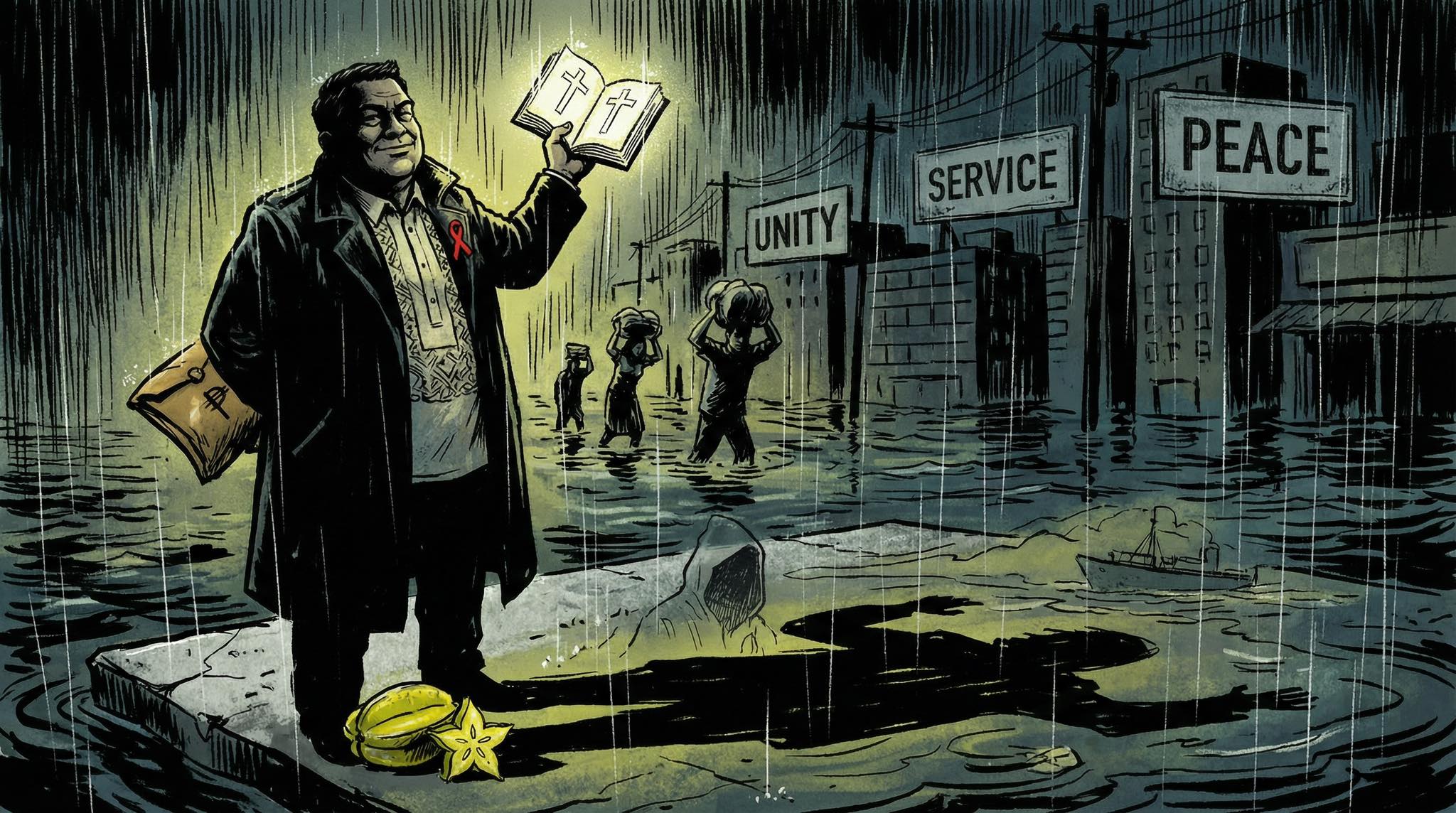
Sometimes this same public servant even quotes the Bible on the floor, voice cracking as he talks about honesty, stewardship, and caring for the poor — while quietly signing off on a spending plan stuffed with last‑minute insertions that nobody can fully trace.
He will thunder against corruption in interviews, then defend a system where hundreds of billions in supposed development funds move through layers of secrecy, split into tiny packages, duplicated entries, and recycled pet projects that look more like cash‑delivery schemes than public service.
You see it in the flood story too.
While families are hauling muddy appliances out of waist‑deep water, billions have already been released on paper for dikes, pumping stations, desilting, and roadside flood control that either don’t exist, are half‑finished, or crumble after one typhoon.
Audits have flagged hundreds of ghost or highly questionable projects — fake inspections, paper‑only construction sites, contracts padded so hard that in some cases less than half of the supposed protection ever reaches the ground.
The rest evaporates upward as kickbacks, luxury cars, and campaign war chests.
A modern traitor is also the loud patriot who is strangely patriotic for somebody else’s flag.
The one who spends all day online attacking anyone who questions a foreign power, who smears fellow Filipinos as warmongers or stupid for demanding that our own territory be defended — and then turns completely silent when that same foreign power builds airstrips on our reefs, rams our boats, shines military‑grade lasers at our coast guard, blocks our fishermen from their own traditional waters, and dumps tons of crushed coral in our seas.
He wraps himself in peace and neutrality, but every time the bully is the one in our backyard, he suddenly has nothing to say.
In other words, being a traitor in 2026 is less about openly joining the enemy and more about hollowing out your own house from the inside.
No need for a basket mask. The betrayal is in the memo, the sneaky amendment, the harmless committee insertion at the last minute.
The Makapili pointed at their neighbors so the occupier could drag them away.
Today’s traitor doesn’t need to point at anyone. He just silently rearranges the rules so that plunder looks legal, accountability becomes optional, and the law bends away from the people at the bottom.
Traitors today are smarter than the Makapili not because they’re braver, but because they learned one key lesson:
You don’t need to shoot a general on a mountain pass if you can sit in a committee room and shoot the future on paper.
FAST FORWARD: THE BETRAYAL DOESN’T STOP
If you think this is just history plus poetic ranting, look at what’s happening now.
In recent years, we’ve seen lawmakers and officials warning about traitors from within in key national security issues — especially where our own waters and territories are concerned.
The pattern is familiar: negotiations and diplomatic language on camera, but soft‑pedaling, downplaying, or outright defending the behavior of a foreign power that is literally pushing our own people out of their fishing grounds and building permanent structures in areas we claim as ours.
We’ve also watched a high‑profile alliance between two political dynasties implode in public.
Two clans that ran on a unity ticket, won together, governed together — then turned on each other fast.
The impeachment of a sitting vice president by a House dominated by allies of the very president she helped elect turned unity into open civil war within the ruling class.
The 2025 midterm elections turned into a referendum on loyalty and betrayal: which side betrayed whom, which side sold out the alliance first.
Voters were not being asked to choose a platform. They were being forced to pick a faction in a family war.
Betrayal has turned into a show. We watch it like a teleserye — gasp, rage, share, comment — and then move on.
THE PSYCHOLOGY: WHY WE STILL ENABLE THEM
Here’s the uncomfortable part: traitors keep surviving not just because they are ruthless, but because the rest of the system gives them space.
On the personal level, betrayal is disorienting. When someone you trusted — a leader, a patron, a family name you grew up respecting — turns out to be a fraud, it hurts your sense of judgment.
Admitting they betrayed you also means admitting you were fooled. That’s hard to swallow. Many people protect their pride instead of updating their beliefs.
Then there is moral disengagement — the mental trick where you park your own ethics on the side when they clash with your interests.
The politician who switches parties calls it practical politics.
The bureaucrat who approves a dubious contract calls it just doing my job.
The lawyer‑senator who buries accountability in legalese calls it due process.
Everyone builds a story where they’re not the villain.
For ordinary citizens, utang na loob is twisted into a chain.
A politician helps with your hospital bill, a scholarship, a coffin, a sack of rice.
Suddenly, he is not just a public official — he’s family.
When he’s later exposed as a plunderer or enabler of national betrayal, a lot of people say: hindi naman siya masama sa amin.
That’s loyalty purchased through desperation.
In a poor country, that’s very hard to break with lectures about democracy and institutions.
THE SYSTEM WAS BUILT TO REWARD TRAITORS
Our so‑called parties are mostly election vehicles, not communities of shared belief.
There is no coherent ideology to betray. Politicians jump between parties — sometimes more than once in a single electoral cycle — depending on who looks likely to win. When they change colors right after an election, everyone shrugs. Nobody expects consistency from something that stands for nothing.
Then there’s the old corruption formula: monopoly + discretion − accountability.
Monopoly: political clans and their networks dominate access to jobs, contracts, permits, and public services in their territories.
Discretion: key decisions are made in the dark, often with little to no transparency, and a lot of chairman’s prerogative.
Accountability: cases drag on for years, evidence gets lost, witnesses disappear, and high‑profile accused almost always walk free or outlive the consequences.
Put all of that together, and betrayal is not only possible — it’s rational for anyone intent on self‑preservation.
On top of that, we live in an era of teflon politics.
Some leaders can be exposed again and again in detailed investigations and still walk away with a loyal base intact.
For hardcore supporters, every scandal is fake news, every investigation is weaponization of the law, every critic is bayaran or dilawan or komunista — pick your label.
In that warped environment, breaking rules is seen as proof of strength, proof that the leader is fighting the system, even when he is the system.
THE REAL DAMAGE: WE STOP FIGHTING BACK
The biggest cost of tolerating traitors is not just the amount stolen. It’s the slow, steady death of civic energy.
When people see investigation after investigation lead nowhere…
When plunderers are allowed to post bail, fly out, get hospital arrest…
When flood control budgets are eaten, and yet the same barangays go underwater every year…
They don’t just get angry. They get tired.
This is what some call institutional betrayal — the feeling that the very institutions meant to protect you have turned against you. Live in that feeling long enough, and your natural response is not resistance. It’s withdrawal.
You stop volunteering. You stop reading beyond the headline. You stop voting, or you vote for whoever gives the biggest help on election day because at least that’s something you can hold.
That exhaustion becomes useful to those who keep winning under the current setup.
SO WHAT DO WE ACTUALLY DO?
You won’t fix this with a hashtag. But giving up is also not an option.
Some hard directions:
Fix the rules of the game. Push for genuine party reform and anti‑turncoat laws that make it costly to jump ship after elections.
If parties are forced to stand for something, betrayal becomes easier to name and punish.
Strengthen institutions that actually bite. Courts, audit bodies, and oversight agencies need real independence and resources, not just nice logos and air‑conditioned offices.
Support media that punches up, not kisses up. Independent journalism needs both money and audience attention. Don’t feed the propaganda mills with your clicks and shares.
Break the weaponized utang na loob. Back social protection systems that don’t depend on politicians — so people aren’t forced to trade their vote for survival.
Call traitors what they are. Not just in viral posts, but in day‑to‑day conversations, classrooms, communities, and churches. Silence is fertilizer for betrayal.
None of this is quick or easy. But it changes the cost–benefit calculation. The more it costs to betray, the fewer will dare.
THE BOTTOM LINE, FOR ME AT LEAST
We don’t tolerate traitors because we like being abused. We tolerate them because the system makes tolerance look like the safest move, while resistance looks risky and pointless, even dangerous.
A patron‑client culture, weak parties, industrial‑scale disinformation, poverty, and fatigue all push people toward a grim kind of pragmatism: wala rin namang mangyayari kahit magreklamo ako.
But here’s the part we can’t run from:
Every traitor in our history was tolerated — or at least allowed — by someone.
Paterno had enablers. The Makapili had recruiters and neighbors who stayed quiet. Today’s balimbings have voters, donors, fixers, lawyers, influencers.
The question is not just why traitors exist.
The question is why we keep giving them a second act.
At some point, tolerating a traitor stops being something done to us and becomes something done by us.
And when that point is reached, the betrayal is no longer just theirs. It’s also ours.
SOURCES
- 10 Most Infamous Traitors in Philippine History – FilipiKnow, https://filipiknow.net/traitors-in-philippine-history/
- Traitors in Philippine history who are only loyal to one thing – Philippine Daily Inquirer Lifestyle, https://lifestyle.inquirer.net/502714/traitors-philippine-history/
- A Desperate Undertaking: Funston Captures Aguinaldo – Army History (U.S. Army Center of Military History), https://armyhistory.org/a-desperate-undertaking-funston-captures-aguinaldo/
- Januario Galut – Wikipedia, https://en.wikipedia.org/wiki/Januario_Galut
- RIPH EX07 Infamous Traitors in Philippine History: A Detailed Study – Palawan State University (Studocu), https://www.studocu.com/ph/document/palawan-state-university/philippine-history/riph-ex07-infamous-traitors-in-the-philippines/29491513
- 10 Most Infamous Traitors in Philippine History – repost / commentary (Temar blog), https://temardotblog.wordpress.com/2019/12/25/10-most-infamous-traitors-in-philippine-history-written-by-filipiknow-in-historyhistory/
- How much is the 1800s or 1900s Php compared to the present? – r/Philippines, https://www.reddit.com/r/Philippines/comments/zkpn6v/how_much_is_the_1800s_or_1900s_php_compared_to/
- Flood control projects scandal in the Philippines – Wikipedia, https://en.wikipedia.org/wiki/Flood_control_projects_scandal_in_the_Philippines
- CBCP warns Senate against use of politics to derail flood control probe – The Philippine Star, https://www.philstar.com/headlines/2025/10/06/2477941/cbcp-warns-senate-against-use-politics-derail-flood-control-probe
- Church leaders denounce flood control corruption scandal in Philippines as ‘moral abomination’ – Christian Daily, https://www.christiandaily.com/news/church-leaders-denounce-flood-control-corruption-scandal-in-philippines-as-moral-abomination
- Public Works department flags 421 ‘ghost’ projects after nationwide audit – BusinessWorld, https://www.bworldonline.com/the-nation/2025/10/09/704336/public-works-department-flags-421-ghost-projects-after-nationwide-audit/
- DOJ: Only 14 of 421 alleged flood control ghost projects have cases filed – The Manila Times (Facebook post / article), https://www.facebook.com/TheManilaTimes/posts/manila-philippines-the-department-of-justice-doj-reported-that-only-14-of-421-al/10161958926954640/
- Sotto, Lacson seek investigation into ‘scandalous’ bicam insertions, pork barrel in 2025 budget – Inquirer.net, https://newsinfo.inquirer.net/2088743/sotto-lacson-seek-investigation-into-scandalous-bicam-insertions-pork-barrel-in-2025-budget
- Philippine 2025 Budget Bloated by Pork – Asia Sentinel, https://www.asiasentinel.com/p/philippines-2025-budget-bloated-by-pork
- Accountibility deficit: Why do citizens vote for corrupt politicians? – U4 Anti-Corruption Resource Centre, https://www.u4.no/blog/accountability-deficit-why-do-citizens-vote-for-corrupt-politicians
- Corruption is criminal, immoral, and the ultimate betrayal of public trust – UNDP, https://www.undp.org/blog/corruption-criminal-immoral-and-ultimate-betrayal-public-trust
- Marcos Jr Versus Duterte: Betrayal and Loyalty in the 2025 Philippine Midterm Elections – Fulcrum, https://fulcrum.sg/marcos-jr-versus-duterte-betrayal-and-loyalty-in-the-2025-philippine-midterm-elections/
- Lacson warns vs ‘homegrown traitors’ amid West Philippine Sea dispute – ABS-CBN News, https://www.abs-cbn.com/news/nation/2026/2/8/lacson-warns-vs-homegrown-traitors-amid-west-philippine-sea-debate-1430
- To Trust is to Survive: Toward a Developmental Model of Moral Injury – Frontiers in Psychology (for institutional betrayal / moral injury), https://pmc.ncbi.nlm.nih.gov/articles/PMC10205960/
- Teflon leadership: crossing moral boundaries with impunity – Frontiers in Political Science, https://www.frontiersin.org/articles/10.3389/fpos.2025.1606466/full
- The Psychology of Betrayal – Psychology Today, https://www.psychologytoday.com/us/blog/slightly-blighty/201607/the-psychology-betrayal
- Study links moral disengagement to cheating in romantic relationships – PsyPost (moral disengagement concept), https://www.psypost.org/psychologists-identify-a-morality-related-psychological-factor-that-is-linked-to-infidelity/
- Turncoatism in PH – Inquirer Opinion, https://opinion.inquirer.net/95478/turncoatism-in-ph
- Balimbing flavor of political season – Philstar, https://www.philstar.com/headlines/2016/03/06/1560412/balimbing-flavor-political-season
- Professional Turncoats: A Sociocultural and Political Analysis of the Balimbing Culture – Academia.edu, https://www.academia.edu/44805060/Professional_Turncoats_A_Sociocultural_and_Political_Analysis_of_the_Balimbing_Culture
- How Flood Control Funds Sink into Corruption While Filipinos Drown – Reality of Aid, https://realityofaid.org/cracks-in-the-wall-how-flood-control-funds-sink-into-corruption-while-filipinos-drown/
- Philippine Inflation Calculator – Filgit, https://filgit.com/philippine-inflation-calculator
- Philippine Inflation Calculator – acesubido, https://ace-subido.github.io/ph-inflation-calculator
- USD to PHP – 300 US dollars to Philippine pesos (reference for present-day peso equivalent) – Revolut, https://www.revolut.com/currency-converter/convert-usd-to-php-exchange-rate/?amount=300