
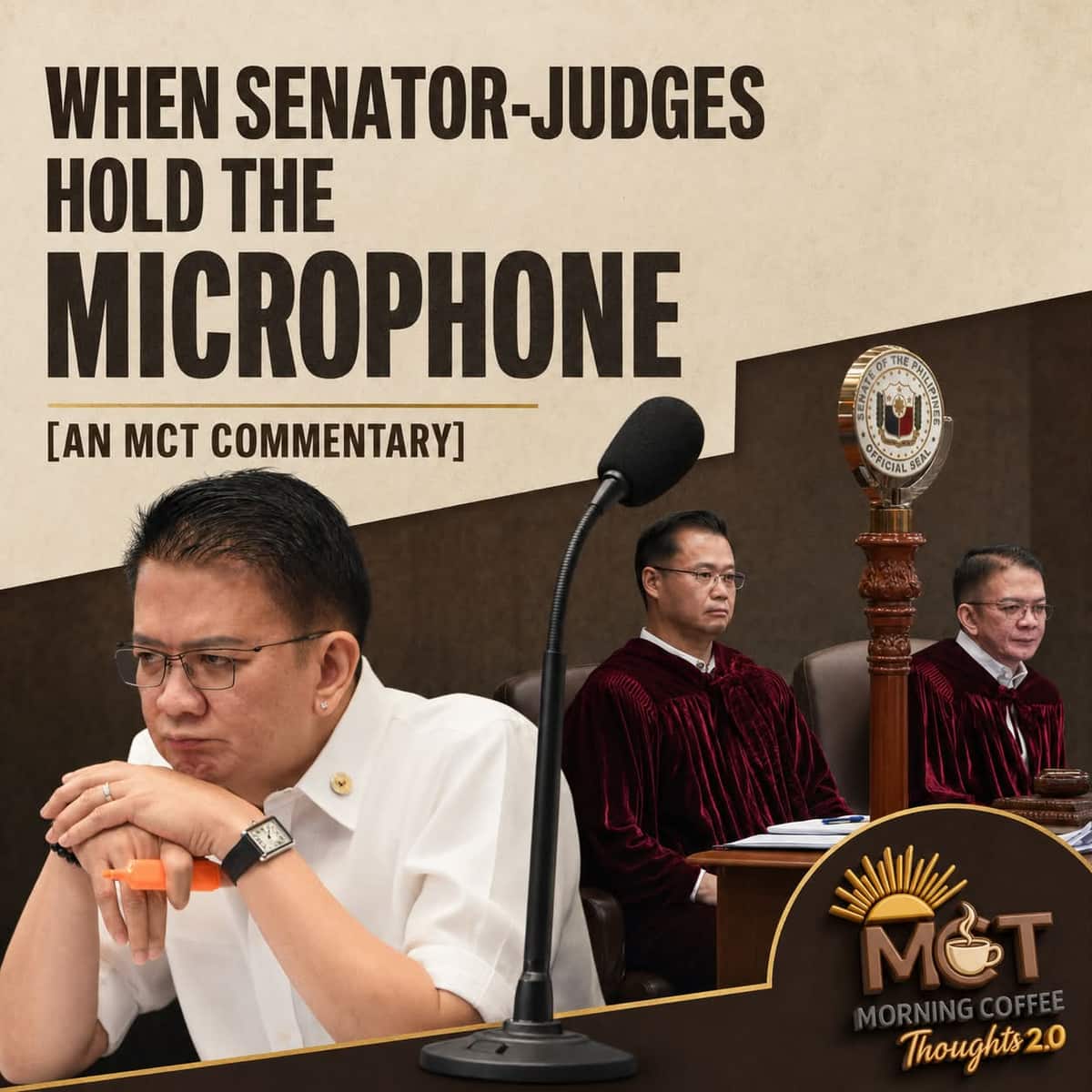
Father Ranhillo Aquino raised an idea during his interview with Ted Failon and DJ Chacha that deserves serious attention.
Why not use the United States Senate method during an impeachment trial?
A senator-judge writes a question. The presiding officer reads it aloud. The witness, prosecutor, or defense lawyer responds. The court moves forward.
Ted Failon answered with a joke that landed far too close to reality.
“Paano naman yung plano ko na pumapel if I am a senator judge?”
We have watched enough Senate hearings to understand the joke.
A microphone in the Senate brings more than a chance to ask a question. It brings a camera angle. It produces a social-media clip. It gives a senator a few minutes to impress supporters, embarrass an opponent, defend an ally, or start a political fight that has little connection to the witness in front of them.
In a regular hearing, that can already be exhausting.
In an impeachment trial, it can pull the court away from its real task.
The Senate is acting as an impeachment court. Senator-judges take an oath. They are expected to hear evidence, test claims, and decide whether a high official should remain in office.
Yet once questioning begins, the old Senate habit returns. Long introductions. Political messages. Repeated questions. Speeches disguised as questions. Somewhere, a social-media team is already preparing the clip.
Father Aquino’s proposal deserves attention because it could reduce the temptation to perform.
It could also force the Senate to confront a deeper question: who keeps senator-judges within the boundaries of the case?
THE UNITED STATES METHOD
The United States Senate uses a more controlled questioning procedure in impeachment trials.
A senator submits a written question to the presiding officer. The presiding officer reads it aloud. The answer becomes part of the record.
The senator still participates. They can challenge the prosecution’s evidence. They can test the defense’s version of events. They can press a witness whose testimony does not hold up.
But the public hears the question through the chair.
That changes the atmosphere inside the room.
A written question leaves less room for a dramatic opening statement. It makes it harder to use a witness as a prop for a personal speech. Attention stays closer to the answer, rather than the senator who wants airtime.
The United States used this procedure during the impeachment trials of former Presidents Bill Clinton and Donald Trump.
American impeachment trials remain political. They involve politicians, cameras, party loyalties, and public pressure. No rule can remove all that.
Still, procedure can reduce how much of the hearing becomes a contest for attention.
That is the value of the written-question system.
WHAT THE PHILIPPINE RULES ALLOW
The Philippine Senate follows another setup.
Under the Senate’s Rules of Procedure on Impeachment Trials, a senator-judge may question a witness for up to two minutes. A senator may also question a prosecutor or counsel.
The ordinary question does not have to pass through the presiding officer in writing.
The senator stands. The senator speaks. The senator frames the question. The senator gets the camera.
Two minutes may sound short.
Two minutes is enough to deliver a political message.
A senator can begin with a long statement. A senator can bring up an old controversy. A senator can repeat a question already answered. A senator can shape the question so heavily that the witness is pushed toward one preferred answer.
Some questioning helps the court.
A senator-judge can expose weak testimony. A senator can test documents. A senator can ask about dates, records, transactions, inconsistencies, and missing proof. A fair court needs that kind of questioning.
A question that seems helpful to Vice President Sara Duterte’s defense should not automatically draw suspicion. The defense has a right to challenge the House prosecution. A weak claim deserves scrutiny.
The same standard applies to questions from senator-judges who seem ready to convict.
The issue is whether a question helps the court assess the charges.
Does it connect to the article of impeachment being heard?
Does it test evidence?
Does it clarify a disputed fact?
If it does, let the question proceed.
If it does not, the presiding officer should require an explanation.
THE JOB OF THE CHAIR
The presiding officer does more than call a session to order or announce a recess.
The Senate’s impeachment rules give the chair authority over questions involving evidence. That includes relevance, materiality, competency, and admissibility.
Those are legal words. The basic idea is easier to understand.
Relevance asks whether the question connects to the charge, the witness, or the evidence before the court.
Materiality asks whether the answer could affect the court’s final decision.
A presiding officer can ask a senator-judge to show that connection.
Senator Francis “Chiz” Escudero can ask for a shorter question.
He can require a senator to stop delivering a speech.
He can point out that the witness has already answered the issue.
He can rule that a question has gone beyond the article being heard.
He cannot silence a senator simply because he dislikes the question.
A senator may challenge the chair’s ruling. The impeachment court may vote. The objection and the vote can become part of the public record.
That process offers a fair path.
Escudero does not have to win every dispute alone. His job is to make the court confront the question that some senator-judges would rather avoid: does this help decide the case?
If the answer is yes, proceed.
If the answer is no, the Senate should stop wasting time.
ESCUDERO’S CREDIBILITY PROBLEM
Here is the difficulty.
Escudero has the authority to control the proceedings. The chair also needs public confidence.
His role during the first impeachment case against Sara Duterte in 2025 follows him into this trial.
Escudero was Senate president when the House transmitted the earlier articles of impeachment.
Critics demanded that the Senate proceed quickly.
The Senate’s handling of the case drew anger, frustration, and accusations that it was avoiding a constitutional duty.
The Supreme Court later voided the 2025 impeachment complaint under the Constitution’s one-year bar.
The Court held that the complaint violated the constitutional ban on initiating more than one impeachment proceeding against the same official within one year.
That legal ruling settled the case.
It did not erase public distrust.
Many Filipinos watched the first case become tangled in delay, procedure, legal arguments, and uncertainty. For them, Escudero became part of a Senate leadership that did not give the process the urgency they expected.
That is a political burden he carries into the present trial.
A senator-judge whom Escudero calls out for an irrelevant speech may quietly ask: why should you lecture me about protecting this process?
That is the credibility problem.
The chair needs to make difficult calls. He needs senator-judges to accept rulings even when they disagree. He needs the public to believe that relevance is being applied equally.
His 2025 record makes that harder.
THE BETTER CHOICE, AND THE LOSS ON THE FLOOR
I still believe Senator Francis “Kiko” Pangilinan would have been the better choice for presiding officer.
He is a lawyer. He served as a senator-judge during the impeachment trial of former Chief Justice Renato Corona.
He has shown familiarity with the constitutional questions surrounding the Senate impeachment court.
He also argued that the Constitution does not require the Senate president to preside in the trial of a vice president.
Pangilinan could have entered the chair with more distance from the controversy surrounding the 2025 case.
That distance is critical here. Supposedly.
A presiding officer has to rule on relevance, evidence, time, and procedure.
Every intervention needs public confidence.
Pangilinan would not have carried the same questions attached to Escudero’s role in the earlier case.
But we also need Pangilinan on the floor.
A presiding officer must exercise restraint. The chair has to recognize speakers, manage objections, control the pace, and avoid becoming part of every argument.
Pangilinan can do more from the floor.
He can challenge weak legal arguments. He can ask focused questions. He can call attention to procedural detours. He can help explain the legal fight in language ordinary Filipinos can follow.
So yes, I still think he was the stronger choice for the chair.
Yet losing his voice from the floor would also have cost the us something.
Operative of word here is “us” because he represents at leas those who us believe in justice being served, and good governance along with it.
That is the frustrating part.
The Senate had options. It amended its impeachment rules to allow the election of another senator as presiding officer. The court then elected Escudero, with 12 votes in favor and eight against.
The decision has been made.
PERO ANDITO NA TAYO
I opposed Escudero’s election.
I still have doubts about whether the Senate chose the person best placed to restore confidence in the impeachment court.
Pero andito na nga tayo.
Andiyan ka na, Senator Escudero.
The court elected you. The trial is moving. Repeating the election fight every day will become beating a dead horse.
The plea now is simple.
Do the job fully.
You have shown that you can manage the traffic of a difficult hearing. You recognize speakers. You move the discussion along. You have reminded lawyers from both sides to avoid long speeches aimed at the audience.
I appreciate that.
A room full of politicians can become chaotic fast. Keeping the proceedings orderly carries value.
But efficient traffic management is only part of the work.
The gap is between keeping discussion moving and protecting the court from questions that lead nowhere.
A traffic officer makes sure vehicles keep moving.
A presiding officer in an impeachment court must also stop a vehicle heading in the wrong direction.
The chair must decide when a senator-judge has gone too far from the evidence.
The chair must stop a speech disguised as a question.
The chair must call attention to repetition.
The chair must ask why an issue belongs in the hearing before giving it more public time.
That is where the harder work begins.
THE PLEA TO ESCUDERO
Senator Escudero, do not ask Filipinos to trust your neutrality through promises alone.
Show it through the small rulings.
When a senator-judge asks a question tied to the evidence, allow it, even if it helps Sara Duterte’s defense.
When a senator-judge exposes a gap in the prosecution’s proof, allow it.
When a senator-judge tests the defense’s claim through actual evidence, allow it.
But when a senator turns their two minutes into a political speech, bring them back to the witness.
When a question has no clear connection to the article of impeachment, ask for that connection.
When an issue has already been answered, say so.
When a senator acts like an additional prosecutor or defense counsel, remind them that they are senator-judges.
Apply the rule evenly.
Apply it to senators seen as pro-Sara Duterte.
Apply it to senators who appear determined to convict her.
Apply it to friends, allies, rivals, administration figures, and opposition figures.
The moment the standard changes according to who holds the microphone, the court loses public confidence.
Escudero cannot erase the doubts left by 2025 in one afternoon. Nobody expects that.
He can show the public that the chair will not allow this trial to become an endless series of political auditions.
Father Aquino’s suggestion points to a better procedure. Written questions through the presiding officer could reduce the urge to perform and preserve more time for evidence.
For now, the Senate has its direct-questioning system.
That gives every senator-judge two minutes and a microphone.
The country deserves a chair who will protect those two minutes from becoming another campaign commercial.
SOURCES
- Senate of the Philippines, Resolution No. 39, Rules of Procedure on Impeachment Trials, https://lawphil.net/congress/senate/r_39_2011.html
- Congressional Research Service, The Impeachment Process in the Senate, https://www.congress.gov/crs-product/R46185
- United States Senate Manual, Rules of Procedure and Practice in the Senate When Sitting on Impeachment Trials, https://www.govinfo.gov/content/pkg/SMAN-117/pdf/SMAN-117-pg217.pdf
- PBS NewsHour, The Impeachment Trial Rules Are Set. Here’s What Happens Next, https://www.pbs.org/newshour/politics/the-impeachment-trial-rules-are-set-heres-what-happens-next
- Supreme Court of the Philippines, G.R. No. 278353, https://lawphil.net/judjuris/juri2025/jul2025/gr_278353_2025.html
- Supreme Court of the Philippines, House Impeachment Complaint vs. VP Duterte Barred by One-Year Rule, https://sc.judiciary.gov.ph/sc-house-impeachment-complaint-vs-vp-duterte-barred-by-1-year-rule-due-process-or-fairness-applies-during-impeachment/
- Inquirer.net, Amended Rules Now Allow Other Senators to Preside Over Impeachment Trials, https://newsinfo.inquirer.net/2239653/amended-rules-now-allow-other-senators-to-preside-over-impeach-trials
- Rappler, Escudero Elected as Presiding Officer in Sara Duterte’s Impeachment Trial, https://www.rappler.com/philippines/chiz-escudero-presiding-officer-sara-duterte-impeachment-trial/
- Inquirer.net, Senator Pangilinan Sees Corona Seeking ‘Rescue’ From Supreme Court Allies, https://newsinfo.inquirer.net/198893/senator-pangilinan-sees-corona-seeking-%E2%80%98rescue%E2%80%99-from-sc-allies