
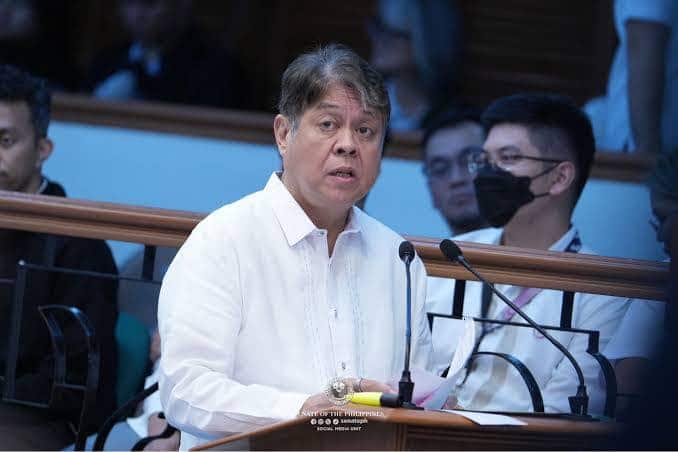
The Senate changed hands yesterday.
Thirteen senators raised their hands. Nine didn't. And somewhere in between the procedural motions and the parliamentary theater, Kiko Pangilinan stood at the podium and said, in effect: we can't object. We don't have the numbers.
That was it.
That was the whole eulogy for good governance in one sentence.
WHAT ACTUALLY HAPPENED
Jinggoy Estrada was sitting as temporary presiding officer when the motion to vacate all Senate leadership positions was put to the floor. Senator Joel Villanueva moved to declare the seats vacant. The motion passed 13-9.
Kiko Pangilinan was at the podium when Estrada asked if there were any objections.
And Pangilinan — one of the most consistent reform voices in that chamber — looked at the room and told the truth.
Something to the effect of: how can we object? We don't have the numbers.
I had to put my phone down. Cover my face with both hands.
Not because I was angry. I've been angry before. Anger at least has energy in it.
This was something else. This was the feeling of watching someone you respect say out loud the thing you've been quietly afraid of for years.
Pakiramdam ko kahapon, para akong binuhusan ng tubig na maraming yelo.
THE FACES I SAW
I kept watching the feed.
Tito Sotto's face when the numbers were called. There was no explosion, no visible rage. Just that brief moment where a man realizes the room he thought he owned had already been decided without him.
That particular kind of disbelief that doesn't look like disbelief — it looks like stillness. Like the body going quiet because the mind hasn't caught up yet.
And Risa Hontiveros.
I don't have the right words for what I saw on her face. It wasn't shock — she's been in that chamber long enough to know how these things go.
It was something more like grief. The kind you carry when you've already mourned something once and you're being asked to mourn it again.
She looked like someone watching a thing she'd spent years fighting for get undone in an afternoon.
And then there was Bam Aquino.
He was standing. And I don't know exactly what I saw — maybe confusion, maybe disbelief, maybe both at once — but he had the look of a man who understood every word being said and still couldn't make it make sense.
Not the disbelief of someone who didn't see it coming. The disbelief of someone who saw it coming, prepared for it, and still wasn't ready when it actually arrived.
There's a particular kind of loneliness in that posture.
Standing in a room where the count is already done, and you're still standing.
I had to look away.
THE WEIGHT OF THAT SENTENCE
I don't blame Kiko. I need to say that clearly, and I need you to believe me when I say it.
He wasn't performing grace under pressure. He was just telling the truth about where they stood. He was being a decent man in an indecent room, and that is not a small thing.
But God, that sentence.
We don't have the numbers.
What got me wasn't the words. It was the tone. No rage. No tears. The kind of calm that only comes when you've made peace with something you didn't want to make peace with.
That calm is what broke me.
THE SELF-DEFEAT NOBODY TALKS ABOUT
Good governance has been losing for a long time — not because it's wrong, but because it never figured out how to win.
There's a kind of delicadeza embedded in the reformist tradition, this almost moral aversion to doing what the other side does without hesitation: counting heads, making deals, trading favors, building a bloc that holds.
The coalition that ousted Sotto was thirteen senators deep.
It was built not on shared values but on shared interest — and that interest, by all accounts, is about moving the Sara Duterte impeachment trial forward.
Thirteen senators who agreed on one thing long enough to flip a chamber.
Nine senators stood on the other side of that.
Nine.
And they could tell you exactly why what was happening was wrong. They could cite procedure. They could cite principle. They could make the argument.
They just couldn't stop it.
That's not a failure of values. That's a failure of political craft. And it's a failure the reform bloc has been making, in different forms, for decades. Showing up right and ending up outnumbered, over and over again, like some kind of penance nobody asked for.
THAT'S THE PATTERN
Matagal na nating nakikita ito. Alam na nating lahat.
The people who can explain why something is wrong are almost never the ones with the numbers to stop it. And the people with the numbers almost never need to explain anything. They just vote.
That asymmetry is the story of Philippine politics. And yesterday, it played out again — not with corruption, not with violence, not with anything dramatic enough to make the international press. Just a procedural motion. Just a vote. Just a senator at a podium, saying quietly:
We can't object.
And somehow that is so much worse than a scandal.
A scandal you can fight. A scandal has a villain and a victim and a moment of reckoning.
This had none of that. This was just math. Cold, indifferent, unglamorous math.
I am so tired of the math always coming out this way.
WHAT COMES NEXT
The Senate is now led by Alan Cayetano, with Loren Legarda as Senate president pro tempore.
The impeachment trial of Sara Duterte is presumably on its way.
There will be speeches about constitutional duty and the rule of law and the Senate as a solemn deliberative body.
And, as always, Pangilinan will do his job well. He will prepare his arguments. He will be sharp, thorough, and precise. He will make the case that needs to be made.
But yesterday, standing at that podium with the room already decided, he reminded me of something I've been trying not to look at directly.
That you can be right, and honest, and thorough, and consistent — and still lose.
That integrity in the minority is still the minority.
That the most honest thing a good senator could say in that room, at that moment, was: we can't object.
Hindi dahil wala silang lakas ng loob.
Kundi dahil yun na talaga ang katotohanan.
And I don't know what to do with that. I genuinely don't.
I've written about Philippine politics long enough to know how this goes.
I've watched enough sessions, enough coups, enough realignments to know that this is the system working exactly as designed — not for the people in the gallery, not for the ones who voted hoping it would be different this time, but for the thirteen who showed up with the count already done.
I just didn't expect it to feel this heavy today.
Maybe I never learn.