
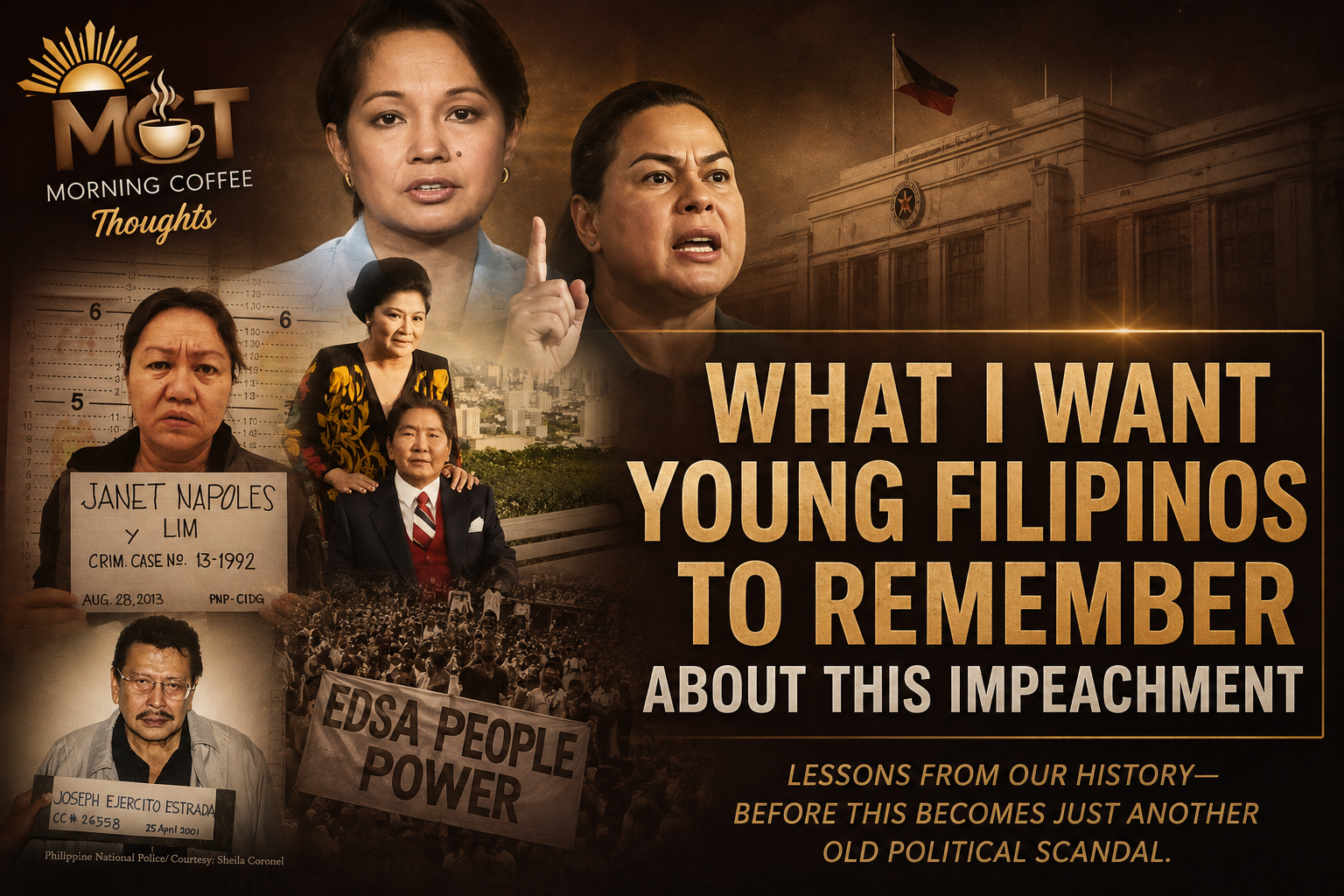
If Sara Duterte’s impeachment is the first impeachment trial you can follow and understand as it happens, there is something I want to tell you before all of this becomes old footage, old headlines and another chapter in Philippine political history.
Some of us have watched the country go through moments that felt this serious before. We remember hearings that consumed the news, allegations that dominated conversations, politicians who seemed finished, and Filipinos who believed they were finally watching accountability happen in real time.
That history does not tell you what conclusion to reach about Sara Duterte. Watch the prosecution, watch the defense, look at the evidence and decide for yourself.
What history can give you is a warning about what happens after everyone stops watching.
The impeachment trial reached Day 13 this week. On August 5, the Supreme Court dismissed petitions questioning the House impeachment proceedings as moot because the Articles of Impeachment had already reached the Senate and the trial was underway.
The impeachment court has also authorized subpoenas for some bank, tax and Anti-Money Laundering Council records connected to the unexplained wealth charge. Witnesses have testified about confidential funds, receipts, audit procedures and government records, while Duterte’s lawyers continue challenging the prosecution’s evidence and arguments.
I am paying attention to all of it. At the same time, I find myself looking backward because I remember other moments when Filipinos believed what they were watching would leave a permanent mark on our politics.
ESTRADA FELT FINAL ONCE
Joseph Estrada was impeached by the House in 2000. His Senate trial collapsed in January 2001 after senator-judges voted 11-10 against opening an envelope believed to contain evidence connected to a secret bank account, prompting prosecutors to walk out.
The crisis helped trigger the protests that became EDSA II. Estrada left Malacañang after the military and police withdrew support, and Gloria Macapagal-Arroyo took her oath as president.
Six years later, the Sandiganbayan convicted Estrada of plunder and sentenced him to reclusion perpetua. Arroyo pardoned him weeks later, restoring his civil and political rights.
Estrada returned to electoral politics. He ran for president in 2010, finished second, then won as mayor of Manila in 2013.
I remember how enormous the Estrada crisis felt. There had been an impeachment, a mass uprising, a president leaving Malacañang, years of prosecution and finally a plunder conviction.
Twelve years after EDSA II, Estrada was back in elected office.
That is the first thing Philippine political history has taught me about accountability. Something can feel final while you are living through it and become much less final once enough years have passed.
THE NAMES THAT ONCE NEEDED NO EXPLANATION
Then came the Arroyo years, and even trying to remember all the controversies from that period reminds me how many political crises Filipinos have already lived through.
“Hello Garci” once needed almost no introduction. Recordings surfaced in 2005 of conversations allegedly involving Arroyo and then Commission on Elections commissioner Virgilio Garcillano during the aftermath of the 2004 election.
Arroyo acknowledged speaking with a Comelec official during the canvassing period and apologized for what she called a lapse in judgment. She denied trying to influence the election result.
The controversy triggered congressional hearings, impeachment efforts, resignation calls and protests. Arroyo remained president until the end of her term in 2010 and is now again an elected member of the House of Representatives.
Then there was NBN-ZTE.
The government’s $329.48-million National Broadband Network contract with China’s ZTE became the subject of Senate investigations after allegations of bribery and irregularities. Former economic planning chief Romulo Neri testified that then Comelec chair Benjamin Abalos had offered him ₱200 million in connection with the project.
The government eventually cancelled the deal. Years later, Abalos was acquitted in one of the graft cases after the Sandiganbayan found that prosecutors had failed to prove guilt beyond reasonable doubt.
The fertilizer fund controversy became another familiar phrase. Investigations examined allegations involving ₱728 million intended for agricultural programs, with questions over how the money was distributed and whether it had been diverted for political purposes.
The Ombudsman later cleared Arroyo of involvement. A plunder case against former Agriculture undersecretary Jocelyn Bolante was also dismissed for lack of probable cause.
Other controversies from those years involved very different issues.
Hacienda Luisita became the center of a long agrarian dispute after at least seven workers and supporters were killed during the violent dispersal of a strike in November 2004. Years of legal proceedings followed before the Supreme Court ordered thousands of hectares of agricultural property distributed to qualified farmworker-beneficiaries.
The Sumilao farmers from Bukidnon also became nationally known during their fight over a 144-hectare agricultural property. Their campaign eventually produced a settlement in 2008 involving 50 hectares from the contested estate and another 94 hectares to be acquired for them.
PEA-Amari belonged to an earlier political period because the original agreement dated to the Ramos administration. Filipinos were still arguing about that reclamation deal when the Supreme Court struck down the amended agreement in 2002.
These controversies cannot be thrown into one box. Hello Garci concerned an election, NBN-ZTE and the fertilizer controversy involved allegations surrounding government decisions and public money, while Hacienda Luisita and Sumilao were agrarian disputes with completely different histories.
What connects them in my memory is how enormous they once felt. There was a time when someone could say “Garci,” “ZTE,” “fertilizer fund,” “Luisita” or “Sumilao” and Filipinos already knew the argument that was about to begin.
Today, some of those names need explaining. That is what time does to events people once thought nobody would forget.
PDAF SHOWED US HOW LONG ACCOUNTABILITY CAN TAKE
Then came the Priority Development Assistance Fund scandal.
The Commission on Audit documented serious problems involving pork barrel releases and projects. Whistleblowers and investigators described schemes in which public money went through nongovernment organizations linked to Janet Lim-Napoles, leading to criminal cases against senators, government officials, Napoles and others.
The Supreme Court declared the 2013 PDAF article unconstitutional, along with arrangements that allowed lawmakers to control lump-sum allocations or intervene after the budget had already been enacted.
The public anger was enormous. Filipinos saw whistleblowers, ledgers, Senate investigations and accusations involving huge amounts of public money.
Then the cases started taking years.
Napoles and Richard Cambe were convicted of plunder in 2018 in the case involving Bong Revilla’s PDAF, while Revilla was acquitted. Napoles received another reclusion perpetua sentence in December 2025 in a separate PDAF case involving former Benguet representative Samuel Dangwa.
Jinggoy Estrada was acquitted of plunder in January 2024. The Sandiganbayan initially convicted him of direct and indirect bribery, then reversed those convictions in August 2024 and later rejected the prosecution’s attempt to restore them.
Those acquittals belong in the history too. Courts have to acquit when prosecutors fail to prove guilt under the law, regardless of how angry the public once was.
What bothers me is how long everything took.
The PDAF scandal exploded in 2013. More than a decade later, major cases connected to it were still producing convictions, acquittals and reversals.
How long are ordinary Filipinos expected to carry the same anger while also dealing with food prices, rent, tuition, jobs, children, elections, disasters and every new crisis that comes along?
I follow politics almost every day and even I get tired. Sometimes I have to remind myself what happened in a case because so many years have passed since the country first became angry about it.
Ordinary people eventually have to get on with their lives. The legal process keeps moving at its own pace, often long after most people have stopped following every development.
PHARMALLY SHOULD STILL FEEL FAMILIAR
Pharmally is different because it happened recently enough for many of you to remember it.
During the COVID-19 pandemic, the Senate spent seven months and 18 hearings investigating government purchases involving Pharmally Pharmaceutical Corporation, a company with only ₱625,000 in paid-up capital that received more than ₱8 billion in government contracts.
The hearings raised allegations of overpricing, preferential treatment and irregular procurement. Commission on Audit chair Michael Aguinaldo also clarified that the COA report itself did not say there had been overpricing, corruption or ghost deliveries.
That belongs in the record because allegations raised during political hearings and findings made by auditors are not automatically the same thing.
After months of hearings, the Senate Blue Ribbon Committee produced a draft report. It received only nine signatures, two short of what was needed to bring it to the plenary.
Legal proceedings continued. Graft cases eventually reached the Sandiganbayan, and in late 2025 the Ombudsman sought the withdrawal of several cases involving accused persons who had not yet been arraigned so prosecutors could reevaluate the evidence and decide whether the cases should be filed again.
Now ask yourself when you last thought about Pharmally.
I had to ask myself the same question.
I remember how impossible that story once seemed to ignore. We were in a pandemic, Filipinos were watching hours of Senate testimony, and names that had been unknown months earlier suddenly became part of everyday political conversation.
The hearings eventually disappeared from daily public attention. The legal process did not disappear with them.
That is the part worth remembering.
THE MARCOS STORY CROSSED GENERATIONS
Then there is the Marcos wealth.
The Presidential Commission on Good Government was created after the 1986 People Power Revolution to recover ill-gotten wealth linked to Ferdinand Marcos Sr., his family and associates. The commission reported in 2025 that total cash recoveries since 1986 had reached ₱182 billion.
One major Supreme Court forfeiture order involved more than $658 million in Swiss deposits ruled to be ill-gotten wealth and ordered transferred to the Philippine government.
The recovery effort has lasted for decades.
Ferdinand Marcos Jr., the son of the president removed from power in 1986, was elected president in 2022.
I find that sequence difficult to think about without feeling frustrated. The Philippine government has spent decades recovering assets linked to the Marcos dictatorship, and the same family returned to Malacañang through an election.
The Marcos story also shows what happens when political memory crosses generations. People who lived through the dictatorship and EDSA remember those years as part of their own lives, while younger Filipinos received that history through families, schools, books, videos, news reports and political arguments.
What gets passed down becomes part of the fight over how the past is understood.
AND NOW WE ARE HERE AGAIN
Sara Duterte’s impeachment is happening in front of us now.
The prosecution has to prove its accusations. Duterte has the right to defend herself, and senator-judges have to decide the case based on the evidence placed before them.
A subpoena does not prove wrongdoing. A witness making an accusation does not automatically make the accusation true, and a defense denial does not automatically answer the evidence against it.
Watch the process closely enough to remember more than the clips.
Pay attention to the documents, the testimony, the weaknesses in the prosecution’s case and the weaknesses in the defense. Then pay attention to the verdict and the reasons behind it.
My concern begins after that.
Five years from now, what will Filipinos remember about this trial?
Ten years from now, will people remember the testimony, the documents and the actual findings of the impeachment court, or will everything have been reduced to a slogan repeated by whichever political side benefits from it?
If Duterte is acquitted, the reasons for that acquittal should remain part of the record. If she is convicted, the evidence supporting that conviction should remain part of the record too.
I used to think our problem was simply that Filipinos forget.
Looking again at Estrada, Hello Garci, NBN-ZTE, the fertilizer controversy, Hacienda Luisita, Sumilao, PDAF, Pharmally and decades of Marcos asset recovery has made that explanation feel incomplete.
Filipinos remember a great deal. Time changes what those memories cost politically.
Court cases drag on. Alliances change. People who were once enemies become allies. Politicians return in different roles, voters develop new priorities, and a new generation eventually inherits events that another generation experienced firsthand.
An old scandal can survive in public memory while losing much of its power to shape what happens next.
That is what I want young Filipinos to watch.
Do not stop at the scandal or the verdict. Watch what happens when the hearings end, when television networks stop carrying testimony live, when court proceedings become too technical for viral clips and when another election asks Filipinos to judge some of the same people again.
You are watching one of those moments now.
Years from today, somebody younger than you may ask what the Sara Duterte impeachment was about. You may find yourself explaining the confidential funds, the receipts, the witnesses, the subpoenas and all the arguments Filipinos are having today.
When that day comes, I hope you remember more than who won.
Remember what was proved. Remember what was not. Remember what happened afterward.
Some of us have watched the country become furious before.
What I want your generation to remember is how much can happen after the fury is gone.
SOURCES
- Philippine Daily Inquirer, https://newsinfo.inquirer.net/2278335/highlights-day-13-of-sara-duterte-impeachment-trial-aug-5-2026
- Philippine Daily Inquirer, https://newsinfo.inquirer.net/2266541/watch-sara-duterte-impeachment-trial-july-20-2026
- Supreme Court E-Library, https://elibrary.judiciary.gov.ph/thebookshelf/showdocs/1/58837
- Supreme Court E-Library, https://elibrary.judiciary.gov.ph/thebookshelf/showdocs/1/70395
- Philippine Center for Investigative Journalism, https://old.pcij.org/blog/2005/06/28/the-president-says-i-am-sorry-i-want-to-close-this-chapter-2
- Supreme Court E-Library, https://elibrary.judiciary.gov.ph/thebookshelf/showdocs/1/45035
- Senate of the Philippines, https://ldr.senate.gov.ph/legislative-issuance/proposed-senate-resolution-no-702-14th-congress
- Amnesty International, https://www.amnesty.org/en/wp-content/uploads/2021/08/asa350062006en.pdf
- International Budget Partnership, https://internationalbudget.org/wp-content/uploads/ibp-audit-case-study-philippines-pork-barrel-2016.pdf
- Supreme Court E-Library, https://elibrary.judiciary.gov.ph/thebookshelf/showdocs/1/55832
- Philippine Daily Inquirer, https://newsinfo.inquirer.net/1975724/sandiganbayan-reverses-jinggoy-estradas-bribery-conviction
- Philippine News Agency, https://www.pna.gov.ph/articles/1217245
- Philstar, https://www.philstar.com/headlines/2025/12/09/2492920/napoles-gets-life-term-pork-barrel-scam
- Senate of the Philippines, https://legacy.senate.gov.ph/lisdata/3780734250!.pdf
- Philippine News Agency, https://www.pna.gov.ph/articles/1153384
- GMA News, https://www.gmanetwork.com/news/topstories/nation/966377/graft-court-allows-withdrawal-of-pharmally-graft-cases/story/
- Presidential Commission on Good Government, https://pcgg.gov.ph/pcgg-39/
- Supreme Court E-Library, https://elibrary.judiciary.gov.ph/thebookshelf/showdocs/23/48708