
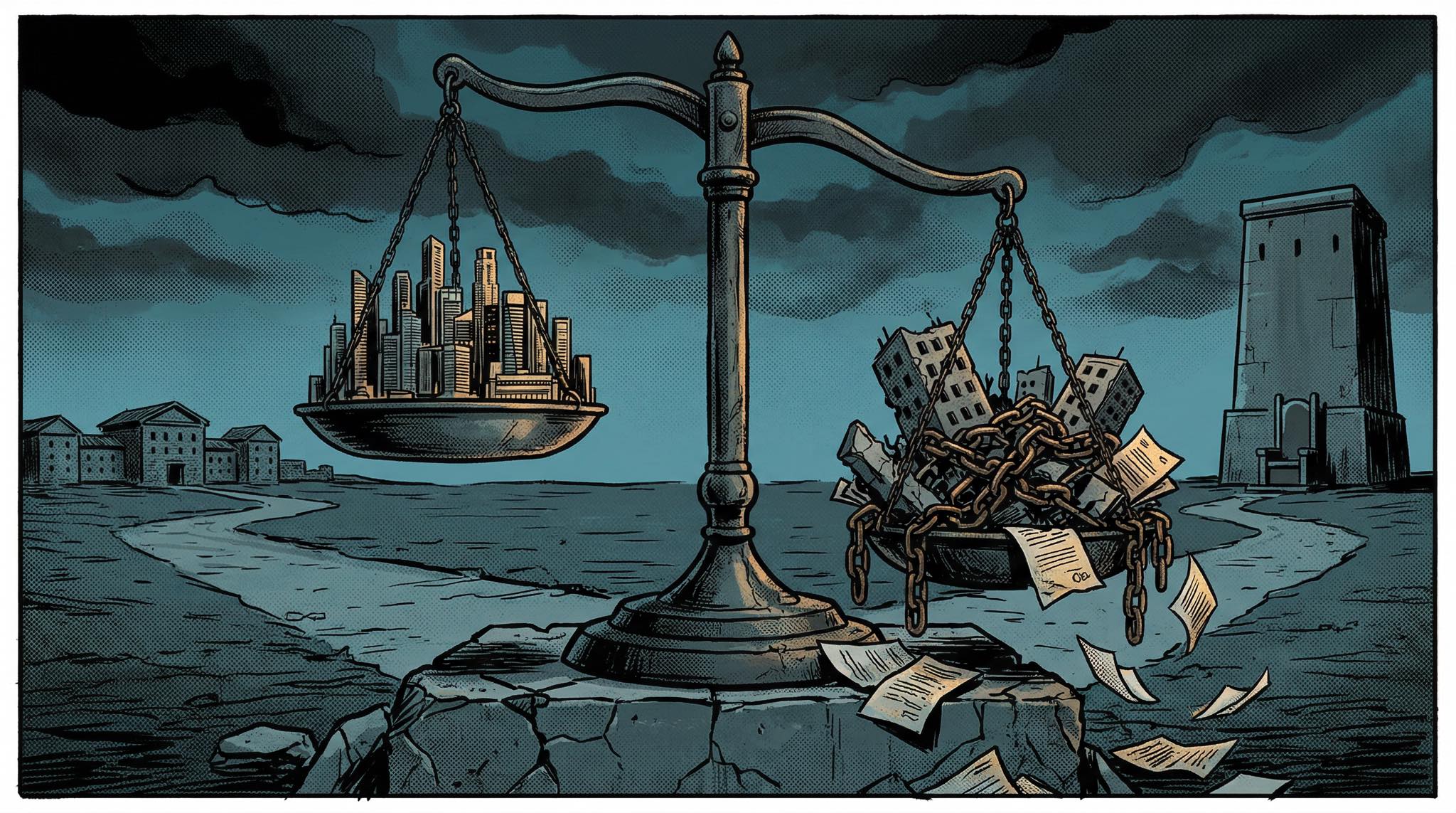
A lot of us are angry.
At the theft, the shamelessness, the flood-control funds that turned into vote-buying, the public works that are really public looting with a ribbon-cutting at the end. We say we want change.
But most days, what we actually do is hope.
Pray for a savior.
Rant online.
Share memes of the latest scandal and move on.
We have a feeling that the system is sick, but feeling is not the same as diagnosis. We sense it in traffic, in brownouts, in crumbling classrooms, in hospitals missing equipment — but we don’t always see how deep it goes, how many people live off it, and what it would really take to crush it.
I’ve been turning this over in my head for a long time.
It doesn’t just upset me; it shapes how I see almost every headline, every budget, every “groundbreaking ceremony” on TV.
And the more I think about it, the more one thing becomes clear:
- if you want real change in the Philippines — not cosmetic, not PR change — the kind of change needed is Thanos-level.
Not literally snapping people out of existence, but wiping out entire ways of doing politics, business, and governance.
Let me show you what I mean.
WHEN WE SAY “WE NEED OUR OWN LEE KUAN YEW”
Filipinos love to name-drop Lee Kuan Yew.
“Kung may LKY lang tayo, Singapore na sana tayo.”
In our heads, the story is simple: he was strict, he was honest, and Singapore became rich.
The real story is far more brutal — and far more honest.
Lee Kuan Yew took a swampy, resource-poor island and, in about three decades, turned it into one of the richest places on earth.
GDP per capita jumped from a few hundred dollars in the 1960s to more than $14,000 by the early 1990s, and kept climbing into the tens of thousands after that.
That did not happen through motivational speeches.
He did things most Filipino politicians would never dare, and most Filipino voters would never accept if they actually understood what it costs.
He paid civil servants and ministers well above market rates to remove the “kailangan ko magnakaw para mabuhay” excuse — and then backed that with the Corrupt Practices Investigation Bureau, an anti-corruption agency that could investigate anyone, including cabinet members.
For investigations involving the Prime Minister, the CPIB needed the elected President’s concurrence — but the point was that no one was shielded.
He centralized power so economic and infrastructure plans could run for decades. No six-year reset, no “iba na ang priorities ng bagong admin.”
He turned Singapore into a haven for foreign investors by promising clean, predictable rules: no bribes, contracts honored, lean bureaucracy.
He controlled the press using laws, license controls, defamation suits, and ownership structures. Media could operate — but only within boundaries set by the state.
He used the Internal Security Act against political opponents and harsh public order laws to impose discipline. A separate law — the Criminal Law (Temporary Provisions) Act — was used to detain gangsters and organized crime figures without trial. People lost their freedom so the state could impose order.
You can think he was a visionary.
You can also think he crossed lines that should never be crossed.
Both can be true at the same time. Now take that template and lay it over the Philippines.
Same tools, completely different battlefield.
THE PHILIPPINES ISN’T JUST CORRUPT. IT’S ARMED.
If you try to “do an LKY” here, you are not just dealing with dishonest bureaucrats and lazy agencies. You are walking into a country where corruption is wired into power — and defended with guns.
Look at what we already know.
Political dynasties dominate Congress and local governments. Davao, Ilocos, Pampanga, Maguindanao — you can recite the surnames by heart.
Those dynasties are not just families. They are businesses with fleets, malls, mines, bus lines, power plants, construction firms, and security firms, all tied to government contracts.
Corruption here is not about “a few bad apples.” Political scientist Peter Kreuzer describes it as a five-pillar structure:
wealth, personalism, greed, protection, and violence reinforcing each other so that stealing public funds is not an accident but a business model.
When competition threatens that business model, people die.
We have a long list of assassinated mayors, candidates, journalists, and activists.
Researchers have documented over 945 politicians killed since 2006. The Committee to Protect Journalists counts 149 journalists killed in the Philippines since 1998.
The Maguindanao massacre of November 2009, where 58 people were killed — including 32 journalists — was the most horrific version of a pattern that continues in quieter ways every election cycle.
Human Rights Watch called it “the foreseeable consequence” of unchecked Ampatuan crimes.
Human rights groups and researchers document how journalists, activists, and local politicians are still being killed or harassed when they push too hard against powerful interests.
So when someone says, “Sana may LKY tayo,” what they’re really saying, whether they know it or not, is:
“I want someone who is willing to go to war with families who can hire assassins, bend police units, and mobilize private armies — and survive long enough to win.”
Hindi ’yan leadership seminar. ’Yan ay death wish.
THE NORDIC WAY: CLEAN GOVERNMENT WITHOUT A STRONGMAN
But LKY is not the only model. If you zoom out, some of the cleanest countries in the world did not go through a strongman phase at all.
Denmark, Finland, Sweden, Norway, New Zealand, Estonia — they sit near the top of the global corruption rankings year after year.
In the 2024 Corruption Perceptions Index, Denmark scored 90 out of 100, Finland scored 88.
The global average was 43.
These places are not paradise, but they are proof that corruption can be pushed to the margins.
How?
Their “magic” looks very un-magical.
Radical transparency. Budgets, contracts, and spending data are public and accessible. You can see where money goes.
Independent courts. When someone powerful cheats, there is a real chance of conviction.
High press freedom. Journalists can dig into scandals without expecting to be shot outside their homes.
Professional civil service. Jobs and promotions actually depend on competence, not just patronage.
Political culture. Citizens lose trust in politicians quickly when even small ethical lines are crossed. People resign over things that would barely trend here.
Estonia shows that even a country with a messed-up past can climb.
It used digital government to rip out many of the human “choke points” where fixers and bribe-takers usually operate — a 2025 study found digital governance reforms associated with a 39% reduction in corruption indicators.
This is the “slow European” path: no savior, no martial law, no iron fist. Just relentless institutional work and a citizenry that actually punishes thieves at the ballot box and in court.
It can work.
It is also painfully slow, very unglamorous, and requires voters who don’t keep recycling the same surnames.
WHY THE PHILIPPINES KEEPS CRAVING AN LKY INSTEAD
You can see why, in this context, the Philippines keeps fantasizing about a Lee Kuan Yew.
Our setup is wired for short-termism and impunity.
Presidents get six years, no re-election.
The safest path is to spend those six years securing your camp’s future and that of your allies, not building institutions that might investigate them later.
Congress behaves like what political scientists have called an “anarchy of parties” — each legislator treats their slice of the budget as a personal ATM to fund reelection and maintain local machinery.
Corruption cases are slow, reversible, or survivable.
Revilla was arrested in 2014 and won a Senate seat in 2019.
Jinggoy Estrada was arrested in 2014 and won a Senate seat in 2022.
Joseph Estrada was convicted of plunder, pardoned, and elected Manila mayor. People charged in massive scams stage comebacks and win again.
In that environment, the LKY fantasy is a shortcut.
“Give me one strong leader who is immune to temptation, immune to bullets, and immune to pressure.”
It’s understandable.
It’s also dangerous.
Because when the country is desperate, any strongman with good branding can walk in, promise to kill corruption, and end up killing critics instead.
This already happened. We have the bodies to prove it.
WHAT A REAL PHILIPPINE LKY WOULD ACTUALLY HAVE TO DO
Let’s say someone really tried it. Not as slogan, but for real.
They would have to go after dynasties — not by name-calling, but by passing and enforcing an anti-dynasty law with real teeth, restructuring local power, and using state resources to protect those who run against entrenched families.
They would have to break the business-political cartel. Audit contracts, cancel sweetheart deals, enforce strict bidding rules, and put some very wealthy, very connected people in jail.
They would have to depoliticize the bureaucracy. Rip out political appointees who treat agencies as fiefdoms, and replace them with career officials bound by clear rules and performance metrics.
They would have to protect reformers and whistleblowers with actual force.
That means state security not just for VIPs, but for journalists, activists, and local officials who expose theft.
They would have to change the rules for campaign finance. Because as long as elections are funded by money that expects “return on investment,” corruption will regenerate every three years at the local and congressional level.
And to even get this far, that leader would need enough control over the military and police to resist capture by old networks.
Enough courage to sign orders that will make them the enemy of people who know how to make opponents disappear.
Enough clarity to start building institutions that can prosecute, check, and limit their own power later.
That’s what “doing an LKY” really means here.
Hindi ’yan tungkol sa pagiging strict. ’Yan ay pakikipaglaban sa isang armado, well-financed na ecosystem — at pagkatapos, sadyang ibigay ang kapangyarihan pabalik sa mga batas at institusyon kapag nanalo na ang laban.
WHY THIS FEELS LIKE THANOS-LEVEL CHANGE
Thanos snapped half the universe out of existence to “restore balance.” It was monstrous — but it was also simple.
One act, one instant, problem solved. Real life is slower and crueler.
To fix the Philippines, there is no single snap. There are years of dismantling ghost projects and sham budgets, one line item at a time.
Confrontations with local warlords who are used to being untouchable. Media offensives from networks and influencers whose patrons suddenly find themselves under audit.
A real risk that someone on a motorcycle with no plate will decide you’ve done enough.
And we, as a people, are not innocent in this.
We are a reklamador citizenry.
We complain about the state of the country, but we cheer for trapos who hand out envelopes.
We demand clean government, but we call the fixer when our paperwork gets delayed.
We curse political killings, then vote for clans whose power was built on exactly that violence.
So if someone really tries to do this — LKY-level, Thanos-level change — two things have to happen at the same time.
The grip has to tighten.
On contracts, on budgets, on policing, on dynasties, on campaign money.
The heart has to stay soft.
Toward ordinary people who are just trying to live.
Toward communities that depended on patronage because the state never worked for them in the first place.
Tight on systems, gentle on people.
Ruthless toward theft, protective toward the vulnerable.
That’s a very narrow path.
Miss on either side and you either get a toothless reformer who gets eaten alive, or a full-blown tyrant who uses “corruption” as an excuse to crush everyone.
IN THE END, IT’S NOT JUST ABOUT THE LEADER
The Nordic route, the New Zealand route, the Estonian route — they prove that you can build clean governance by changing rules, culture, and expectations over time.
No single hero, no father of the nation.
Just a long, stubborn refusal to accept “anong magagawa natin eh ganyan na talaga dito sa Pilipinas.”
The Singapore route, the LKY route, shows the other extreme: one man, one party, high discipline, low tolerance for dissent, and a lifetime spent building institutions that stayed clean even when he left.
Given the depth and violence of corruption in the Philippines, both paths will hurt.
The Nordic-style path demands patience, boring reforms, and voters who keep choosing the hard road for decades.
The LKY-style path demands a leader who tightens the grip, goes up against people who kill for a living, and then has the humility to step back once the foundations are fixed.
Either way, the fantasy where we just stay angry, keep praying, and magically wake up one day in a Singapore-level country — that one has to die first.
SOURCES
- World Economic Forum – How Lee Kuan Yew transformed Singapore, https://www.weforum.org/stories/2015/03/how-lee-kuan-yew-transformed-singapore/
- BBC – How Lee Kuan Yew engineered Singapore’s economic miracle, https://www.bbc.com/news/business-32028693
- Britannica – Lee Kuan Yew | Biography, Education, Achievements, & Facts, https://www.britannica.com/biography/Lee-Kuan-Yew
- Facts and Details – Singapore under Lee Kuan Yew, https://factsanddetails.com/southeast-asia/Singapore/sub5_7a/entry-3716.html
- Transparency International – Corruption Perceptions Index 2025, https://www.transparency.org/en/cpi/2025
- The Northern Voices – Nordic Countries (and Estonia) Lead the World in Clean Governance (2025 Rankings), https://www.thenorthernvoices.com/post/nordic-countries-and-estonia-lead-the-world-in-clean-governance-2025-rankings
- Databoks – 15 Countries with the Least Corruption in 2025, https://databoks.katadata.co.id/en/economics-macro/statistics/698c3ff4644db/15-countries-with-the-least-corruption-in-2025
- World Population Review – Least Corrupt Countries 2026, https://worldpopulationreview.com/country-rankings/least-corrupt-countries
- World Bank – Worldwide Governance Indicators, https://www.worldbank.org/en/publication/worldwide-governance-indicators
- UNCTAD – Governance and Anti-Corruption Reforms in Developing Countries, https://unctad.org/system/files/official-document/gdsmdpbg2420064_en.pdf
- Core – Emulating Models of Good Governance: Learning from the Nordic Experience, https://core.ac.uk/download/pdf/250168385.pdf
- Nordic Business Ethics – Nordic countries are not corruption-free, https://www.nordicbusinessethics.com/2019/12/09/nordic-countries-are-not-corruption-free/
- Scribd – The Scandinavian Governance Model Explained, https://www.scribd.com/document/837114074/The-Scandinavian-governance-model-refers-to-a-social-democratic-system-practiced-in-De
- IMF – Three Strong Governance Performers in Sub-Saharan Africa, https://www.elibrary.imf.org/display/book/9781513584058/CH003.xml
- World Economic Forum – 5 leaders exposing corruption and bringing hope to Africa, https://www.weforum.org/stories/2017/05/5-leaders-exposing-corruption-and-bringing-hope-to-africa/
- US Embassy (Philippines) – U.S. State Department Honors Pasig Mayor Vico Sotto for Transparency Initiatives, https://ph.usembassy.gov/u-s-state-department-honors-pasig-mayor-vico-sotto-for-transparency-initiatives/
- Inquirer – Vico Sotto named ‘anti-corruption champion’ by US State Department, https://globalnation.inquirer.net/194015/vico-sotto-named-anti-corruption-champion-by-us-state-department
- PNA – US names Vico Sotto ‘anticorruption champion’, https://www.pna.gov.ph/articles/1131746
- Democratic Erosion – The Ruling Family: How Political Dynasties Are Destroying Democracy in the Philippines, https://democratic-erosion.org/2025/05/01/the-ruling-family-how-political-dynasties-are-destroying-democracy-in-the-philippines/
- SSRN – Cronyism, Oligarchy and Governance in the Philippines: 1970s vs 2020s, https://papers.ssrn.com/sol3/papers.cfm?abstract_id=4032259
- UP CIDS – Corruption in the Philippines: Framework and Context, https://cids.up.edu.ph/wp-content/uploads/2022/03/Corruption-in-the-Philippines-vol.5-no.1-Jan-June-2001-2.pdf
- PRIF Blog – Déjà Vu: The Flood of Corruption Engulfs the Philippines Again, https://blog.prif.org/2025/10/15/deja-vu-the-flood-of-corruption-engulfs-the-philippines-again/
- BTI Project – Philippines Country Report 2026, https://bti-project.org/en/reports/country-report/PHL
- Philstar – Philippines falls in corruption index, among worst in SEA, https://www.philstar.com/headlines/2026/02/12/2507429/philippines-falls-corruption-index-among-worst-sea
- Fortune – ASEAN chair Philippines starts 2026 on ‘weaker footing’ after flood, corruption, tariffs, https://fortune.com/2026/01/14/philippines-asean-chair-marcos-flood-corruption-tariffs/
- Wikipedia – 2025–2026 Philippine anti-corruption protests, https://en.wikipedia.org/wiki/2025%E2%80%932026_Philippine_anti-corruption_protests
- BusinessWorld – Philippines may take 70 years to catch up with Singapore, https://www.bworldonline.com/top-stories/2025/11/13/711937/philippines-may-take-70-years-to-catch-up-with-singapore/
- Wikipedia – Corruption Perceptions Index, https://en.wikipedia.org/wiki/Corruption_Perceptions_Index
- TIME – Member of Philippines Political Family Convicted in Deadliest Attack on Journalists, https://time.com/5752718/philippines-maguindanao-journalist-massacre/
- Al Jazeera – Timeline: The Maguindanao killings and the struggle for justice, https://www.aljazeera.com/news/2019/12/19/timeline-the-maguindanao-killings-and-the-struggle-for-justice
- Wikipedia – Maguindanao massacre, https://en.wikipedia.org/wiki/Maguindanao_massacre
- Wikipedia – List of assassinations in the Philippines, https://en.wikipedia.org/wiki/List_of_assassinations_in_the_Philippines
- PRIF / SSOAR – Killing Politicians in the Philippines: Who, Where, When, and Why, https://www.ssoar.info/ssoar/bitstream/handle/document/77990/ssoar-2022-kreuzer-Killing_Politicians_in_the_Philippines.pdf
- Amnesty International – Philippines: Political Killings, Human Rights and the Peace Process, https://www.amnesty.org/fr/wp-content/uploads/2021/08/asa350062006en.pdf
- OMCT – The Philippines: Extra-judicial executions of six peasant leaders, https://www.omct.org/en/resources/urgent-interventions/the-philippines-extra-judicial-executions-of-six-peasant-leaders-in-the-n
- Lowy Institute – The killings in the Philippines grow more brazen, https://www.lowyinstitute.org/the-interpreter/killings-philippines-grow-more-brazen
- Human Rights Watch – Philippines: Harassment, Killings of Critics Persist, https://www.hrw.org/news/2026/02/04/philippines-harassment-killings-of-critics-persist
- BBC – Philippines martial law: The fight to remember a decade of arrests and torture, https://www.bbc.com/news/world-asia-63056898
- Inquirer Opinion – ‘Assassination watch’ in the Philippines, https://opinion.inquirer.net/178810/assassination-watch-in-the-philippines
- New York Times – Singapore Pushing a Stern Drive To Silence Critics and Dissidents, https://www.nytimes.com/1977/04/09/archives/singapore-pushing-a-stern-drive-to-silence-critics-and-dissidents.html
- US State Dept – 1996 Human Rights Report: Singapore, https://1997-2001.state.gov/global/human_rights/1996_hrp_report/singapor.html
- Amnesty International – Singapore (1976 report on Internal Security Act and detentions), https://www.amnesty.org/en/wp-content/uploads/2021/06/asa360011976en.pdf
- Rauli / CBS – The War on Terrorism and the Internal Security Act of Singapore, https://rauli.cbs.dk/index.php/cjas/article/download/691/724/0
- Amnesty International – Singapore: Defamation suits threaten Chee Soon Juan and others, https://www.amnesty.org/fr/wp-content/uploads/2021/06/asa360102001en.pdf
- Inforrm – Lee Kuan Yew and freedom of expression: the libel action as a means of silencing political opposition, https://inforrm.org/2015/03/26/lee-kuan-yew-and-freedom-of-expression-the-libel-action-as-a-means-of-silencing-political-opposit/
- Lawyers’ Rights Watch Canada – J.B. Jeyaretnam, https://www.lrwc.org/j-b-jeyaretnam/
- International Commission of Jurists – Singapore: ICJ observes trial of opposition leader charged with contempt of court, https://www.icj.org/singapore-icj-observes-trial-of-opposition-leader-charged-with-contempt-of-court/
- UW Law – Political Defamation and the Normalization of a Statist Rule in Singapore, https://digitalcommons.law.uw.edu/cgi/viewcontent.cgi?article=1562&context=wilj
- CPJ – Lee Kuan Yew’s legacy, https://cpj.org/2015/03/lee-kuan-lews-legacy/
- Wikipedia – Internal Security Act (Singapore), https://en.wikipedia.org/wiki/Internal_Security_Act_(Singapore)