
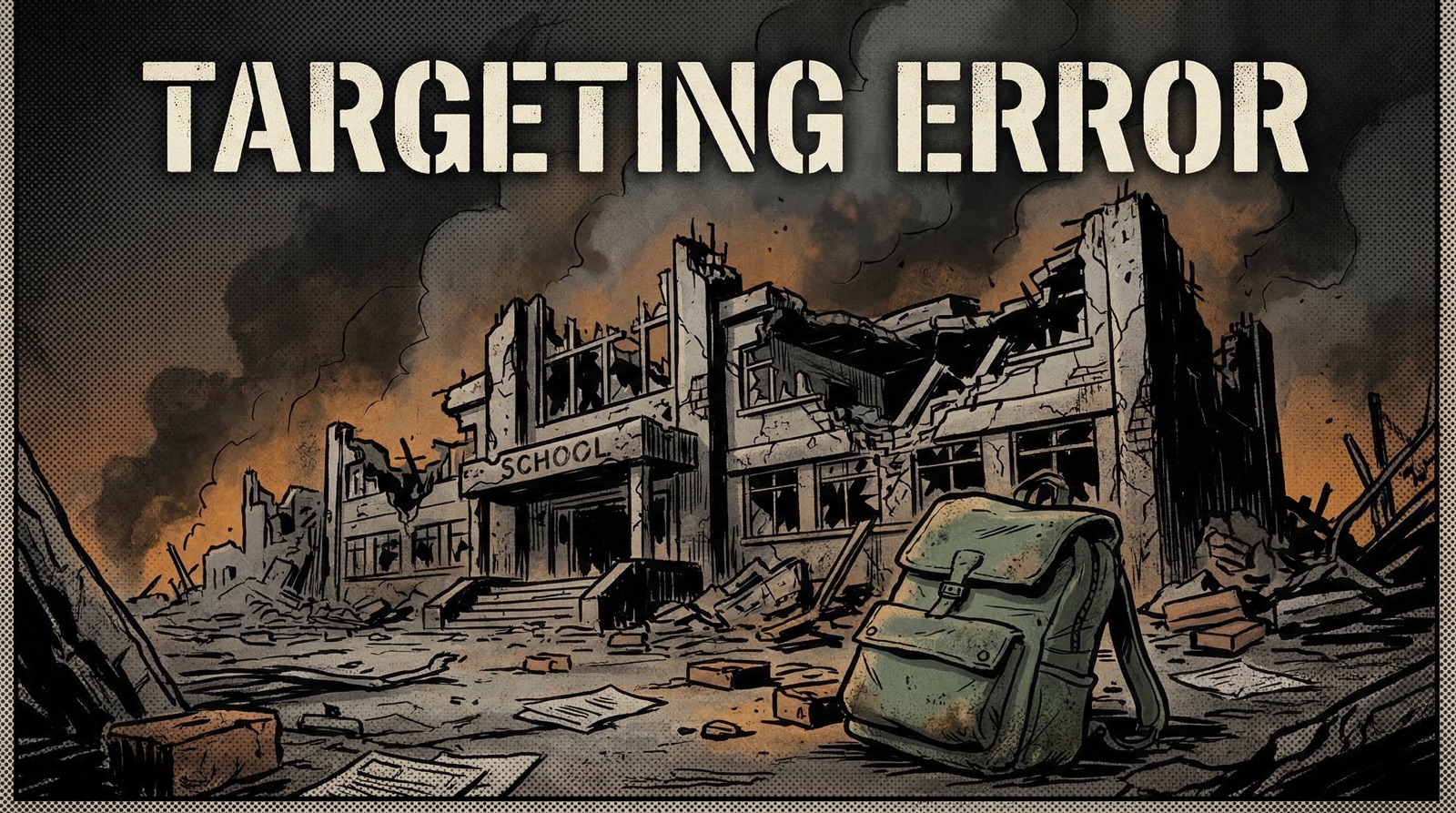
On February 28, a Tomahawk cruise missile destroyed the Shajarah Tayyebeh elementary school in Minab, southern Iran. A preliminary US military investigation has now found that American forces were responsible for that strike. The New York Times broke the story on March 11, confirmed by Reuters, CBS News, NPR, and The Independent.
The investigation is ongoing, but its early finding is direct: this was a targeting error.
WHAT THE INVESTIGATION FOUND
Officials familiar with the preliminary findings told the New York Times that US Central Command built its targeting package using outdated data supplied by the Defense Intelligence Agency. That data classified the school building as a military objective — because it once was.
The Shajarah Tayyebeh school sits adjacent to a naval base operated by Iran's Islamic Revolutionary Guards Corps. Satellite imagery analyzed by the Times shows the school was physically separated from the base by a fence sometime between 2013 and 2016. The DIA's records apparently did not reflect that change.
Investigators are still working to determine how the outdated information was transmitted to CENTCOM and whether updated data existed inside the DIA at the time.
The school sits in Minab, near the Strait of Hormuz, roughly 600 kilometers from Tehran. It was Saturday morning — the start of the Iranian school week — when the strike occurred.
THE DEATH TOLL
Iranian officials reported that at least 175 people were killed in the strike, the majority of them children. This figure, attributed to Iranian authorities, has been cited by the New York Times, Reuters, CBS News, and NPR.
The school attack is one of the largest single-incident civilian death tolls since the war began on February 28, according to Al Jazeera's Day 12 summary. Iranian officials separately report more than 1,300 civilians killed across Iran since the start of operations.
TRUMP'S SHIFTING POSITION
In the days following the February 28 strike, President Donald Trump suggested Iran may have been responsible. "In my opinion, based on what I've seen, that was done by Iran," he told reporters aboard Air Force One.
Military analysts pushed back. The Tomahawk is manufactured by Raytheon and operated by only a handful of countries. Iran does not possess Tomahawks.
When asked on March 11 about the investigation's preliminary findings, Trump told reporters: "I don't know about it."
Secretary of State Marco Rubio had said the prior week: "The United States would not deliberately target a school. I don't have the details as to what led to it, but what is clear is that the United States will not deliberately target a school."
INTERNATIONAL LAW AND THE SCHOOL QUESTION
Elise Baker, a senior staff lawyer at the Atlantic Council, stated in an assessment cited by the Associated Press: "Targeting schools would be a clear violation of international laws governing armed conflict. Strikes can only legally target military objectives and combatants, but the school was a civilian object and the students and teachers were civilians."
Baker added: "The school's proximity to Guard facilities and the attendance of children of Guard members at the school does not change that conclusion. It was a civilian object."
UN High Commissioner for Human Rights Volker Turk called for a "prompt, impartial and thorough investigation." UNESCO called the bombing "a grave violation of humanitarian law." The UN Committee on the Rights of the Child said it was "alarmed by reports of assaults on civilian facilities including schools and hospitals."
WHERE THE WAR STANDS
March 11 marked Day 12 of US and Israeli strikes against Iran under Operation Epic Fury. CENTCOM commander Admiral Brad Cooper reported in a video update that American forces have struck more than 5,500 targets inside Iran, including over 60 naval vessels.
Iran has continued its missile and drone retaliatory strikes. Seven US service members have been killed in combat since the war began, according to the Pentagon.
The Strait of Hormuz remains severely disrupted. Reuters reported that tanker traffic effectively collapsed after the war's first day — from 37 vessels on February 27 to near zero within days. About 20 percent of the world's daily oil supply travels through the strait.
Iran's foreign ministry said on March 9 there was "no room to discuss a ceasefire while military attacks continue," a position Iran International confirmed was reiterated through March 11.
THE PHILIPPINE EXPOSURE
Crude oil prices surpassed $100 per barrel after the war began, the first time since 2022, according to the Los Angeles Times.
The Philippines imports nearly all of its fuel. MUFG Bank estimates that every $10 per barrel increase cuts Philippine GDP growth by approximately 0.2 percentage points. At sustained $100-per-barrel oil, MUFG projects Philippine GDP growth could fall from 4 percent to approximately 3.7 percent in 2026.
The Asian Development Bank flagged the Philippines as among the smaller Asian economies likely to face stronger macroeconomic impacts from the oil shock, citing its heavy dependence on imported energy.
According to Philippine diplomatic and migration data cited by the Asian Journal News, approximately 2.1 million Filipinos currently live and work across the Middle East. Any prolonged stall in ceasefire prospects directly affects their employment security and the remittance flows their families depend on.
SOURCES
- New York Times, https://www.nytimes.com/2026/03/11/us/politics/iran-school-missile-strike.html
- New York Times (visual investigation), https://www.nytimes.com/2026/03/08/world/middleeast/iran-minab-school-strike.html
- Reuters (Rubio statement), https://www.reuters.com/world/us-says-it-wouldnt-deliberately-target-school-after-iran-said-over-160-killed-2026-03-02/
- Reuters (UN experts), https://www.reuters.com/world/middle-east/un-experts-deeply-disturbed-by-child-deaths-escalating-middle-east-conflict-2026-03-04/
- CBS News, https://www.cbsnews.com/news/us-iran-war-targets-map-numbers/
- NPR, https://www.npr.org/2026/03/11/nx-s1-5744981/pentagon-iran-missile-school-hegseth
- The Independent, https://www.the-independent.com/news/world/americas/us-politics/iran-us-missile-strike-school-investigation-b2936553.html
- PBS NewsHour (Trump quote), https://www.pbs.org/newshour/politics/watch-white-house-says-trump-will-accept-outcome-of-investigation-into-bombing-of-school-in-iran
- PBS NewsHour (Tomahawk fact-check), https://www.pbs.org/newshour/politics/fact-checking-trumps-claim-that-iran-has-tomahawk-missiles
- Sentinel Colorado / Associated Press (Elise Baker quote), https://sentinelcolorado.com/nation-world/evidence-suggests-the-deadly-blast-at-an-iranian-school-was-likely-a-us-airstrike/
- Atlantic Council (Elise Baker profile), https://www.atlanticcouncil.org/expert/elise-baker/
- US State Department (Rubio remarks), https://www.state.gov/releases/office-of-the-spokesperson/2026/03/secretary-of-state-marco-rubio-remarks-to-press-6
- UN DPPA (UNESCO statement), https://dppa.un.org/en/node/213881
- Human Rights Watch, https://reliefweb.int/report/iran-islamic-republic/usisrael-investigate-iran-school-attack-war-crime
- Al Jazeera (Day 12 summary), https://www.aljazeera.com/news/2026/3/11/iran-war-what-is-happening-on-day-12-of-us-israel-attacks
- Stars and Stripes (5,500 targets), https://www.stripes.com/theaters/middle_east/2026-03-11/brad-cooper-centcom-video-update-mar-11-21030165.html
- Institute for the Study of War, https://understandingwar.org/research/middle-east/iran-update-morning-special-report-march-11-2026/
- Reuters (Strait of Hormuz tanker traffic), https://www.reuters.com/world/middle-east/iran-war-see-how-tanker-traffic-collapsed-strait-hormuz-2026-03-06/
- NPR (Strait of Hormuz closure), https://www.npr.org/2026/03/04/nx-s1-5736104/iran-war-oil-trump-israel-strait-hormuz-closed-energy-crisis
- Iran International (ceasefire rejection), https://www.iranintl.com/en/202603091619
- Los Angeles Times (oil prices), https://www.latimes.com/world-nation/story/2026-03-08/crude-oil-prices-surpass-100-barrel-as-iran-war-impedes-production-shipping
- Bloomberg (oil prices), https://www.bloomberg.com/news/newsletters/2026-03-09/iran-war-oil-spikes-past-100-as-conflict-risks-deepening-economic-fallout
- MUFG Research (Philippines GDP impact), https://www.mufgresearch.com/fx/philippines-strait-of-hormuz-closure-impact-of-higher-oil-prices-and-more-9-march-2026/
- Manila Bulletin / ADB report, https://mb.com.ph/2026/03/09/middle-east-war-threatens-asias-growth-fuels-inflation-risksadb
- Asian Journal News (2.1 million Filipinos), https://asianjournal.com/features/far-from-home-millions-of-filipinos-in-the-middle-east-navigate-work-war-and-uncertainty/