
I had the outline, the sources, the thread of the idea. My body just said no. So I rested. And now I’m writing it anyway, because some reflections feel late on the timeline but still right on time for where our heads need to be.
I've been thinking about this for a while now.
Not in a productive way. More like the way you think about something you already know the answer to but aren't ready to say out loud.
We talk about freedom like it's a destination.
Like there's a finish line somewhere — one more election, one more protest, one more administration — and then we finally get there. Kalayaan. The real kind.
But I don't think that's true anymore.
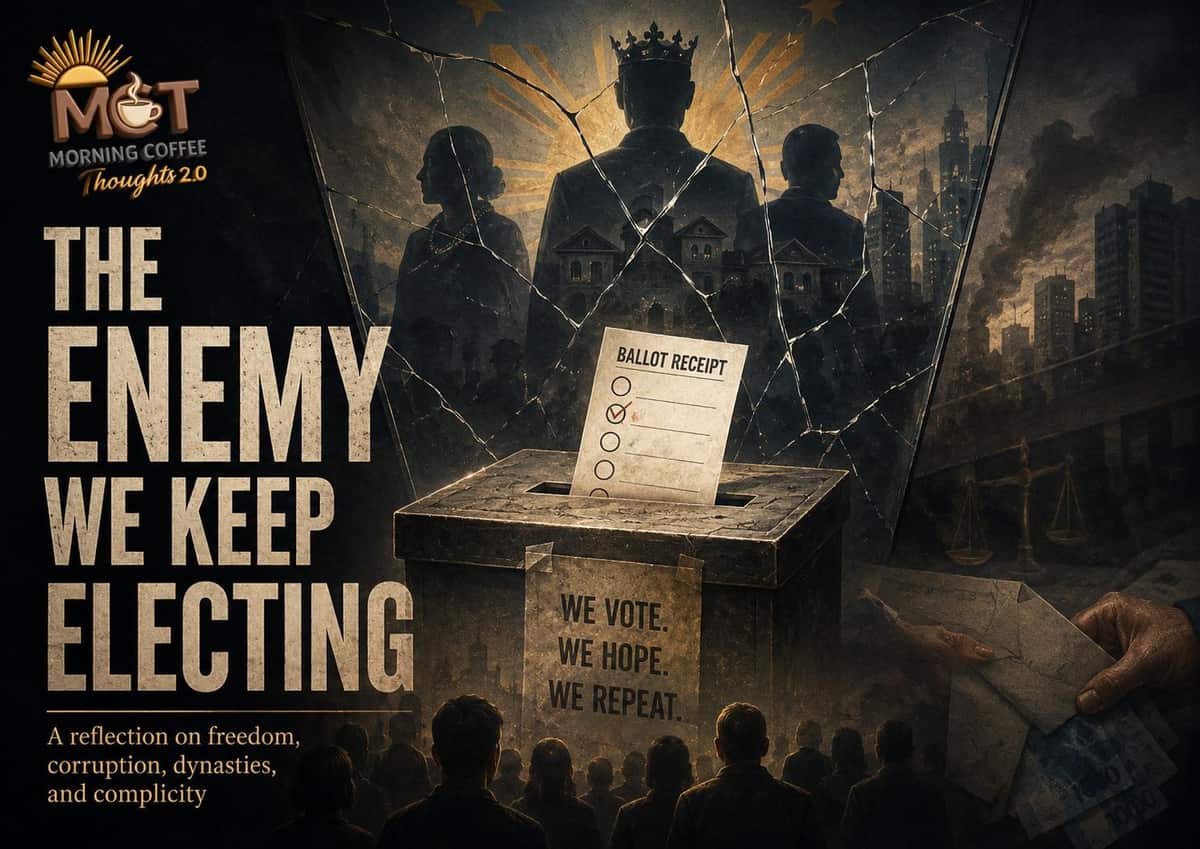
THE ENEMY WE KEEP ELECTING
We fought the Spanish for three hundred years. We survived American colonization, which came wearing the mask of liberation and stayed long enough to rewire how we see ourselves. We endured twenty years of Marcos. We were on EDSA in 1986 and we told ourselves that was it. That was the turn.
And then in 2022, we voted the family back in.
Not reluctantly. By a landslide.
So I have to ask — and I'm asking myself too — what exactly were we fighting for?
THE CORRUPTION WE NORMALIZED
The Philippines scored 33 out of 100 on the latest Corruption Perceptions Index and ranked 114th out of 180 countries.
That number doesn't shock us anymore. That's the part that scares me.
Corruption here didn't start with one politician or one family. It grew slowly, across centuries, from the colonial period through every administration that followed.
What keeps it alive isn't just the people in Malacañang or the Philippine Congress.
It's the kind of environment where bending the rules becomes normal, where "everyone does it anyway," where resisting feels risky and pointless.
When corruption is built into how power and resources move, law-breaking stops looking exceptional and starts feeling like the default.
And we live in that default. We help maintain it too.
THE RECEIPT WE CALL A BALLOT
Here's the part that keeps me honest.
Utang na loob is a beautiful value at its core. It’s about remembering kindness, honoring relationships, and carrying the good someone has done for you. It says: we are not separate. What you did for me, I don’t forget.
But every election season, someone finds a way to twist that.
The barangay captain fixes the road. The vice president shows up at the wake. A senator visits an earthquake-hit area. The mayor pays for your hospital bill. Suddenly, the ballot doesn’t feel like a tool of accountability anymore. It feels like a receipt.
Studies on Filipino voting show that a lot of support for dynasties passes through these exact channels — kinship, patronage, and a sense of debt that feels moral even when it’s being carefully engineered for political ends.
Experiments on vote-buying in the Philippines found that voters who received payments were less willing to punish corrupt politicians afterward, even when they knew about wrongdoing.
The price of that "help" isn't just the vote. It’s the accountability that disappears with it. It’s the nation that suffers with it. It’s the future that gets sacrificed with it.
THE DYNASTIES WE KEEP CHOOSING
Political dynasties have controlled Philippine politics for generations, from town halls to the Senate.
We like to say "walang choice," and sometimes that’s literally true. The ballot is full of cousins, siblings, and children of the same few families.
But the research paints a more complicated picture.
The staying power of dynasties isn’t mainly about voters being uninformed.
It grows out of the way votes are gathered — through family ties, patronage, and local power brokers who shape who gets resources, visibility, and protection.
In many areas, the closer you live — socially or physically — to a political clan, the more likely you are to depend on them for jobs, health care, or basic assistance.
One study found that a small increase in the share of voters closest to a candidate generated a clear boost in that candidate’s vote share.
Call it what it is: a survival strategy in a system that punishes anyone who refuses the deal.
The larger structure — weak public services, concentrated wealth, patronage as the main safety net — was built over time and repeatedly reinforced.
Dynasties don't just exploit that system; they sit at the center of it.
And we keep returning to them, in part, because the alternative is trusting institutions we already know will fail us.
THE PERMISSION WE GIVE WITHOUT REALIZING IT
There’s an argument I keep circling back to: that tolerance of corruption has sunk deep into our collective psyche. I resist sweeping statements like that, because they can sound like: "ganito na lang talaga tayo." But I also can’t deny the patterns.
We shame the person who reports a corrupt official. We tell them "ingat ka" instead of "sige, lalaban tayo." We vote for someone because "may nagagawa," even when what they "do" is redistribute stolen funds with their name printed on the tarp. We treat government efficiency as a favor instead of a basic right.
We laugh at corruption jokes because what else do you do when you feel powerless. That laughter is coping. But it becomes permission when it stops being followed by anything else.
Colonial mentality research describes how centuries of foreign rule left many Filipinos with an internalized sense that foreign standards are superior and that our own institutions are naturally defective.
Over time, that fatalism shows up in political life: a quiet belief that "all politicians are the same," that cleaning up government is impossible, that expecting better is idealistic or childish.
When you believe nothing will change, your choices start to match that belief.
THE BUCKET WE WON'T LOOK AT
We throw “crab mentality” around like it's our national personality.
Someone succeeds, someone else pulls them down.
A classmate excels, we smart-shame them.
A reformer pushes for change, we question their motives instead of their evidence.
But crab mentality doesn’t grow in a vacuum.
In environments where resources are scarce, competition is intense, and the system feels rigged, pulling someone down can feel like the only way to keep things "fair."
The problem sits in the bucket itself — in the structures that keep the number of slots small, the wages low, the opportunities concentrated in the hands of a few.
Instead of asking who designed the bucket and why it stays that small, we fight each other inside it.
And the people who own the bucket never have to break a sweat.
The same energy shows up in politics.
Coalitions fracture over personal slights.
Movements crumble because of internal distrust.
We hold our potential allies to a higher standard than the trapos we supposedly oppose.
The system wins when we keep treating each other as the main problem.
THE MIRROR NOBODY WANTS TO LOOK AT
I'm not saying this from a distance.
I've excused politicians because they’re from my region. I've stayed silent when friends repeated Martial Law myths because I didn't want to start a fight at a family gathering. I’ve rolled my eyes at minor corruption and told myself, "mas malaki pa ang ginagawa ng iba."
There’s a phrase that I’m reminded of: habitual individual adaptation to a corrupt environment.
It means that when you live long enough in a system where corruption is normal and accountability is rare, you stop reacting. You adjust your expectations downward.
You focus on surviving your small corner and stop believing your reaction will affect anything beyond it.
We adapted. Individually. Then as a nation.
THE FREEDOM WE HAVEN'T GOTTEN TO YET
Angela Davis talks about freedom as a constant struggle.
She’s speaking from a different context — Ferguson, Palestine, the long fight against racism and state violence — and still, the word “constant” describes our reality more than we’d like to admit.
We like the big moments: the overthrow, the snap election, the people power story. The kind of scenes they show in documentaries, where the credits roll not long after the dictator leaves the palace.
But the fights that remain for us now don’t look like that.
Fighting colonizers and dictators had a clear target. You could point, shout, march, and say: sila. Yan ang kalaban.
Fighting your own quiet tolerance of corruption? Your willingness to exchange your vote for short-term security? Your reflex to drag down the neighbor who dares to expect more? There is no EDSA shrine for that kind of struggle. No holiday. No anniversary.
It’s just choices. Daily, boring, tiring choices.
Whether to sell your vote or not. Whether to let a lie about Martial Law slide in silence again. Whether to mock the idealist friend or join them in doing the unglamorous work of organizing, educating, and showing up.
It’s difficult. Exhausting even.
But if freedom really is a constant struggle, then maybe this is the version assigned to us — not the dramatic overthrow, but the slow, internal untangling of our own habits, mindsets, and quiet complicity.
And maybe "late" reflections like this still count, as long as they move us one small step closer to finally facing the mirror.