
I've written over five thousand articles.
Some for clients. Brands, businesses, companies abroad that needed sharp copy with a clear purpose: move people toward a decision. Sell this. Get attention. Convert. That work has a simple measure. It either worked or it didn't.
MCT is different. No client. No campaign. Just me at a kitchen table, trying to say something honest about politics and how we got here.
For years, the honest thing I kept writing about was good governance. Accountability. Corruption. The same recurring wound. People respond. Someone says it helped them see things clearer. Someone else shares it. Tags a friend. Calls it important.
And then the week passes and nothing outside the screen moves.
THE WEIRD GAP
That gap bothers me more than I usually admit.
I get told the writing is good. I get hired because of it. I've built a career around putting words together so other people can sell things. That part works.
But when the writing is about good governance? It feels heavier. Slower. Like I'm doing something that people appreciate but nobody acts on.
I know the term for that feeling. Impostor syndrome. The sense that your success isn't real, that you're one step away from being exposed, even when the evidence says otherwise. High performers are supposed to be more prone to it because their own expectations rise faster than the proofs in front of them.
I recognize that in myself.
Because on paper, I should be confident. Five thousand articles is not an accident. But the part of me that cares most, the part that wants a Filipino voter somewhere to rethink one pattern, one habit, one name on a ballot, that part doesn't feel successful.
It feels like I built something sharp and pointed it at nothing.
WHY FACTS DON'T MOVE PEOPLE
In my head, the logic was always simple.
Show people COA (Commission on Audit) findings. Show the numbers. Show how much money was stolen that could have gone to schools, to hospitals, to flood control. Explain it plainly. Connect it to daily life.
But that's not how political beliefs move.
People don't treat political information like a quiz they want to pass. They treat it like a loyalty test. They defend family. They defend tribe. They defend the leaders they’ve already decided are “ours.”
A voter who trusts a certain politician will bend every new detail to keep that trust intact. He'll say, "They're all corrupt anyway." He'll say, "At least he helps our barangay." He'll say, "The rich steal more than he ever will."
My carefully written piece turns into one more thing to explain away.
I don't take that personally. He's defending his place in the world. His community. His history. His feeling that this man is one of them.
That feeling is more ancient than my article.
HOW DO YOU SELL GOOD GOVERNANCE TO AN EMPTY STOMACH
This part keeps me up.
I know how to sell a product. I know how to write about a service. Translate features into benefits. Benefits into reasons to act. That side of my brain works like a well-trained muscle.
Good governance is not like that.
You can't put a price on it. There's no delivery date. No guarantee. No receipt. It’s slow, abstract, and fragile.
And the people who most need it are often the ones with the least reason to wait for it.
When poor Filipinos accept money for their vote, the driving force isn’t stupidity, it’s the need to get through the week.
A few hundred pesos today means food. Medicine. A break from the constant pressure of not having enough.
Good governance is a promise that might pay off years from now, if the system doesn’t betray them again.
From where they stand, that trade is not crazy.
People who live under constant financial pressure are not less rational. Their decisions just live inside shorter windows. When your brain is pulled hard toward “today,” ten years from now feels like fiction.
So I write about clean elections. Strong institutions. Accountability. And somewhere, someone is measuring rice by the cup and hoping the money holds until Sunday.
MCT article, no matter how well articulated, is not his answer. Not by a long shot.
THE TRANSLATION EXPERIMENT
People kept asking me to translate my articles into Filipino. On paper, it made sense. We live here. We talk about our own country. Filipino is what most people use at home, in the palengke, in the jeepney.
So I did it. I translated. I wrote original pieces in Filipino. I even asked others to help me. Then I watched what happened.
The English articles still did better.
Not by a little. Clearly.
How Filipinos use the internet explains a lot. We spend hours online. Most of that time goes to videos, short clips, livestreams, content you can watch while cooking, working, scrolling. Long reads are not the first choice when people open their phones.
So it wasn’t really English versus Filipino.
The problem is the format. Blogs.
My Filipino versions did not pull in a new audience. They reached the same people in a different language, and those people preferred English.
The Filipinos who do not read political blogs in English are not reading them in Filipino either.
They are on Facebook, TikTok, YouTube. They are in comment sections, group chats, live streams. They are somewhere my blog does not reach.
My own data told me something I didn’t want to see: most Filipinos don’t see much value in blogs, period.
WHO IS ACTUALLY READING THIS
That forces a harder truth.
Political blogs here are not mass platforms. They are niche. The people who read them tend to be more educated, more comfortable with English, more politically engaged than the average voter. They are already asking questions before they reach my page.
So what do my pieces actually do?
Most days, they give language to people who are already worried. They connect dots they were already trying to connect. They confirm what they suspected. They make them feel less alone in their frustration.
But if my deeper goal is to help change how Filipinos think about power, then I have to admit this: I am mostly talking to people who already care. The rest of the country is somewhere else.
WHAT MCT IS ACTUALLY TRYING TO DO
This is where I have to call out what MCT really is.
From the start, the point was not virality. Not clickbait. Not “owning” anyone.
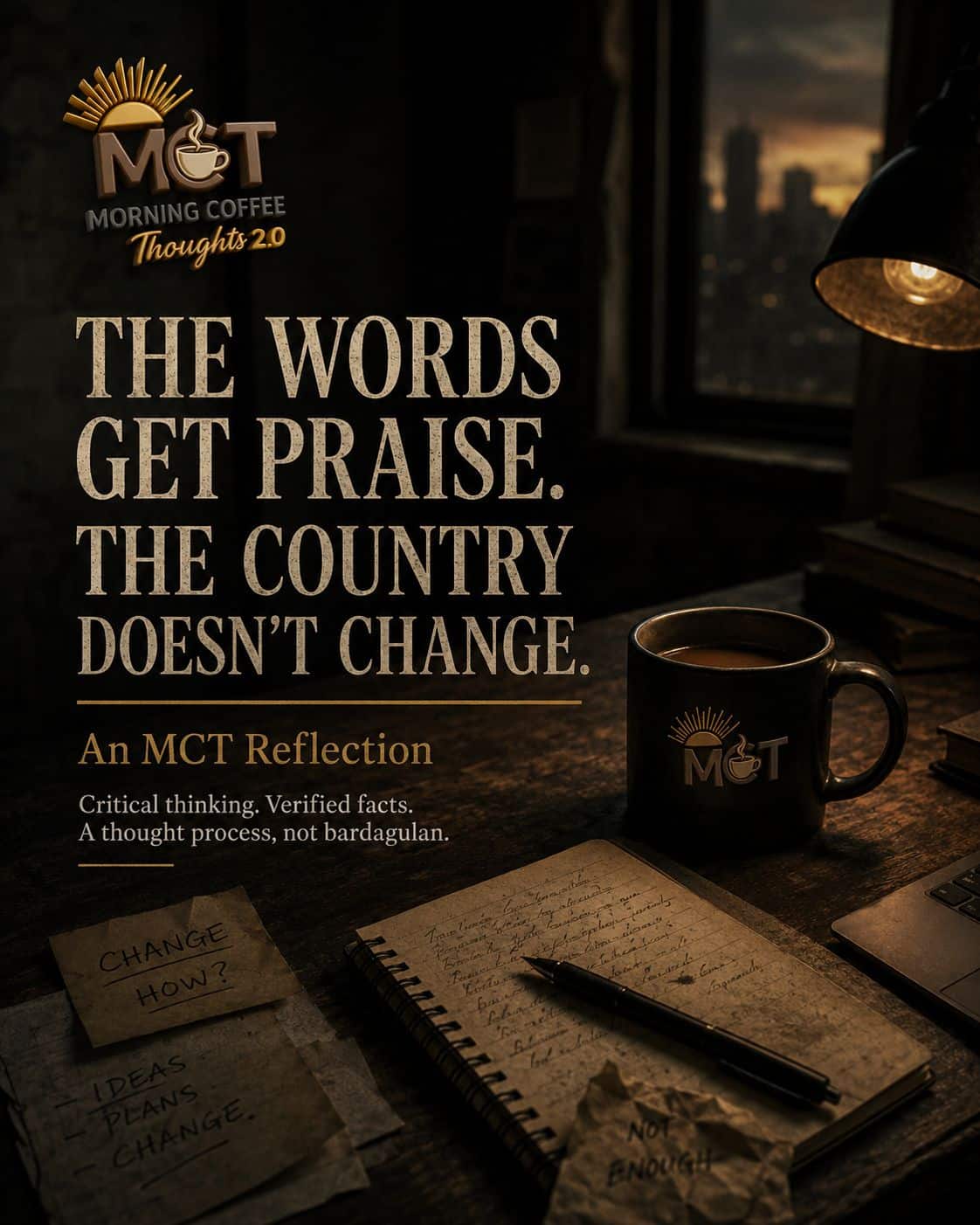
MCT is built on two simple things: critical thinking and verified facts.
I don’t always get it right. But the target is consistent. Take something that looks noisy and confusing, strip away the drama, the noise, and thr hatred, and show the thought process. What question am I asking? What data am I using? What pattern am I seeing? What might I be missing?
It would have been cheaper and easier to join the daily bardagulan with trolls. (If I do that, I don't even have to ask for donations and risk sounding like Oliver Twist.)
I know how to do that too. One-liners. Claps backs. Screenshots. Quote-tweets. You can grow fast that way. You can build a crowd that comes back for the spectacle.
But that’s what everyone else is already doing.
If all I add to the space is one more angry voice, one more thread of insults and side comments, then what exactly am I contributing?
The country already has more than enough rage. What it doesn’t have enough of is calm, step-by-step thinking that still tells the truth.
So I chose the slower, lonelier route. Explain. Check. Connect. Admit uncertainty when the facts are thin. Lay out how I reached a conclusion so someone else can trace it, not just believe it.
I’m starting to realize this is both the strength and the limit of MCT.
Face-to-face conversations will always beat a blog post when it comes to changing a mind in the barangay. But this space is where I practice how to think, so that if I ever get pulled into those conversations, I don’t show up empty.
THE OTHER WALL: FEAR
There’s another layer I can’t ignore.
Research says what moves people most is still human conversation. Relatives. Friends. Co-workers. Neighbors. The people you share a table with. Those are the voices people listen to when they drop their guard.
So why aren’t more of us doing that? Why aren’t more people who share these frustrations talking calmly to their own circles?
Because the climate got poisoned.
We saw how harsh the attacks could get. Duterte’s most loyal base didn’t stay in discussion mode. They organized, shouted down critics, made “DDS” both a badge and a weapon. Critics got drowned in insults. Activists got red-tagged. Journalists were harassed, sued, sometimes killed.
That changes how you move.
You think twice before posting a political take under your real name. You think twice before correcting a relative in a thread. You think twice before bringing up extrajudicial killings in a family reunion where one cousin still idolizes the people who ordered them.
So we end up with this split: the people who might be able to hold soft, honest conversations on the ground are often the ones who have seen enough harassment to step back. The ones who are loudest are the ones least interested in thinking together.
And I sit here at my table, trying to improve my craft, knowing full well that the real battlefield is not my blog. It’s the conversations that do or do not happen in homes, in tricycles, in group chats, in churches, in schools.
WHAT I CAN CONTROL
So where does that leave me?
I can’t force people to value blogs. I can’t turn myself into a one-man replacement for community organizing. I can’t make trolls disappear or guarantee safety for anyone who speaks up.
What I can do is tighten what I already own.
I can write with more clarity and less jargon. I can center the thought process, not just the conclusion. I can keep the facts solid and admit the gaps instead of pretending to know more than I do. I can make it easier for someone who already agrees with the destination but doesn’t know how to explain it, to borrow my words and use them in their own circles.
Maybe that is the actual role of MCT.
Not to replace grassroots work, but to feed it. To give people who still have the courage to speak up something sharper, calmer, and clearer than pure rage. Something they can take offline.
I’m still frustrated. I’m still tired. I still wish the numbers looked different.
But for now, this is the part of the work I can improve. The writing. The honesty. The way I walk a reader through a thought instead of just dropping a hot take and walking away.
The rest—the face-to-face work, the organizing, the risk—that might not be my lane. Or at least, not yet.
What I know is this: I’m done pretending that the only thing missing is a “better” article. The writing is one tool. The country needs more than that.
And I need to keep figuring out how my small corner of the internet can actually serve the people who are still brave enough to do the rest.
Kape po tayo.