
The Pasay City Regional Trial Court Branch 118 issued the warrant of arrest against Jay Sonza yesterday afternoon. On the face of the document, the offense is marked non-bailable. Sonza himself, when arrested, held up the warrant and read from it on camera: "It was supposed to be bailable, nakalagay dito, non-bailable."
Less than 24 hours later, the marking is in dispute. Sonza's lead counsel says it is wrong as a matter of law. So far, no lawyer has gone on the record defending it.
This is the dispute, in plain terms.
WHAT THE WARRANT SAYS
A copy of the warrant has been circulating online since last night. It names two respondents — Sonza and Jeffrey "Eric" Celiz — for one charge: unlawful use of means of publication under Article 154 of the Revised Penal Code, in relation to Section 6 of Republic Act 10175, the Cybercrime Prevention Act of 2012.
Above the signature line, the document marks the offense as non-bailable.
That is what got Sonza booked at the NBI overnight without the option to post bond.
THE LAW THE LAWYERS ARE READING
The statutory math is simple. Walk through it slowly.
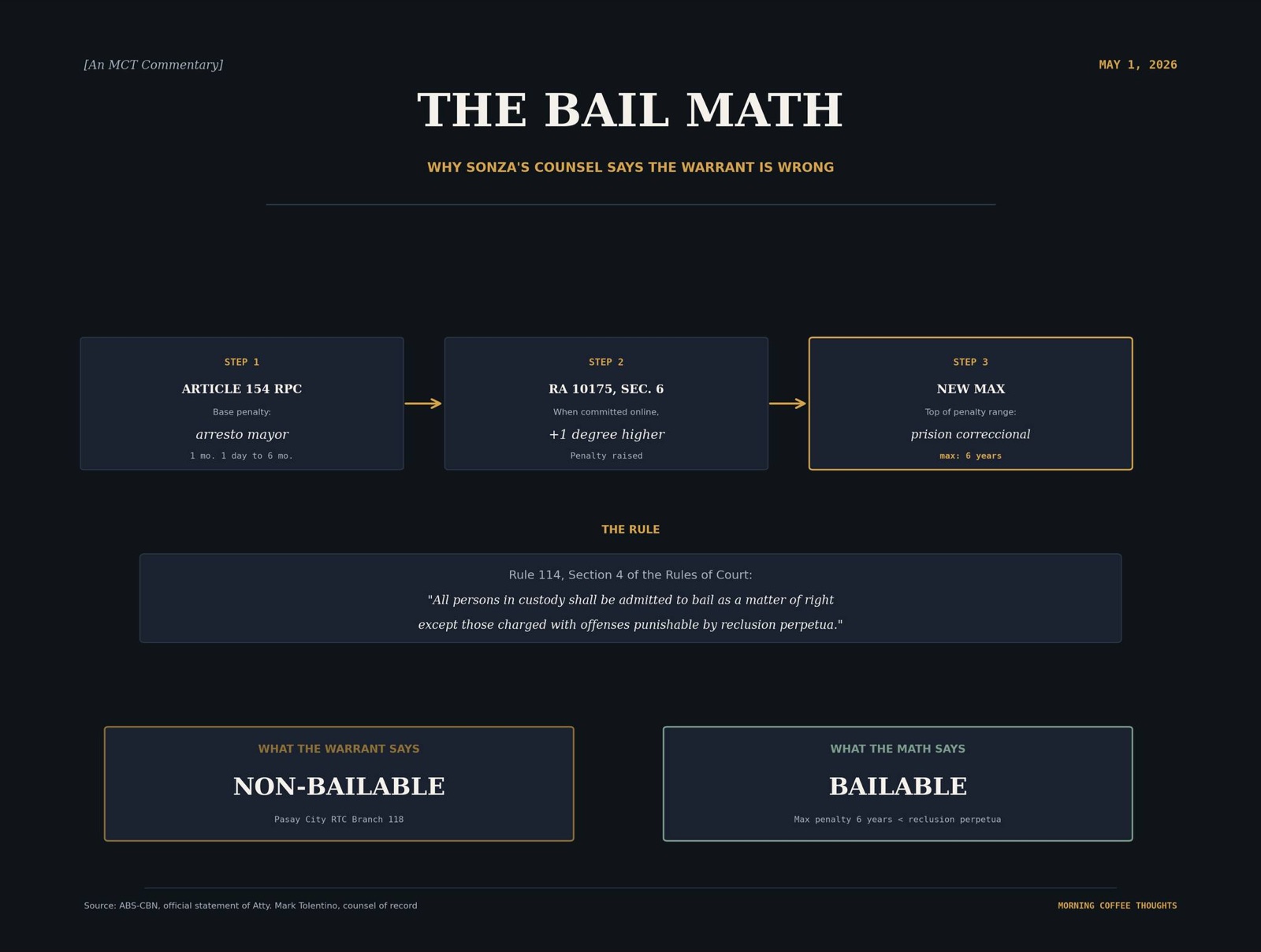
Article 154 of the Revised Penal Code, the provision Sonza is charged under, carries a base penalty of arresto mayor — one month and one day to six months — plus a fine that RA 10951 updated to between P40,000 and P200,000.
Section 6 of RA 10175 raises the penalty by one degree when the offense is committed through a computer system. One degree above arresto mayor is prision correccional. That penalty range tops out at six years.
Rule 114, Section 4 of the Rules of Court, on bail as a matter of right, says it plainly. Before conviction by a Regional Trial Court, all persons in custody are entitled to bail as a matter of right, except those charged with offenses punishable by death, reclusion perpetua, or life imprisonment when evidence of guilt is strong.
Six years is well below all three of those thresholds. By every standard reading of the rule, Sonza is entitled to bail as a matter of right.
That is the math. No competing legal theory has been publicly offered to dispute it.
WHO IS SAYING WHAT
Atty. Mark Tolentino, Sonza's counsel, made the strongest version of the argument hours after the arrest. In his official statement and in his ABS-CBN interview, he laid out two distinct claims.
The first is the bail claim. "Ang kasong 'unlawful publication' in relation to cybercrime sa ilalim ng Cybercrime Prevention Act of 2012 at Revised Penal Code ay hindi punishable ng reclusion perpetua o life imprisonment. Samakatuwid, ito ay bailable as a matter of right." Calling it non-bailable, he said, is "maling aplikasyon ng batas." A misapplication of the law.
The second claim is sharper. Tolentino argued that for an offense this minor — with a base penalty of six months — the proper remedy under the rules is a summons, not a warrant of arrest at all. "Maybe nagkamali ang court nag-issue ng warrant. Bakit nag-issue ng warrant na the bail is not required in this case." The implication: the NBI, in arresting Sonza on a warrant that should not have been issued, lacked legal basis to detain him at all.
Tolentino has said the defense will file a manifestation with the court asking for Sonza's immediate release. The earliest filing day is Monday, May 4, since today is Labor Day and the court did not sit yesterday after the warrant was served.
Beyond Sonza's own counsel, the broader legal community has not yet weighed in through institutional channels. No statement from the Integrated Bar of the Philippines. No statement from the Free Legal Assistance Group. No published analysis yet from a recognized criminal law academic. Online commentary from individual lawyers on social media has trended in one direction — the warrant marking is an error — but that is private commentary, not institutional response. The institutional voices that typically engage on questions like this tend to wait for filings, not warrants. The first filing comes Monday.
THE OTHER SIDE OF THE LEDGER
NBI Director Melvin Matibag has stated repeatedly that the case is no-bail. In a televised statement on the night of the arrest, he said, in Filipino, "this case has no bail recommended, and this will be processed, and we will bring him to the court that issued the warrant of arrest against him."
Note the framing. Matibag did not offer a legal theory for why the offense is non-bailable. He stated it as a fact, following from the document the court issued. That is the pattern of an arresting agency executing a warrant as written, not a legal defense of the warrant's classification.
The DOJ has not, as of this writing, issued a public statement responding to the legal community's criticism. The text of the DOJ Information that triggered the warrant has not been made public, so it is not possible to determine whether the non-bailable notation came from the prosecutor's recommendation, the issuing judge's independent determination, or some procedural step in between.
THE THEORY THAT WOULD HAVE WORKED
There is exactly one charging theory under which the warrant marking would be legally defensible. It is not the theory that was charged.
If the DOJ had filed a separate count for inciting to sedition under Article 142 of the Revised Penal Code, the penalty math would change. Article 142 carries prision correccional in its minimum period to prision mayor maximum. Apply Section 6 of RA 10175 and the ceiling rises to reclusion temporal. That is the territory where Rule 114, Section 7 allows the court to deny bail when evidence of guilt is strong.
But that count was not in the NBI's February complaint. The NBI's own February press release listed exactly two recommended charges: cyberlibel under Section 4(c)(4) of RA 10175, and unlawful use of means of publication under Article 154. Inciting to sedition was never on the table.
The warrant the Pasay court issued was for Article 154 only. The cyberlibel matter, per Tolentino, is still on a separate DOJ track and no warrant has been issued for it. There is no third charge that could carry the bail calculus into non-bailable territory.
Which leaves the question of how the non-bailable marking got onto the warrant in the first place.
That is the question the manifestation Tolentino plans to file on Monday is designed to make the court answer.
WHAT HAPPENS MONDAY
The defense will file a manifestation with Branch 118 asking for Sonza's release. The court will have to address two questions: whether the offense is bailable as a matter of right, and if so, whether the warrant should have been issued at all given the proper remedy was a summons.
If the court agrees with Tolentino on the first question, bail is set and Sonza is released. If the court agrees on the second, the entire detention is unlawful and the release should be immediate without bail.
If the court rejects both, the defense will have grounds to escalate. A petition for certiorari with the Court of Appeals, arguing grave abuse of discretion in the issuance of the warrant, is the standard next step.
For now, Sonza spends the holiday weekend in NBI custody on the strength of a warrant whose central marking — the one that determines whether he goes home or stays detained — is the most contested document in Philippine legal commentary today.
The court reopens Monday. The lawyers are ready. The math is simple.
What the court does with all of it is the only thing that has not yet happened.
SOURCES
- Jay Sonza arrested for spreading misinformation online — ABS-CBN News, https://www.abs-cbn.com/news/nation/2026/4/30/jay-sonza-arrested-for-spreading-misinformation-online-2110
- NBI arrests Jay Sonza for cyberlibel — GMA News Online, https://www.gmanetwork.com/news/topstories/nation/985975/nbi-arrests-jay-sonza-cyberlibel/story/
- NBI arrests Jay Sonza for cyberlibel — Manila Bulletin, https://mb.com.ph/2026/04/30/nbi-arrests-jay-sonza-for-cyberlibel
- NBI arrests former journalist Jay Sonza over alleged spread of false information on PBBM's health — DZRH News, https://www.dzrh.com.ph/post/nbi-arrests-former-journalist-jay-sonza-over-alleged-spread-of-false-information-on-pbbms-health
- Ex-broadcast journalist Jay Sonza arrested for cyber libel — Philstar Life, https://philstarlife.com/news-and-views/566826-ex-broadcast-journalist-jay-sonza-arrested-for-cyber-libel
- Official statement of Atty. Mark Kristopher Tolentino, counsel of Jay Sonza and Eric Celiz — Facebook, https://www.facebook.com/MarkTolentinoLaw/posts/1486871103088167/
- Republic Act No. 10175 — Cybercrime Prevention Act of 2012 — Official Gazette, https://www.officialgazette.gov.ph/2012/09/12/republic-act-no-10175/
- Article 154, Revised Penal Code (Act No. 3815) — Official Gazette, https://www.officialgazette.gov.ph/1930/12/08/act-no-3815-s-1930/
- Republic Act No. 10951 (penalty and fine adjustments under the RPC) — Official Gazette, https://www.officialgazette.gov.ph/2017/08/29/republic-act-no-10951/
- Rule 114, Rules of Court (Bail) — Lawphil, https://lawphil.net/courts/rules/rc_110-127_crim.html
- When Bail is a Matter of Right and When It Is a Matter of Discretion — Alburo Law, https://www.alburolaw.com/when-bail-is-a-matter-of-right-and-when-it-is-a-matter-of-discretion/