
I keep reading about the Strait of Hormuz. I keep seeing it in my feed — that it's locked, that it's blocked, that there's a war and oil prices are going up. Truthfully, I know almost nothing about it.
This is the kind of topic I envy people like Richard Heydarian and other foreign-policy folks for — they can connect these dots in their sleep because of their background and training. I don't have that, but I do have curiosity.
So this piece is me trying to understand what's going on and sharing that learning process with you, not pretending to be an expert.
SO, WHAT EXACTLY IS THE STRAIT OF HORMUZ?
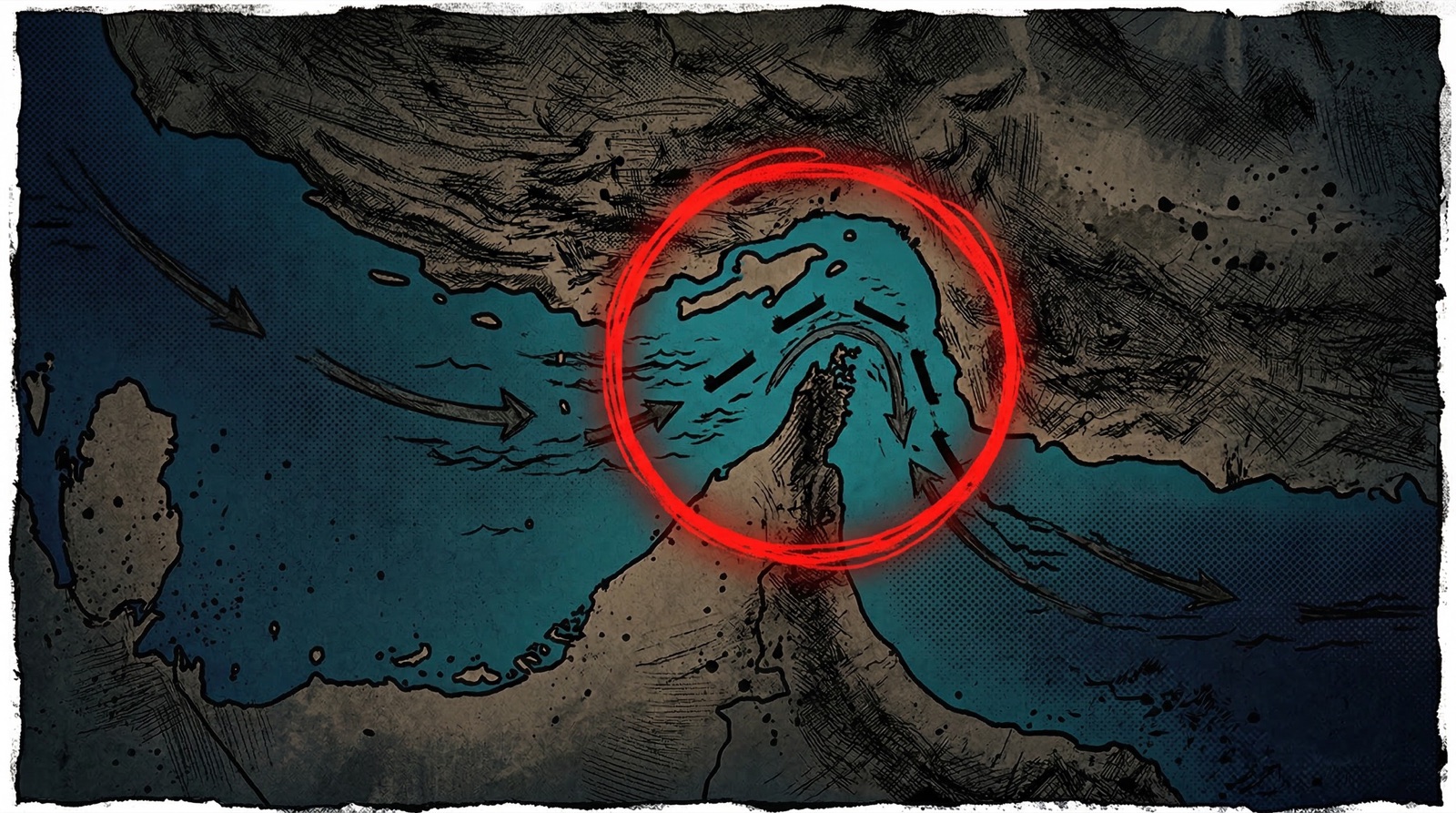
The Strait of Hormuz is a narrow body of water between Iran on the north and Oman plus the UAE on the south. It connects the Persian Gulf — where many of the world's biggest oil producers sit — to the Gulf of Oman and the Arabian Sea, which then opens to global shipping routes.
At its narrowest point, it is about 21 miles or 33 kilometers wide, but tankers don't get to use all that space.
The actual shipping lanes are like painted lines on the sea: roughly two miles wide going out, two miles wide going in, with a two-mile buffer in between. That means the global economy is funneling giant oil supertankers through a corridor narrower than a Manila expressway.
It's deep enough for the biggest ships on earth, but because the lanes are so constrained and so close to Iran's coast, it's very easy to disrupt.
WHY THIS TINY STRIP OF WATER IS THE MOST IMPORTANT ENERGY CHOKEPOINT ON EARTH
Around 20 million barrels of oil pass through the Strait of Hormuz every single day. That is roughly 20 percent of total world oil consumption and about a quarter of all seaborne oil trade.
On top of that, about one-fifth of the world's liquefied natural gas, mostly from Qatar, also moves through this same passage.
Most of that oil doesn't go to the West. Roughly 84 percent of the crude passing through Hormuz is headed for Asian markets — China, India, Japan, South Korea, and the rest of East and Southeast Asia, including the fuel we eventually import.
The United States today imports relatively little oil via Hormuz, but that doesn't protect them from price shocks. Oil is priced globally, so when this chokepoint is in trouble, everyone pays more.
WHY FILIPINOS SHOULD CARE
For us, this is not just "Middle East news." The Philippines is a net oil importer. According to MUFG Research, 95 percent of the crude oil that the Philippines imports comes from the Middle East. Even when we buy refined fuel from South Korea, Singapore, or China, a lot of that fuel starts its life as Gulf crude that sailed out through Hormuz.
This is why, even before we fully process the geopolitics, we feel the consequences at the pump.
The Department of Energy has already warned that local fuel prices could rise by anywhere from P2.50 to as high as P10 per liter as companies stagger their price hikes. Government projections say that in a worst-case scenario, inflation could briefly spike into the 6.3 to 7.5 percent range, which hits transport, food, and basically everything that moves by truck.
We have enough oil inventories to get us through the next few weeks, but if the disruption drags on, we'll be forced to pay higher prices or scramble for alternative suppliers.
HOW WE GOT HERE IN 2026
On February 28, 2026, the United States and Israel launched coordinated strikes on Iran, targeting nuclear facilities and key military infrastructure. Those strikes killed Iran's supreme leader, Ayatollah Ali Khamenei — which is about as escalatory as it gets.
Iran responded with missiles and drones against U.S. bases in the region, Israel, and Gulf states including Saudi Arabia and the UAE.
In that context, the Strait of Hormuz became the obvious pressure point.
The Islamic Revolutionary Guard Corps announced that the strait was closed and warned that ships attempting to pass would be attacked. Within days, maritime traffic fell dramatically, with thousands of commercial vessels effectively stuck.
Iran then began laying naval mines in and around the shipping lanes — the kind of weapon that doesn't need to move or "win" a battle to be effective. It just needs to exist and be uncertain.
The U.S. has sunk dozens of Iranian vessels and struck thousands of targets inside Iran, but as long as there is a risk of mines, missiles, or drones, insurers and ship captains will hesitate to send tankers through.
WHY IRAN HAS LEVERAGE HERE
Iran does not need to defeat the U.S. Navy to make Hormuz unusable. Its entire strategy is what analysts call anti-access and area denial: make the waters so risky that commercial shipping stops itself.
Mines are cheap, hard to detect, and terrifying when you're steering a ship full of oil. Add coastal missile batteries, drones, and swarms of fast boats, and you get a situation where a single miscalculation can cause a huge spill or explosion.
Geography helps Iran. It controls most of the key islands in and around the strait and sits right on the northern shoreline overlooking the outbound lane. From land, it can track ships, threaten them, or in crises, physically block them.
Historically, Iran has shouted about closing Hormuz but stopped short because it also needs it to export its own oil. The danger now is that with its leadership struck and the regime feeling cornered, Tehran is willing to accept more economic pain for the sake of political leverage.
ARE THERE WORKAROUNDS?
There are pipelines, but they are not magic bullets.
Saudi Arabia has an East-West pipeline system with a rated capacity of 5 million barrels per day, running from the eastern oil fields to the Red Sea port of Yanbu. Saudi Aramco CEO Amin Nasser said this week that the company is pushing to bring the pipeline to its full expanded capacity of 7 million barrels per day within days. The UAE has the Habshan-Fujairah pipeline from its onshore fields to the Gulf of Oman, with a capacity of about 1.5 million barrels per day.
Together, at maximum capacity, they can reroute roughly 6.5 to 8.5 million barrels per day. That is still less than half of the normal 20 million barrels per day that pass through Hormuz.
Countries like Iraq, Kuwait, Qatar, and Bahrain have no alternative routes at all — if the strait is effectively closed, their exports are stuck.
One analyst described these pipelines as "shock absorbers, not substitutes," which is a polite way of saying they can soften the blow but not solve the problem.
WHAT THIS TELLS US
The Strait of Hormuz is a reminder that geography is still raw power.
A narrow stretch of water, with shipping lanes only a few miles wide, is now influencing inflation rates in Manila, fuel bills in Tokyo, and policy debates in Washington and Beijing.
I'm still learning, and I won't pretend to have the level of analysis that full-time geopolitical scholars bring to this topic, but even a basic understanding already helps connect the dots: when you hear "missiles in the Gulf" or "mines in Hormuz," you're really hearing "brace for higher prices" back home.
SOURCES
- Reuters, https://www.reuters.com/world/middle-east/what-is-strait-hormuz-why-is-it-so-important-oil-2026-02-28/
- U.S. Energy Information Administration (EIA), https://www.eia.gov/todayinenergy/detail.php?id=65504
- U.S. Energy Information Administration (EIA), https://www.eia.gov/todayinenergy/detail.php?id=61002
- Forbes, https://www.forbes.com/sites/rrapier/2026/03/09/irans-real-nuclear-option-isnt-a-bomb-its-the-strait-of-hormuz/
- BusinessWorld, https://www.bworldonline.com/top-stories/2026/03/09/734961/philippines-eyes-alternative-oil-suppliers-as-middle-east-war-stokes-fuel-concerns/
- MUFG Research, https://www.mufgresearch.com/fx/philippines-strait-of-hormuz-closure-impact-of-higher-oil-prices-and-more-9-march-2026/
- Fortune, https://fortune.com/article/strait-of-hormuz-alternate-routes-oil-prices-energy-markets-iran-us-israel-attack/
- The Conversation, https://theconversation.com/what-is-the-strait-of-hormuz-and-why-does-its-closure-threaten-global-energy-supplies-250575
- Manila Bulletin, https://mb.com.ph/2026/03/03/philippines-among-worst-hit-by-oil-price-surge-amid-middle-east-tensionsing
- Philstar, https://www.philstar.com/business/2026/03/10/2513299/how-philippines-its-asian-neighbors-are-limiting-mideast-wars-impact-home
- HORN Review, https://hornreview.org/2026/03/04/operational-closure-navigational-denial-in-the-strait-of-hormuz-and-bab-al-mandeb/
- Watson Farley & Williams, https://www.wfw.com/articles/strait-of-hormuz-its-closure-and-its-implications/
- Morningstar/MarketWatch, https://www.morningstar.com/news/marketwatch/20260304468/prices-to-charter-large-oil-tankers-soar-as-strait-of-hormuz-traffic-grinds-to-a-halt
- Anadolu Agency, https://www.aa.com.tr/en/middle-east/pipeline-routes-that-could-help-oil-bypass-strait-of-hormuz/3517847
- Strauss Center/University of Texas, https://www.strausscenter.org/strait-of-hormuz/
- Asharq Al-Awsat, https://english.aawsat.com/business/5247576-saudi-east-west-pipeline-underpins-kingdom%E2%80%99s-energy-security-strategy
- Global Energy Monitor, https://www.gem.wiki/East-West_Crude_Oil_Pipeline
- MarketScreener, https://www.marketscreener.com/news/saudi-aramco-ceo-we-are-bringing-east-west-pipeline-to-full-capacity-in-the-next-couple-of-days-as-ce7e5fdedc80f321