
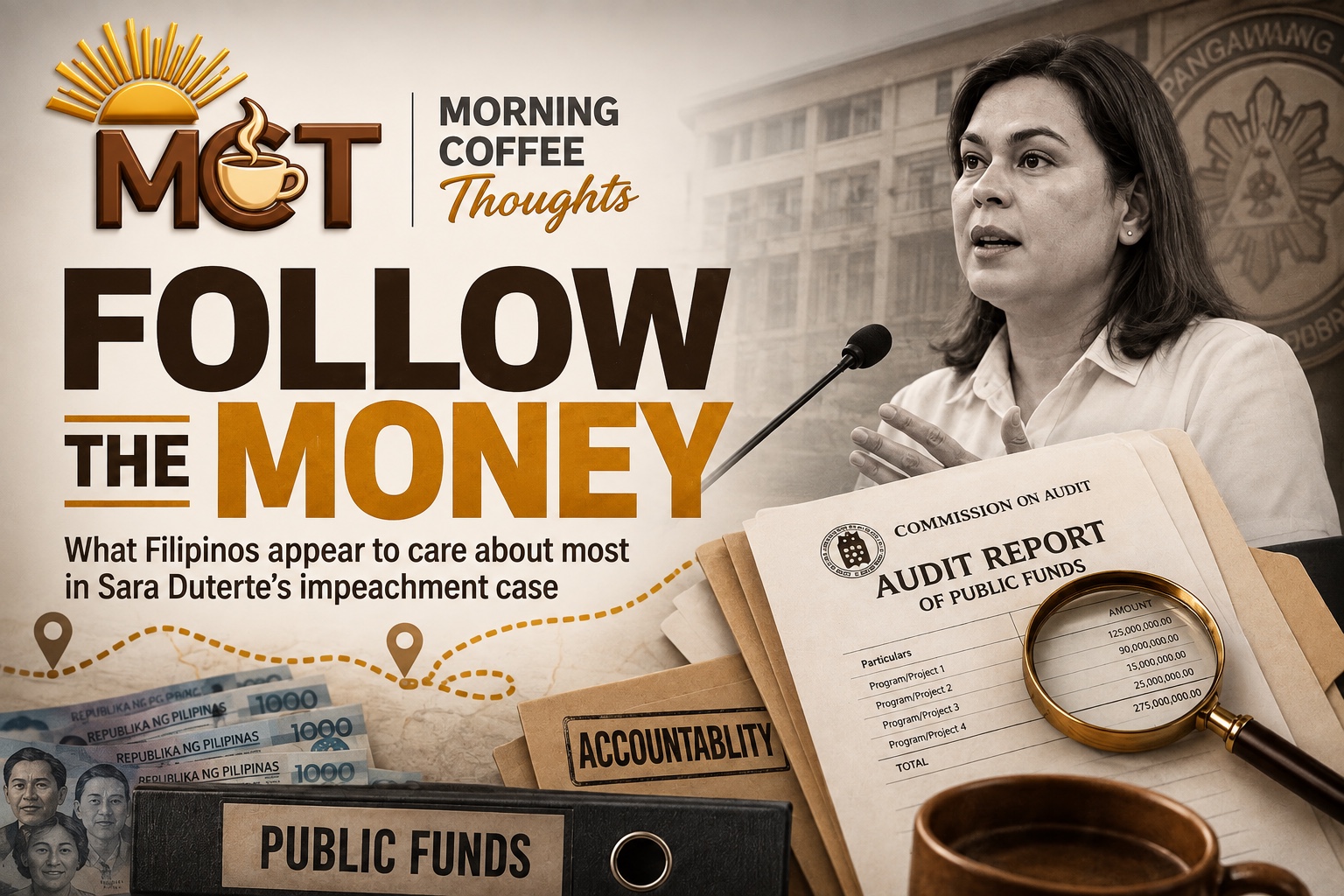
The OCTA Research graphic looked simple. Bribery was first at 43%, followed by misuse of confidential funds at 28%, while unexplained wealth and grave threats each received 10%.
I thought that was the whole story until I added 43, 28, and 10. Those three choices add up to 81%.
OCTA did not group them together. I did, because bribery, misuse of confidential funds, and unexplained wealth all involve money, assets, public funds, or possible financial gain.
The poll did not ask whether people believed Sara Duterte was guilty. It asked which allegation they considered the most serious or thought should receive priority.
Still, 81% chose one of the three allegations tied to money. That changed how I read the survey.
THE 81% BEHIND THE 43%
Bribery deserves the headline because it finished first by a wide margin. It led misuse of confidential funds by 15 points nationwide, far beyond the survey’s reported national error margin of plus or minus three points.
Once the three financial choices are placed side by side, most respondents had put a money-related accusation first. Grave threats received 10%.
The three accusations have their own facts, evidence, and legal questions. I am grouping them for one reason: all three send us back to money, assets, or public funds.
My reading is that the financial evidence will receive the closest public attention. People will want to know where the funds went, who approved the releases, what records exist, and whether the documents match the transactions being described.
OCTA did not ask those follow-up questions, so I cannot claim that every respondent had them in mind. The numbers still suggest that the money trail will be easier for many people to follow than arguments built mainly around constitutional language.
A threat can be grave, yet judging it may require a long discussion about the words used, the setting, the intended meaning, and the charge attached to it. Money leaves records that can be checked.
There may be vouchers, signatures, bank entries, sworn statements, property records, and named recipients. That could help explain why the financial accusations drew so much attention, although the survey did not ask respondents to explain their choice.
EIGHT IN TEN ACROSS THE COUNTRY
The numbers line up across all four large areas in the poll. At least eight in ten chose bribery, confidential-fund misuse, or unexplained wealth.
The total was 84% in the National Capital Region, 80% in Balance Luzon, 85% in the Visayas, and 80% in Mindanao. Different parts of the country did not always agree on which financial allegation came first, but the overall choice barely changed.
Balance Luzon is a good example. Bribery received 38% while misuse of confidential funds received 33%.
OCTA reported an error margin of plus or minus six points for each large area, so a five-point gap is too close for me to call a clear lead. Balance Luzon was almost divided between bribery and confidential-fund misuse, while 80% still chose one of the three financial allegations.
The detailed regional table needs more care because some of its biggest percentages came from very small groups. The Cordillera Administrative Region showed 75% for bribery, but that figure came from 10 respondents and carried an error margin of plus or minus 31 points.
MIMAROPA had 20 respondents, Region II had 25, and Caraga had 30. Ten people cannot tell us what an entire region thinks, so those percentages should not be turned into firm regional claims.
THE BURIED MINDANAO NUMBER IS 16%
Mindanao is where I expected to find the clearest regional difference. Sara Duterte’s family has deep political roots there, so it would have been easy to assume that the region would play down the accusations against her.
The broad numbers do not show that. Bribery received 43% in Mindanao, exactly the same as the national result.
Misuse of confidential funds received 23%, while unexplained wealth received 14%. Together, the three financial allegations account for 80% of Mindanao’s answers.
Grave threats received only 3%. The number that stands out is the 16% who answered “don’t know” or “can’t say.”
That was twice the national figure of 8%. The unsure group was 8% in the National Capital Region, 6% in Balance Luzon, and 5% in the Visayas.
OCTA did not ask why Mindanao had more people who would not choose. The table cannot tell us whether the reason was limited knowledge of the charges, discomfort with the question, political loyalty, or something else.
What we can say is simple. Mindanao still placed the financial accusations far ahead of grave threats, while a larger group remained unsure.
That is more useful than assuming the region will automatically defend any Duterte. The numbers show concern and hesitation at the same time.
ARE PEOPLE USING DIFFERENT WORDS FOR THE SAME CONCERN?
I also wonder whether every respondent understood the four choices in the same way. “Bribery” is a familiar word, usually understood as money or some other benefit given in exchange for a favor, an official act, or protection.
“Misuse of confidential funds” is more technical. It brings in budgets, liquidation papers, audit rules, certifications, and the special secrecy allowed for some government spending.
Bribery may have served as the everyday word for corruption, especially for people already thinking about confidential funds. Another group could have kept the charges separate and picked the one they understood best.
OCTA did not ask people to explain their choice, so we cannot tell which reading is closer. A few of its tables still make the question worth asking.
Among respondents aged 18 to 24, bribery and confidential-fund misuse were almost tied at 38% and 35%. College and postgraduate respondents were also close, with bribery at 40% and confidential-fund misuse at 35%.
Respondents with vocational education went the other way, choosing confidential-fund misuse at 41% and bribery at 28%. OCTA did not publish the number of respondents inside those smaller groups, so we do not know how much weight each percentage can carry.
I would not use these figures to declare that one age group or education group thinks a certain way. I would ask whether people disagree about corruption itself or are choosing different names for the part of the case that worries them.
THE QUESTION MIXED SERIOUSNESS WITH PRIORITY
OCTA asked which allegation was “the most serious or should be prioritized.” A person can answer those two ideas differently.
A respondent could see grave threats as the gravest accusation and still want the Senate to hear the financial evidence first. Bribery may also feel easier to prove because it could come with documents and witnesses.
The poll folded both ideas into one question. We cannot tell whether a respondent picked an answer because it felt more serious or because that person wanted it heard first.
The survey also required one choice, so a respondent who selected bribery may still believe the threats deserve close attention. The 10% for grave threats only tells us that 10% placed it ahead of the other three choices.
A follow-up poll could ask people to rate every allegation on its own, then ask which one the Senate should hear first. That would give us a clearer picture of how Filipinos see the case.
For now, OCTA has given us a ranking. Bribery is first, and money-related accusations take up most of the answers.
THE MONEY TRAIL STILL HAS TO BE PROVEN
The poll was conducted from July 4 to 11 through face-to-face interviews with 1,200 respondents. OCTA reported a national error margin of plus or minus three points.
None of those percentages proves an allegation. A survey cannot replace documents, testimony, questioning, or the Senate’s duty to judge the case from the evidence placed before it.
The 81% still shows where public attention is likely to go. Financial claims are easier to follow when people can see the dates, amounts, approvals, and records behind them.
The prosecution now has to show the path of the money clearly enough for its claims to be checked. Any records placed before the court will also have to be answered by the defense.
The Senate has to put the evidence on the table and test every explanation against it. Only then will Filipinos know where the money went and whether the accusations can be proven.
SOURCES
- OCTA Research — What Filipinos Consider the Most Serious Impeachment Allegations Against VP Sara Duterte, https://www.octaresearch.com/
- GMA News Online, https://www.gmanetwork.com/news/topstories/nation/997117/octa-43-of-filipinos-see-bribery-as-most-serious-impeachment-charge-vs-vp-sara-duterte/story/
- Reuters, https://www.reuters.com/world/asia-pacific/impeachment-trial-philippine-vp-sara-duterte-open-divided-senate-2026-07-05/