
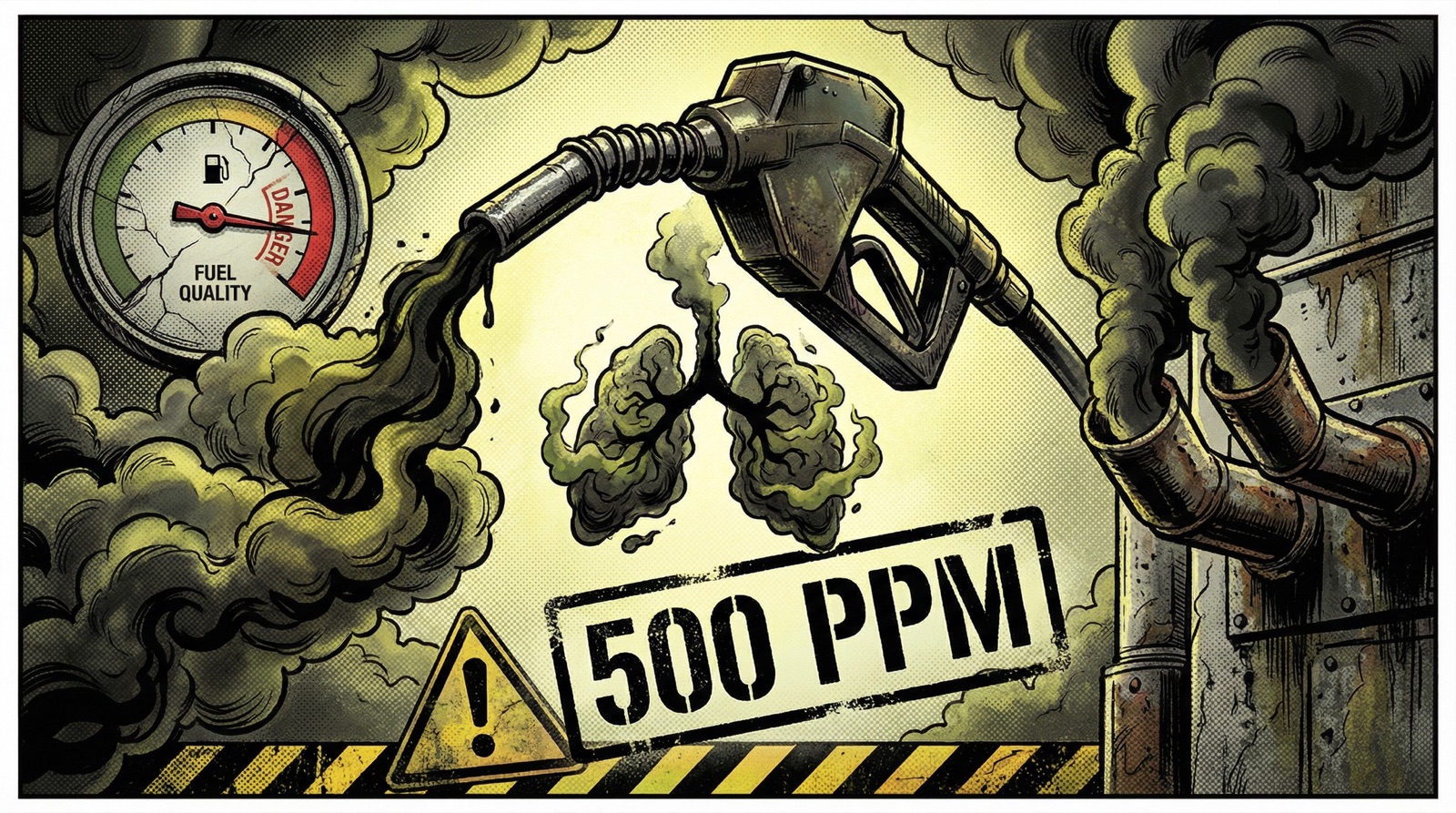
500 parts per million. That is how much sulfur is allowed in Euro II diesel. Euro IV — the standard the Philippines has been running on since 2016 — caps sulfur at 50 ppm.
That is a tenfold difference. Not a marginal downgrade. Ten times.
On March 22, 2026, the Department of Energy issued Department Circular No. DC2026-03-0010, authorizing the temporary, controlled use of Euro II petroleum products for select sectors. Energy Secretary Sharon Garin signed the order as part of the government's contingency response to a global oil supply disruption that has pushed diesel past ₱100 per liter and left the Philippines scrambling to keep its fuel lines intact.
HOW THE COUNTRY GOT HERE
The Strait of Hormuz — the narrow passage through which roughly 16 to 20 percent of the world's daily petroleum supply flows — has been effectively shut down to normal tanker traffic since late February 2026, when U.S. and Israeli forces launched strikes against Iran. Iran has reportedly been laying naval mines in the waterway since then, compounding the disruption.
The Philippines is particularly exposed. According to the Philippine Information Agency, 98 percent of the country's crude oil originates from the Middle East. The country does not import directly from Iran, but the knock-on effect is severe: refineries in China, South Korea, Singapore, and Japan — which supply the finished petroleum products the Philippines actually uses — are themselves starved of Persian Gulf crude.
Then China made it worse. Starting in early March 2026, Beijing banned exports of diesel, gasoline, and aviation fuel to protect its domestic supply. China had supplied roughly half of the Philippines' fuel in 2024. With that source gone, Asian diesel derivatives surged to $150 per barrel by March 17. Jet fuel hit $163.
Forbes flagged the Philippines as among the countries most at risk of running out of oil entirely, given its near-total import dependency and lack of a strategic petroleum reserve.
WHAT THE CIRCULAR ACTUALLY DOES
The order does not scrap Euro IV standards across the board. It carves out specific sectors where Euro II fuel can be used: vehicles manufactured in 2015 or earlier, traditional jeepneys, industrial power plants and generators, and the marine and shipping industry.
New vehicles — anything built from 2016 onward — must still run on Euro IV. The DOE described the measure as "temporary," "interim," and "narrowly targeted," with no fixed end date published. It stays in effect until the department revokes or supersedes it.
Oil companies that want to sell Euro II fuel under this circular must notify the DOE's Oil Industry Management Bureau, identify the specific retail stations carrying the lower-grade product, maintain full physical segregation between Euro II and Euro IV fuel throughout their supply chain, and post clear advisories at the pump so consumers know what they are getting. The DOE will conduct random product sampling and testing. Non-compliance carries penalties under existing law.
Garin framed the circular as a supply security measure. In her words: "We are adopting a prudent and temporary measure to help ensure an adequate and accessible fuel supply for sectors that may require limited flexibility during this period. This interim authority is subject to strict quality controls, clear notification requirements, and appropriate consumer protection measures."
The country currently holds roughly 60 days of fuel inventory — triple the legal minimum. Oil companies are already ordering May stocks. The Philippine National Oil Company has been directed to procure at least 2 million barrels as a government buffer, and the DOE announced an order of up to 300,000 barrels of diesel from a Southeast Asian supplier for late March delivery. The government is also in talks with India, China, Japan, South Korea, Thailand, and Brunei over supply options.
THE HEALTH COST NOBODY IS LEADING WITH
Euro II diesel permits 500 ppm sulfur. Euro IV permits 50 ppm. That is not a technical footnote.
Sulfur in fuel creates sulfur dioxide and fine particulate matter when burned. These pollutants worsen asthma, chronic obstructive pulmonary disease, cardiovascular disease, and other respiratory conditions. They also contribute to acid rain and haze.
The Philippines shifted to Euro IV fuel in 2016 after years of delay. The move was supposed to reduce air pollution and improve compatibility with newer vehicle emission-control systems.
Allowing Euro II again means older jeepneys, generators, ships, and industrial users can legally burn fuel with ten times the sulfur content of the standard the country spent a decade enforcing.
The DOE says the use is temporary and controlled. But the circular does not publish an end date. It does not specify a maximum volume. It does not explain how long-term health effects will be monitored in communities near ports, transport routes, power plants, or stations selling Euro II.
The policy solves an immediate supply problem by shifting part of the cost into the air.
That may be necessary during a genuine emergency. But the government should say plainly what it is asking the public to absorb, how long the rollback will last, and what conditions will trigger a return to Euro IV-only fuel.
SOURCES
- Reuters, https://www.reuters.com/business/energy/philippines-allows-temporary-use-dirtier-fuel-amid-middle-east-crisis-2026-03-22/
- Channel NewsAsia, https://www.channelnewsasia.com/asia/philippines-allows-dirtier-fuel-jeepney-oil-prices-middle-east-6009806
- Philstar, https://www.philstar.com/headlines/2026/03/23/2516231/doe-allows-dirtier-fuel-imports-amid-iran-crisis
- GMA News, https://www.gmanetwork.com/news/topstories/nation/980951/euro-2-petroleum-products-doe/story/
- DOE Official Press Release (DC2026-03-0010), https://doe.gov.ph/articles/group/notices-and-releases?category=Press+Releases&display_type=Card
- Daily Tribune, https://tribune.net.ph/amp/story/2026/03/22/doe-allows-limited-use-of-lower-grade-fuel-to-secure-supply
- Philippine Information Agency (Strait of Hormuz), https://pia.gov.ph/news/how-the-strait-of-hormuz-closure-affects-our-oil-prices/
- MUFG Research, https://www.mufgresearch.com/fx/philippines-strait-of-hormuz-closure-impact-of-higher-oil-prices-and-more-9-march-2026/
- Fortune, https://fortune.com/2026/03/21/iran-war-asia-energy-crisis-hormuz-oil-lng-stagflation/
- Reuters (China fuel export ban), https://www.reuters.com/business/energy/chinas-fuel-export-ban-further-tighten-asia-supply-2026-03-17/
- Modern Diplomacy, https://moderndiplomacy.eu/2026/03/17/chinas-fuel-export-freeze-deepens-asias-energy-shortage/
- Forbes, https://www.forbes.com/sites/christopherhelman/2026/03/17/the-countries-most-in-danger-of-running-out-of-oil/
- BusinessWorld, https://www.bworldonline.com/editors-picks/2026/03/19/737287/philippines-building-up-fuel-stockpiles-until-may-doe-chief/
- Inquirer.net (fuel supply), https://newsinfo.inquirer.net/2192016/public-must-remain-calm-govt-has-enough-fuel-supply
- Philstar (Russian oil), https://www.philstar.com/business/2026/03/17/2514746/philippines-eyes-russian-oil-amid-supply-fears
- ABS-CBN (triple-digit diesel), https://www.abs-cbn.com/news/business/2026/3/17/as-diesel-prices-breach-triple-digits-gas-stations-forced-to-improvise-price-displays-2004
- Clean Air Asia & Partnership for Clean Air (joint statement), https://www.cleanairasia.org/our-news/joint-statement-clean-air-asia-and-partnership-clean-air-support-cleaner-fuels
- IntelliNews, https://www.intellinews.com/philippines-down-to-its-last-three-weeks-of-fuel-reserves-turns-to-russia-for-help-431862/
- CNN (IEA emergency reserve release), https://www.cnn.com/2026/03/11/business/oil-prices-rebound-iran-war-intl
- Manila Bulletin (diesel procurement), https://mb.com.ph/2026/03/23/why-cutting-fuel-taxes-might-not-be-the-cure-we-think-it-is