
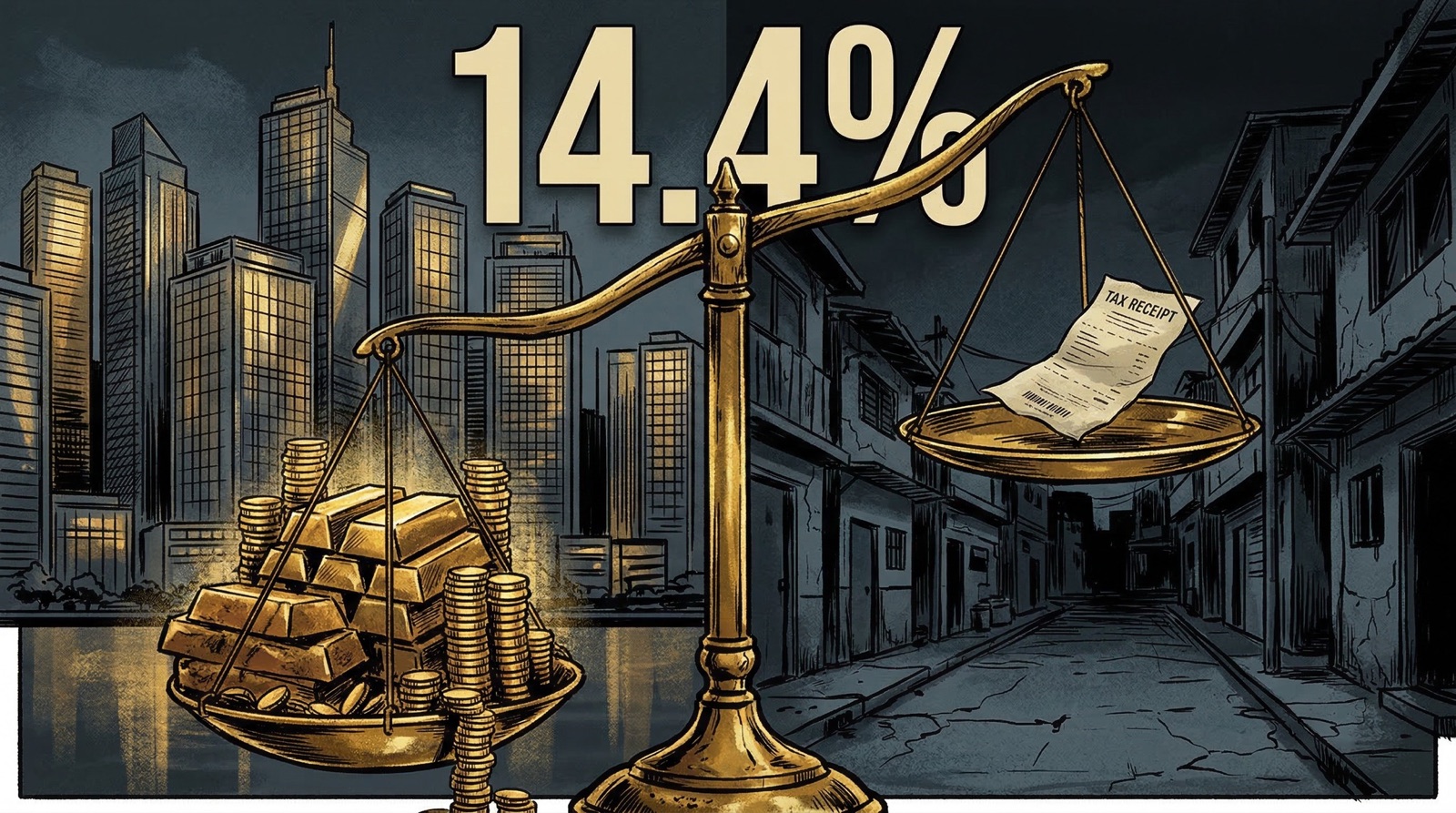
Here is the number that started this: ₱280 million.
That is what Jacinto Ng — the businessman behind Rebisco biscuits — paid in individual income taxes in 2014. The BIR celebrated it. He was the top individual taxpayer in the country that year. Second was Manny Pacquiao, at ₱210 million. Both were held up as models of compliance.
Now here is the other number.
Enrique Razon Jr. is currently worth $16.5 billion. If his wealth grew by just 5% in 2014 — a conservative estimate for a man whose fortune spans ports, gaming, and logistics — that is roughly ₱2.5 billion in a single year. The gap between what the richest Filipino accumulates in a year and what the BIR's top-ranked individual actually paid is not marginal.
Razon does not appear on the BIR's top individual taxpayer list. None of the names on the Forbes Philippines rich list appear there with any regularity. I want to place those two lists next to each other and let the reader look at them.
THE CELEBRITY QUESTION
In 2025, Alden Richards was recognized as BIR's Most Valuable Taxpayer at a ceremony in Calamba, Laguna. In 2024, it was Vice Ganda, Julia Barretto, Kathryn Bernardo. Dingdong Dantes. Catriona Gray.
The same names, year after year, just shuffled.
This is not an accident. The BIR's top individual taxpayer list measures something very specific: personal income tax paid and declared through an individual income tax return. Celebrities earn in the most visible, traceable way possible — talent fees, endorsements, network contracts, all flowing to individual names, all subject to withholding. Every peso is visible to the BIR.
Billionaires do not earn that way.
THE STRUCTURAL REASON
A conglomerate owner does not typically receive a salary large enough to rank on a personal income tax list. His holding company owns shares in listed subsidiaries. Those subsidiaries pay dividends up the chain. Here is the key: when one domestic corporation pays dividends to another domestic corporation, the tax is zero. Inter-corporate dividends between Philippine companies are fully exempt.
The wealth compounds inside the corporate structure, tax-free, until the owner decides to extract it personally. When that extraction happens — if it happens — the dividend is taxed at 10% final withholding. That tax is collected at the source and never appears in the individual's income tax return. The BIR's top taxpayer ranking does not see it.
A senior executive earning ₱8 million a year faces a 35% marginal rate, withheld automatically, no options. The man who owns the firm pays 10%, and only when he chooses.
THE ZERO THAT IS NOT A ZERO
The capital gains number is worth sitting with.
When a billionaire sells listed shares on the Philippine Stock Exchange, the capital gains tax is zero. What exists instead is the stock transaction tax — a levy on gross selling price, not on gains. It was 0.6% until last year. Under the Capital Markets Efficiency Promotion Act signed in May 2025, it dropped to 0.1%.
Sell ₱10 billion worth of listed shares. Pay ₱10 million in stock transaction tax. Owe nothing further.
A middle-class family selling a second property worth ₱5 million pays ₱300,000 in capital gains tax at 6%. The effective tax rate on selling a second home is 60 times the rate on selling ₱10 billion in blue-chip stock.
THE WALLS AROUND THE DATA
The BIR has been asking for the same thing for decades: access to bank records.
The Law on Secrecy of Bank Deposits — Republic Act 1405, signed in 1955 — prohibits the government from accessing bank account information without a court order. The BIR Commissioner can look into deposits only in two situations: when a taxpayer wants to compromise a tax liability, or when determining an estate for estate tax purposes.
Every BIR audit starts from documents the taxpayer submits. The agency cannot verify whether declared income matches actual cash movements, cannot trace dividend flows, cannot detect unexplained wealth accumulation without first obtaining a court order showing probable cause.
Multiple BIR commissioners have called RA 1405 the single biggest obstacle to collecting from the wealthy. The law has been in place for 71 years and has not been substantively amended.
929 CASES, 10 CONVICTIONS
The BIR runs a program called RATE — Run After Tax Evaders. Between 2005 and 2018, the program filed 929 tax cases with a combined claimed collectible of ₱148.35 billion.
Over 13 years: 10 convictions. No known conviction of any Forbes-listed billionaire.
The targets of RATE are typically entertainment personalities, medium-scale business owners, and professionals — people whose income is visible and whose assets are simpler to document. The structural complexity of oligarchic wealth makes building a tax evasion case exponentially harder.
The BIR had 14,742 employees in 2024 covering 28 million registered taxpayers. It has no dedicated unit for high net worth individuals. A proposal for one was raised in 2016 and never created.
THE NUMBERS THE GOVERNMENT CHOOSES NOT TO COUNT
The Philippines collects about 14.4% of GDP in taxes by the government's own measure. The OECD average is 33.9%. Even the Asia-Pacific average — a region not known for high tax collection — is 19.5%.
In 2024, the government granted a ₱147 billion net revenue shortfall from tax incentives to PEZA and BOI-registered companies. The manufacturing sector alone received ₱274 billion in tax expenditures and generated ₱52 billion in collections — roughly 19 centavos back for every peso surrendered. The Fiscal Incentives Review Board's own reports document it.
THE TRAIN QUESTION NOBODY FULLY ANSWERED
The Tax Reform for Acceleration and Inclusion Law — TRAIN, enacted in 2018 — raised the top individual income tax rate from 32% to 35%. Workers earning below ₱250,000 were exempted from income tax entirely. The government called it a win for the poor.
Here is what else TRAIN did.
Estate taxes, previously graduated from 5% to 20%, were simplified to a flat 6%. A wealthy family inheriting a ₱10 billion estate saw their tax burden drop from as much as ₱2 billion to ₱600 million. TRAIN also raised excise taxes on fuel, sugar-sweetened beverages, and tobacco. These are consumption taxes. They apply at the same rate regardless of income. As a share of monthly income, the burden lands differently on a family spending ₱3,000 a month than on one spending ₱300,000.
The IBON Foundation's assessment by 2026: the tax burden is shifting from corporations to households.
The 35% top rate applies to wage income above ₱8 million. For a salaried executive, that is the ceiling they reach. For a conglomerate owner extracting dividends at 10%, the 35% bracket is structurally irrelevant. The rate went up on the income type that billionaires do not use.
THE INHERITANCE THAT NEVER GETS FULLY SETTLED
The estate tax amnesty has been extended four times.
The original law allowed estates of decedents who died before December 31, 2017 to settle unpaid taxes at a flat 6% with all penalties waived. It was supposed to be a one-time window. It was extended to 2021, then 2023, then June 2025. A Senate bill filed in 2026 proposes extending it to December 2028.
Between 2020 and 2022, the amnesty collected roughly ₱11 to 12 billion total. That is a modest number for settling decades of unpaid taxes across the country. The most complex and most valuable estates largely did not participate — the process requires full asset disclosure.
The perpetual extension tells you something about what the BIR can realistically collect through normal enforcement. The amnesty is not a supplement. It is the substitute.
THE LIST AND THE LIST
The 50 richest Filipinos collectively held $86 billion in wealth in 2025. Razon alone sits at $16.5 billion on the Forbes 2026 billionaires list published this month. The Sy siblings, Manny Villar, Ramon Ang, the Consunjis, the Ayalas — names that have appeared on Forbes for decades, fortunes that have grown across generations.
The BIR's most celebrated individual taxpayers across those same years: Alden Richards, Vice Ganda, Manny Pacquiao, Judy Anne Santos.
Different lists. Different people. Different tax structures.
The BIR collected ₱2.85 trillion in 2024 — a record. It was a genuine achievement. And yet: the largest share of Philippine tax revenue comes from consumption — VAT, excise — taxes paid by everyone regardless of accumulated wealth. The portion that is supposed to rise with income is constrained by every structure described above.
This is where the numbers keep arriving: the system is not broken. It is working as designed. Every mechanism — the inter-corporate dividend exemption, the 0.1% stock transaction tax, the bank secrecy law, the estate tax amnesty that keeps getting extended — was enacted by a legislature. Maintained across administrations. Examined and kept.
The question I cannot fully answer is whether a tax system looks like this by coincidence, or because the people with the most to lose from changing it are also the people closest to the people who write it.
SOURCES
- Inquirer.net, https://business.inquirer.net/204333/manny-pacquiao-2nd-top-taxpayer-for-2014-with-p210-3m
- Inquirer.net, https://entertainment.inquirer.net/600121/vice-ganda-julia-barretto-kathryn-bernardo-among-top-celeb-taxpayers-in-qc
- Manila Bulletin, https://mb.com.ph/2025/3/4/catriona-gray-vice-ganda-dingdong-dantes-celebrities-honored-by-bir
- Asian Journal News, https://asianjournal.com/entertainment/alden-richards-recognized-as-birs-2025-most-valuable-taxpayer/
- Forbes, https://www.forbes.com/sites/janeho/2025/08/06/philippines-50-richest-2025-collective-wealth-climbs-6-to-86-billion-sy-siblings-remain-at-top/
- BusinessWorld Online, https://www.bworldonline.com/top-stories/2025/08/07/690082/sy-siblings-razon-villar-lead-2025-forbes-list-of-phls-50-richest/
- Inquirer.net, https://business.inquirer.net/578596/razon-tops-filipinos-on-forbes-2026-billionaires-list
- Philstar.com, https://www.philstar.com/headlines/2026/03/12/2513658/razon-richest-filipino-forbes-billionaires-list
- GMA News, https://www.gmanetwork.com/news/money/personalfinance/304267/bir-explains-why-forbes-richest-filipinos-not-among-top-taxpayers/story/
- Mindanao Daily News, https://mindanaodailynews.com/why-the-richest-filipinos-do-not-always-appear-on-the-top-taxpayer-lists/
- Philippine Daily Inquirer, https://opinion.inquirer.net/51241/missing-names-in-bir-taxpayer-list-a-study-in-inequity
- Inquirer.net, https://newsinfo.inquirer.net/392055/why-lopezes-not-on-bir-list-of-top-taxpayers-explained
- KPMG, https://kpmg.com/xx/en/our-insights/gms-flash-alert/flash-alert-2025-150.html
- PwC Tax Summaries, https://taxsummaries.pwc.com/philippines/individual/taxes-on-personal-income
- Chambers Global Practice Guide, https://practiceguides.chambers.com/practice-guides/comparison/1066/18660/29144-29145-29146-29147-29148-29149-29150-29151-29152
- OECD Revenue Statistics Asia-Pacific 2025, https://www.oecd.org/content/dam/oecd/en/publications/reports/2025/06/revenue-statistics-in-asia-and-the-pacific-2025-country-notes_0a069779/philippines_f65e8261/7982d549-en.pdf
- CPBRD Congress, https://cpbrd.congress.gov.ph/wp-content/uploads/2025/05/FF2025-39-Tax-Revenue-Performance-Update-on-ASEAN-5.pdf
- DOF Annual Report 2024, https://www.dof.gov.ph/wp-content/uploads/2024/12/2024-DOF-ANNUAL-REPORT.pdf
- PCO, https://pco.gov.ph/news_releases/bir-collected-record-p2-85-trillion-tax-in-2024-pbbm/
- Manila Bulletin, https://mb.com.ph/2026/01/02/tax-incentives-for-investors-leave-govt-147-billion-short-in-2024
- PwC Philippines, https://www.pwc.com/ph/en/tax/tax-publications/taxwise-or-otherwise/2023/estate-tax-amnesty-a-refresher.html
- Respicio & Co, https://www.respicio.ph/commentaries/is-the-philippine-tax-amnesty-extended-latest-deadlines-and-coverage
- Inquirer.net, https://newsinfo.inquirer.net/2184006/estate-tax-amnesty-extension-to-2028-pushed-in-senate-anew
- DOF, https://www.dof.gov.ph/train-to-benefit-99-percent-of-filipino-families/
- UP CIDS, https://cids.up.edu.ph/wp-content/uploads/2023/06/Inequality-Tax-Justice-and-the-Philippine-Wealth-Tax-Campaign.pdf
- DOF, https://www.dof.gov.ph/dof-says-super-rich-tax-bill-to-lead-to-capital-flight-tax-avoidance/
- BSP, https://www.bsp.gov.ph/Media_and_Research/Primers%20Faqs/Primer_on_Bank_Secrecy.pdf
- Washington University Law Review, https://journals.library.wustl.edu/globalstudies/article/358/galley/17197/view/
- ASEH Compliance, https://asehaseglobal.com/core-value-of-the-center/f/philippines-bank-secrecy-law-faces-scrutiny-in-2026
- PIDS, https://serp-p.pids.gov.ph/publication/public/view?slug=estimate-of-the-individual-income-tax-gap
- CPBRD Congress, https://cpbrd.congress.gov.ph/wp-content/uploads/2023/09/FF2022-33-Revenue-Impact-of-TRAIN-Laws-on-BIR-Tax-Collections-2020-2021.pdf
- CPBRD Congress, https://cpbrd.congress.gov.ph/wp-content/uploads/2023/09/FF2023-30-Revenue-Impact-of-Train-and-Create-Laws-on-BIR-Collections-2021-2022.pdf
- ACPAPP, https://www.acpapp.org.ph/post/why-the-philippines-must-catch-up-with-asean
- InvestAsian, https://www.investasian.com/economy/countries-with-no-capital-gains-tax/
- Oxfam Pilipinas, https://oxfam.org.ph/ph-inequality-report-launch/
- ANC YouTube, https://www.youtube.com/watch?v=d4DKyETmLNk
- Grant Thornton Philippines, https://www.grantthornton.com.ph/insights/articles-and-updates1/lets-talk-tp/domestic-level-profit-shifting-how-its-done-and-why-should-it-be-avoided/
- GreatDay HR, https://greatdayhr.ph/blog/train-law-income-tax-rates/
- Inquirer.net Business, https://business.inquirer.net/207810/bir-eyes-unit-to-go-after-rich-individuals
- Bureau of Internal Revenue Wikipedia, https://en.wikipedia.org/wiki/Bureau_of_Internal_Revenue
- Tax Observatory EU, https://www.taxobservatory.eu/repository/global-distribution-of-revenue-loss-from-tax-avoidance/
- OECD Asia-Pacific brochure, https://www.oecd.org/content/dam/oecd/en/topics/policy-sub-issues/global-tax-revenues/revenue-statistics-asia-pacific-brochure.pdf
- CPBRD — Global Minimum Tax, https://cpbrd.congress.gov.ph/pb2025-03-global-minimum-tax-what-it-means-for-the-philippine-tax-system/
- Deloitte Southeast Asia, https://www.deloitte.com/southeast-asia/en/services/tax/perspectives/beps-pillar-two.html