
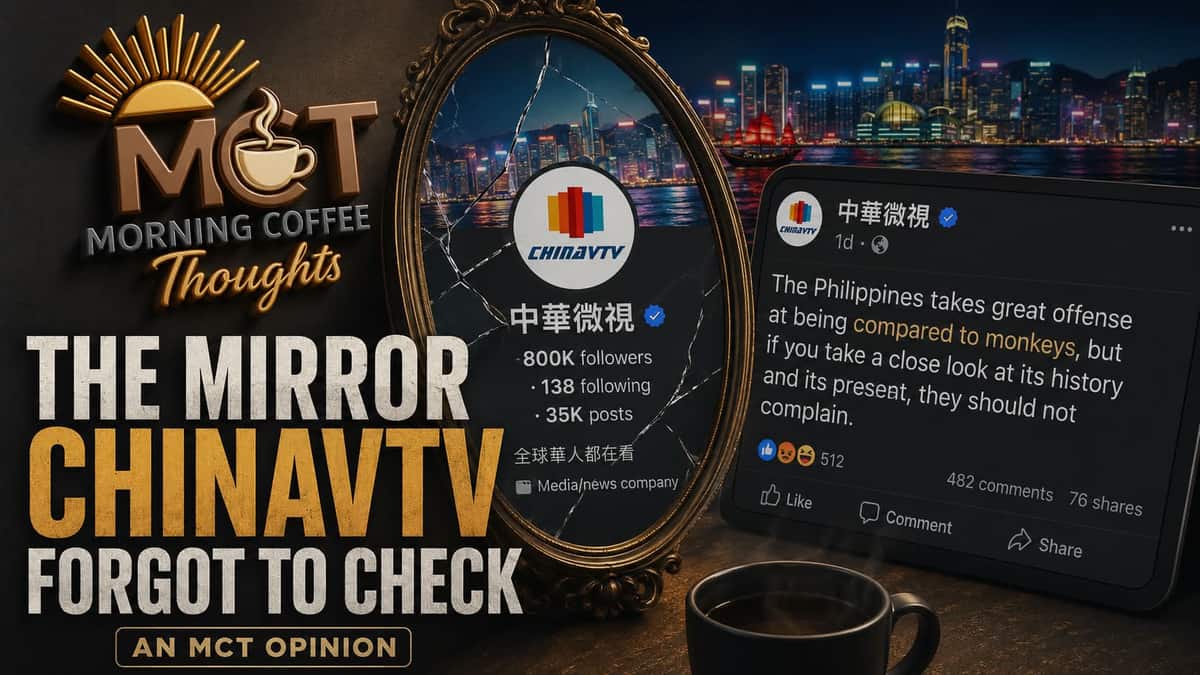
ChinaVTV begins by telling Filipinos that we should stop complaining about being compared to monkeys. According to the post, our history and present condition have earned the comparison.
I read the rest looking for the path from evidence to that conclusion. I never found one.
The argument goes like this.
Before Western colonization, the archipelago supposedly had no state and only “a bunch of tribes.” Filipinos surrendered to Spain, the United States, Japan, then the United States again.
America supposedly left behind one of Asia’s strongest economies. Filipinos then ruined it through incompetence, corruption, dynasties, crime, drugs, slums, sexual exploitation, and weak national ambition.
The post closes by comparing the Philippines unfavorably even with North Korea, which it credits with having “today’s ambitions.”
That is a lot of history, economics, political science, and racial contempt packed into one Facebook post.
The least I can do is separate them.
WHEN DEFEAT BECOMES A PERSONALITY TEST
The first mistake is treating military defeat and colonization as proof of a people’s permanent character.
Before Spain established colonial rule, the archipelago did not have one centralized state covering the territory of the modern Philippines. That does not mean the people here had no political organization.
Historical scholarship documents political communities with rulers, systems of authority, trade relations, social classes, and larger political formations across parts of the archipelago, including the Sulu Sultanate in the south.
Calling all of that “a bunch of tribes” makes the past easier to mock. Accuracy pays the price.
Then we come to surrender.
Ferdinand Magellan died at Mactan in 1521 after forces under Lapulapu resisted his expedition. Spain eventually established colonial rule over much of the archipelago, but resistance continued in different places and forms, and the Philippine Revolution later challenged Spanish rule directly.
The First Philippine Republic fought the United States after Washington asserted sovereignty over the archipelago. American forces defeated conventional Filipino armies, and fighting continued through guerrilla warfare.
Japan invaded during World War II and occupied the Philippines. Filipino guerrillas fought Japanese forces throughout the occupation, a fact recorded in military histories and archival records.
That history contains defeat, occupation, collaboration, survival, and resistance. Compressing centuries into “they surrendered” produces a wonderfully simple story, which may explain its appeal.
The standard becomes more interesting when applied elsewhere.
Modern Chinese historical memory gives enormous weight to foreign invasion, military defeat, unequal treaties, foreign concessions, and the period widely remembered as the “Century of Humiliation.”
Chinese people do not become lesser human beings because stronger foreign powers once defeated China or imposed terms on it.
So I am curious about the rule being used here.
Colonial subjugation apparently reveals something shameful and permanent about Filipinos, while China’s own experience of foreign domination receives an entirely different moral meaning.
Perhaps conquest proves racial weakness only when somebody else was conquered.
THE ECONOMIC STORY IS BETTER WITHOUT THE MYTHS
The post moves from colonial history to economics with another familiar argument.
America supposedly handed Filipinos one of Asia’s strongest economies, then self-government exposed our inability to run a country.
There is a painful truth buried inside the exaggeration.
The Philippines lost economic ground relative to several Asian neighbors that grew much faster, and generations of Filipinos have paid for failures in governance, policy, investment, public institutions, and political leadership.
The old claim that the Philippines was once the richest or second-richest country in Asia after Japan has been repeatedly checked and found unsupported by historical economic data.
I have no interest in replacing ChinaVTV’s insult with a Filipino fairy tale.
Some neighbors that once had lower income levels passed us. The reasons deserve serious economic study rather than a theory about Filipino character.
ChinaVTV goes further and calls the Philippines one of the poorest countries in Asia today.
The World Bank moved the Philippines into its upper-middle-income group on July 1, 2026. That classification says little about whether a poor family has enough to eat or whether public services work as they should.
Still, describing the Philippines as “one of the poorest countries on the continent” is a strange choice for anyone presenting a supposedly factual argument in 2026.
THE PART I WILL NOT DEFEND
Political dynasties are real, and anyone expecting me to defend them will be disappointed.
The 1987 Constitution says the state shall prohibit political dynasties as may be defined by law. Philippine Center for Investigative Journalism research found that 212 of 254 district representatives elected in 2025 came from political dynasties.
ChinaVTV is welcome to criticize that.
It can criticize the Marcos record too. Ferdinand Marcos Sr. ruled from 1965 until his ouster in 1986, and documented killings, torture, enforced disappearances, and arbitrary arrests from his dictatorship remain part of the historical record.
His son later won the presidency in 2022.
Filipinos should be capable of hearing ugly truths about our politics without collapsing into patriotic denial.
The post takes those truths somewhere else. Corruption, dynasties, slums, pagpag, crime, drugs, insurgency, and sexual exploitation are assembled into a case about the worth of Filipinos as a people.
A child eating food recovered from garbage tells me something terrible about poverty and government failure. It tells me nothing about whether Filipinos belong in an animal caricature.
DUTERTE AND THE FOREIGN COURT
The post seems especially pleased with the idea that Filipinos allowed a former president to be sent to a foreign court.
Rodrigo Duterte was arrested in March 2025 after the International Criminal Court issued a warrant in its investigation of alleged crimes against humanity connected to killings during his anti-drug campaign. In April 2026, ICC judges confirmed three counts of crimes against humanity and committed him to trial.
His defense has challenged the court’s jurisdiction, and Duterte denies wrongdoing. Those legal disputes belong in any honest account of the case.
I still struggle to see the humiliation ChinaVTV sees.
A former president facing a court after leaving office becomes a sign of national weakness only if permanent protection for powerful leaders is the preferred measure of national strength.
That may be the writer’s standard. I do not share it.
NORTH KOREA ENTERS THE ARGUMENT
Then the post reaches a comparison I had to read again.
Poor Asian countries, it says, can still possess something admirable. Myanmar is offered as the example of a country with a glorious history, and North Korea gets credit for “today’s ambitions.”
North Korea.
The writer offers a hereditary dictatorship as evidence that poverty can coexist with national purpose, then points at the Philippines as the country with no future.
That is quite a measuring stick.
I am left wondering what counts as success in this worldview.
A state can severely restrict political freedom and still earn admiration if it projects enough power, while a noisy, corrupt, frustrating democracy becomes proof of civilizational failure because its weaknesses can be seen and argued about in public.
The Philippines has serious democratic defects. People can still vote governments out, criticize leaders openly, and publish investigations exposing those in power.
Sometimes powerful people evade accountability anyway.
I would still rather argue publicly about the failures of my government than live under a system where the argument itself can become the offense.
THE HISTORY A COUNTRY IS ALLOWED TO REMEMBER
That brings me to another part of the mirror.
Reporters Without Borders ranked China 178th out of 180 countries in its 2026 World Press Freedom Index.
It is Freedom House reported in 2025 that internet users in China had faced the world’s worst conditions for internet freedom for more than a decade.
Beijing rejects many foreign assessments of its political system. Restrictions on public discussion, however, are extensively documented.
The 1989 crackdown in and around Tiananmen Square remains one of the clearest examples.
The death toll is disputed, so I will not pretend there is a single verified number, but the violent suppression of the demonstrations is documented, while public discussion of the events has faced strict censorship inside China for decades.
ChinaVTV says the Philippines has no history.
I find that an odd accusation from a political environment where parts of modern Chinese history remain difficult to discuss openly. 🤷♂️
Censorship can restrict what people say about the past. It cannot erase what happened.
THE COUNTRY THAT SUPPOSEDLY ALWAYS SURRENDERS
There is one more problem with ChinaVTV’s portrait of Filipinos as people waiting for the next stronger outsider.
In 2013, the Philippines initiated arbitration against China over disputes in the South China Sea. A tribunal constituted under the United Nations Convention on the Law of the Sea issued its award in 2016, finding no legal basis for Chinese historic-rights claims to resources within the nine-dash line beyond the rights provided by the convention, and finding that China had violated Philippine sovereign rights in areas covered by the case.
The tribunal did not decide sovereignty over every disputed feature. China rejected the proceedings and the award.
Taking a dispute with a far more powerful neighbor to an international tribunal is a curious example of national surrender.
Ten years after the award, China Daily, a separate state-run Chinese outlet, posted an AI-generated editorial video depicting the Philippines as a monkey while attacking the ruling. The Philippine government protested and demanded its removal, while China’s Foreign Ministry said the video did not represent the government’s official position and repeated Beijing’s rejection of the award.
ChinaVTV and China Daily are separate outlets. I am not going to pretend otherwise.
I do notice the coincidence.
ChinaVTV tells Filipinos to accept the monkey comparison because our history supposedly proves we are born to submit. A separate state-run publication used the same animal imagery while attacking the legal case the Philippines brought against China.
Somewhere inside that combination is a very unusual definition of surrender.
THE MIRROR
The ChinaVTV post could have been a harsh criticism of the Philippines, and I might have agreed with parts of it.
There is plenty to criticize here. Filipinos themselves have spent generations doing exactly that.
The argument changes when every national failure becomes evidence that an entire people deserve dehumanization.
ChinaVTV selected the Philippine failures that served its conclusion and flattened the history that got in the way. Military defeat became proof of a national instinct to surrender. Poverty became evidence against the people living through it.
A former president facing prosecution became another humiliation.
Then North Korea somehow became the example with ambition.
I do not know whether the writer expected Filipinos to feel ashamed after reading all of that.
I finished the post thinking about the mirror.
SOURCES
- ChinaVTV / 中華微視, https://www.facebook.com/share/p/1DAuWhUuF1/
- William Henry Scott, Barangay: Sixteenth-Century Philippine Culture and Society, https://ia802800.us.archive.org/32/items/BarangaySixteenthCenturyPhilippineCultureAndSociety/Barangay%20-%20Sixteenth%20Century%20Philippine%20Culture%20and%20Society_text.pdf
- Philippine Studies, Filipino Class Structure in the Sixteenth Century, https://archium.ateneo.edu/cgi/viewcontent.cgi?article=4392&context=phstudies
- Cesar Adib Majul, Political and Historical Notes on the Old Sulu Sultanate, https://www.jstor.org/stable/41491838
- Library of Congress, Negotiating Empire, Part I: From Magellan to the Founding of Manila, https://blogs.loc.gov/international-collections/2021/10/negotiating-empire-part-i-from-magellan-to-the-founding-of-manila-16th-18th-centuries/
- Library of Congress, Journal of Magellan’s Voyage, https://www.loc.gov/item/2021667606
- National Quincentennial Committee, Battle of Mactan: Beyond the Textbooks, https://www.nqc.gov.ph/ceb/resources/battle-of-mactan-beyond-textbooks/
- Library of Congress, The World of 1898: The Philippines, https://guides.loc.gov/world-of-1898/philippines
- U.S. Department of State Office of the Historian, The Philippine-American War, 1899–1902, https://history.state.gov/milestones/1899-1913/war
- U.S. Army Center of Military History, A Brief History of the U.S. Army in World War II, https://history.army.mil/portals/143/Images/Publications/catalog/72-2.pdf
- U.S. Army Center of Military History, Special Operations in World War II, https://history.army.mil/portals/143/Images/Publications/catalog/70-42.pdf
- U.S. Army Center of Military History, Leyte: The Return to the Philippines, https://history.army.mil/portals/143/Images/Publications/catalog/5-9.pdf
- U.S. Department of State Office of the Historian, The First Opium War and the Treaty of Wangxia, https://history.state.gov/milestones/1830-1860/china-1
- U.S. Department of State Office of the Historian, The Second Opium War and the Unequal Treaties, https://history.state.gov/milestones/1830-1860/china-2
- U.S.-China Economic and Security Review Commission, The “Century of Humiliation” and China’s National Narratives, https://www.uscc.gov/sites/default/files/3.10.11Kaufman.pdf
- AFP Fact Check, https://factcheck.afp.com/false-claim-circulates-online-philippines-was-second-richest-nation-after-japan-under-ferdinand
- Vera Files, https://verafiles.org/articles/vera-files-fact-check-false-claim-ph-was-second-richest-japa
- Vera Files, https://verafiles.org/articles/vera-files-fact-check-ph-not-richest-country-asia-during-mar
- Rappler Fact Check, https://www.rappler.com/newsbreak/fact-check/philippines-richest-country-next-japan-marcos-term/
- World Bank, 2026–2027 Country Income Classifications, https://blogs.worldbank.org/en/opendata/who-moves-up-and-why–a-closer-look-at-the-new-world-bank-group-
- World Bank, Upper-Middle Income: A Launchpad for the Philippines’ Future, https://www.worldbank.org/en/news/opinion/2026/07/07/upper-middle-income-a-launchpad-for-the-philippines-future
- 1987 Philippine Constitution, https://lawphil.net/consti/cons1987.html
- Philippine Center for Investigative Journalism, 8 in 10 District Reps Still From Dynasties, https://pcij.org/2025/06/30/most-district-representatives-still-from-political-dynasties-clans-control-multiple-districts/
- Philippine Center for Investigative Journalism, 8 in Every 10 District Reps Belong to Dynasties, https://pcij.org/2024/10/26/lower-house-district-representatives-political-dynasties-reelection/
- Republic Act No. 10368, https://lawphil.net/statutes/repacts/ra2013/ra_10368_2013.html
- Amnesty International, Five Things to Know About Martial Law in the Philippines, https://www.amnesty.org/en/latest/news/2022/04/five-things-to-know-about-martial-law-in-the-philippines/
- Human Rights Watch, Why the Late Philippine Dictator Was No Hero, https://www.hrw.org/news/2016/11/08/why-late-philippine-dictator-was-no-hero
- International Criminal Court, Duterte Case, https://www.icc-cpi.int/philippines/duterte
- International Criminal Court, ICC Pre-Trial Chamber I Confirms All Charges Against Rodrigo Roa Duterte, https://www.icc-cpi.int/news/icc-pre-trial-chamber-i-confirms-all-charges-against-rodrigo-roa-duterte-and-commits-him-trial
- Human Rights Watch, Philippines: Duterte Arrested on ICC Warrant, https://www.hrw.org/news/2025/03/12/philippines-duterte-arrested-icc-warrant
- BBC News, https://www.bbc.com/news/articles/cg5e1v85lrdo
- Freedom House, Philippines: Freedom in the World 2026, https://freedomhouse.org/country/philippines/freedom-world/2026
- Reporters Without Borders, Philippines, https://rsf.org/en/country/philippines
- Freedom House, North Korea, https://freedomhouse.org/country/north-korea
- Reporters Without Borders, China, https://rsf.org/en/country/china
- Reporters Without Borders, 2026 World Press Freedom Index, https://rsf.org/en/2026-rsf-index-press-freedom-25-year-low
- Freedom House, China: Freedom on the Net 2025, https://freedomhouse.org/country/china/freedom-net/2025
- Freedom House, China: Freedom in the World 2025, https://freedomhouse.org/country/china/freedom-world/2025
- U.S. Department of State Office of the Historian, Tiananmen Square, 1989, https://history.state.gov/milestones/1989-1992/tiananmen-square
- Amnesty International, The 1989 Tiananmen Crackdown, https://www.amnesty.org/en/projects/the-1989-tiananmen-crackdown/
- Permanent Court of Arbitration, South China Sea Arbitration Case, https://pca-cpa.org/en/cases/7/
- Permanent Court of Arbitration, Award of 12 July 2016, https://docs.pca-cpa.org/2016/07/PH-CN-20160712-Award.pdf
- United Nations Reports of International Arbitral Awards, https://legal.un.org/riaa/cases/vol_XXXIII/153-617.pdf
- U.S.-China Economic and Security Review Commission, South China Sea Arbitration Ruling, https://www.uscc.gov/research/south-china-sea-arbitration-ruling-what-happened-and-whats-next
- Reuters, https://www.reuters.com/world/china/philippines-condemns-chinese-state-medias-racist-video-depicting-filipinos-2026-07-16/
- Associated Press, https://apnews.com/article/9a3ecba63ddd4801d2d07be0087e0781
- Philstar, https://www.philstar.com/headlines/2026/07/17/2542769/philippines-demands-takedown-china-daily-racist-video-against-filipinos
- Ministry of Foreign Affairs of the People’s Republic of China, https://www.mfa.gov.cn/eng/xw/fyrbt/202607/t20260717_11985234.html