
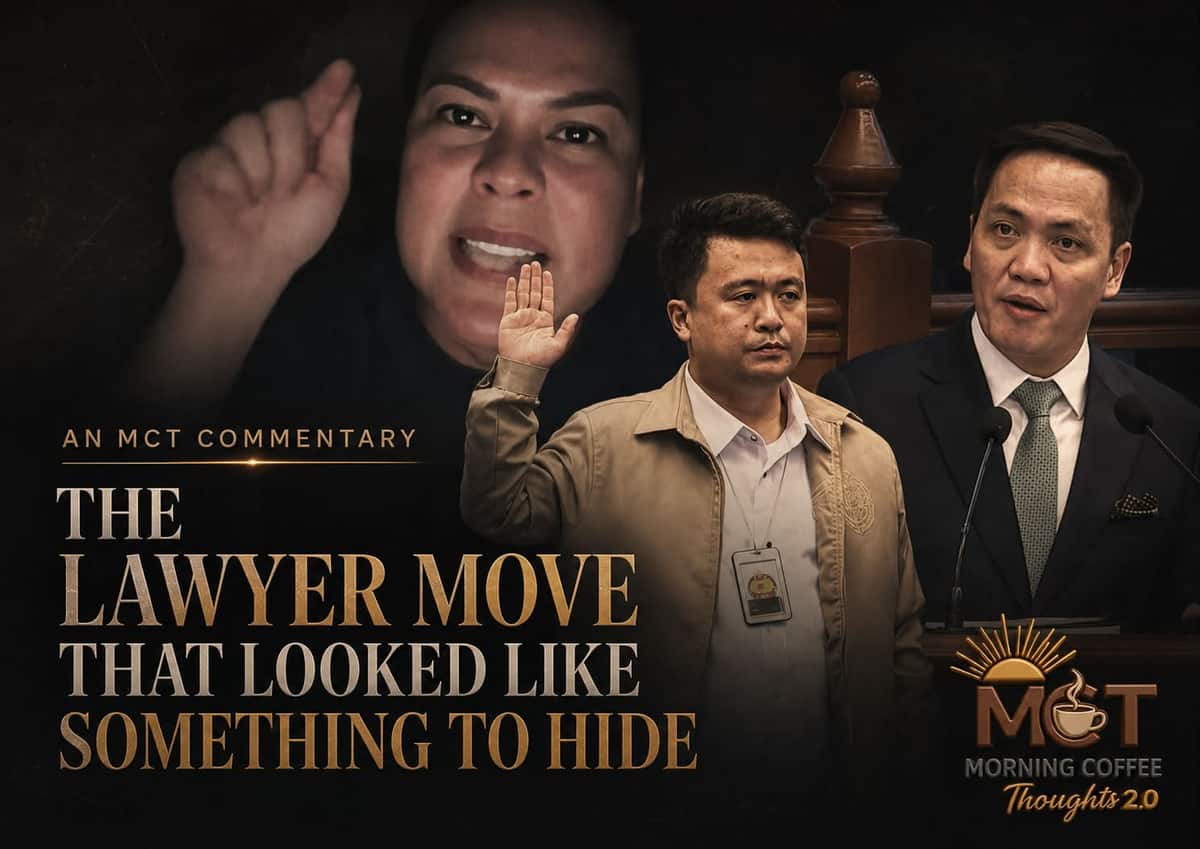
In November 2024, Harry Roque livestreamed a press conference on his Facebook page.
Buried inside that recording is a moment that changed everything Sara Duterte thought she could control about her public image. Vice President Sara Duterte, during that virtual press briefing, said:
"Huwag kang mag-alala sa security ko kasi may kinausap na ako na tao. Sabi ko sa kanya, kapag pinatay ako, patayin mo si BBM, si Liza Araneta, at si Martin Romualdez. No joke. No joke. Nagbilin na ako, Ma'am. 'Pag mamatay ako, sabi ko, huwag ka tumigil ha, hanggang hindi mo mapatay sila. And then he said yes."
That video is not a secret. That video is the internet.
And yet, during Day 2 of the impeachment trial on July 7, Sara Duterte's defense team, led by Atty. Sheila Sison, a partner at Fortun Narvasa & Salazar (FNS) law firm, threw objection after objection at the prosecution just for trying to play a two-minute, 18-second clip of it.
From the outside, watching the proceedings on live TV or social media, it looked like the defense was trying to stop everyone from watching something they had already watched a hundred times.
WHAT ACTUALLY HAPPENED IN THAT COURTROOM
The prosecution's first witness was National Bureau of Investigation (NBI) Senior Agent John Mark Calilung.
He was there to authenticate the video, specifically the portion uploaded through Harry Roque's Facebook page, and to confirm that Meta had been asked to preserve the recording.
Atty. Carlo Narvasa, one of Sara's defense lawyers, objected almost every step of the way.
He questioned Calilung's qualifications to testify on Meta's evidence preservation process.
He questioned the certification documents and affidavits.
He questioned the flash drive.
And then, when the prosecution asked to play a two-minute, 18-second clip from the full recording, Narvasa insisted the entire video had to be shown, citing Rule 132.
His argument was legal. Under Rule 132, when a part of a record is given as evidence, the remainder is also admissible. He said the defense wanted the full video played for "full context."
Presiding officer and Senator-Judge Francis "Chiz" Escudero denied the motion. He ruled it was entirely up to the prosecution to decide what part of the evidence to present, and that the defense could play the whole video when it was their turn.
The impeachment court denied several other defense motions that day too. House prosecution trial spokesperson Rep. Zia Alonto Adiong called it a Day 2 victory for their side.
WHY THE DEFENSE SAYS IT WAS FINE
After the proceedings, defense spokesperson Atty. Michael Poa explained that the objections were "natural" in any trial, especially during witness examination.
He said the defense did not care if the objections were overruled, as long as they were on record.
He framed the day as neither a win nor a loss for either side, saying it was too early to keep score.
Legally, that reasoning holds. Placing objections on record is standard procedure.
It protects the right to appeal.
It forces the court to rule on contested issues.
And there is something else worth noting: the defense filed a formal written answer before the trial even began, arguing that the charges are built on "statements taken out of context" and "interpretations unsupported by competent and admissible evidence."
Sison herself said impeachment is not just political theater but a legal, political, and constitutional mechanism.
That is exactly why the communication side of this matters. On law and procedure, the defense is fighting hard. On public communication, they are leaving Sara exposed.
So the context argument exists. They made it in writing. The question is why that argument never showed up in the room when it would have actually done some public good.
But here is where the courtroom logic and the kitchen table logic split completely.
THE PROBLEM WITH OBJECTING TO WHAT EVERYONE HAS ALREADY SEEN
Ordinary Filipinos watching the trial on television or on their phones do not think in terms of Rule 132. They think in terms of: if you have nothing to hide, why are you fighting this hard to stop the video from playing?
Public interest lawyer and good governance advocate Dino de Leon said it outright after the session: the defense team's repeated objections to the video could create a negative public impression, the kind of optics that suggests "parang may tinatago" (like something is being hidden).
That phrase, "parang may tinatago," is almost universally understood by Filipino voters. It does not require a law degree. It does not need a three-paragraph explanation.
You feel it in your gut when you see a politician's lawyers fighting to delay what everyone knows is already out there.
The video was originally broadcast on a public Facebook live stream. It was watched, shared, screenshot, clipped, and posted across every social media platform.
During Day 2, the defense raised no formal objection to the authenticity of the video itself. What they objected to was the way the prosecution was presenting it: the length of the clip, the qualifications of the witness, the format of the documents.
Legally, those objections may have had some basis. Publicly, they looked like stalling. Legal analysts watching the proceedings were already saying before the trial started that the defense appeared to be leaning heavily on technicalities to slow the process down.
THE OPTICS PROBLEM IS DEEPER THAN ONE OBJECTION
The optics issue did not start on Day 2. It started on Day 1.
Lead counsel Sheila Sison was called out twice by Presiding Officer Escudero for rule violations on the first day of the trial.
She was reprimanded for propounding questions at the prosecution instead of addressing the presiding officer.
Prosecutor Chel Diokno noted it was already the second time she had done that.
Then came the walkout incident.
During the session, private prosecutors said Sison "gave a statement addressed to this representation and she walked out."
Sison's team later insisted she had only left for a bathroom break.
Whether it was a walkout or a comfort room (CR) break depends on who you believe.
But that is exactly the problem.
The defense has now created a situation where even bathroom trips are being reported as dramatic exits. Every small thing is being read through the lens of a team that looks like it is scrambling.
THE QUESTION THE DEFENSE SHOULD HAVE ANSWERED IN THAT ROOM
Senator-Judge Risa Hontiveros stopped the proceedings to ask the prosecution directly: "Why are these acts impeachable?" She was pointing at something the defense itself had argued in writing: that the video shows statements, not proof of an actual assassination contract, and that making a statement, however alarming, is not automatically an impeachable offense.
Then Senator-Judge Pia Cayetano moved to have the prosecution's response to that question expunged from the record.
If you're being generous, it looked like a reflex. If you're not being generous, it looked like she was more interested in countering Hontiveros than in reading what
Hontiveros was actually asking.
Because what Hontiveros was asking was not a favor to the prosecution.
She later clarified she was interrogating the prosecution's framing, not signaling sympathy for the Vice President.
She subsequently said she would block any premature move to dismiss the trial outright.
But the question itself sat in the air for a moment. And the defense said nothing useful with it. Sayang.
Why?
The defense has been running a procedural strategy from day one.
They filed motions to junk the case before the trial started.
Their written answer was a technical assault on admissibility and process.
The objections on Day 2 were consistent with that same posture.
There is a logic to it: if you can keep the evidence out, you never have to explain it.
The problem is that logic only works if your audience is the court. In an impeachment trial, it is not.
The senator-judges deciding Sara's fate are elected officials. They read the front pages. They watch the same clips on social media that everyone else watches.
A defense that looks like it is hiding something makes it harder for even sympathetic senators to justify a not-guilty vote publicly.
You cannot ask a senator to stake their political reputation on a defendant whose lawyers spent an entire day fighting to keep a video that everyone has already seen from being played in court.
The deeper issue is this: the moment you start publicly arguing "those words don't mean what they sound like," you've made the quote the center of the conversation again.
The defense may have calculated it was safer to fight procedure than to fight meaning. But fighting procedure in a room full of cameras, with the public watching every overruled objection, made the quote the center of the conversation anyway.
They just lost control of how it was being read.
Hontiveros asked the right question.
The defense had the answer on paper. They chose not to use it.
The objections kept coming. House prosecutor Terry Ridon called them "repetitive."
And the public watching at home kept getting the same signal: the defense does not want you to see this.
THE ACKNOWLEDGMENT THAT NEVER CAME
The defense had a written position that the video's words were taken out of context. They said so clearly in their formal answer. They chose not to say it out loud in court on Day 2, at least not in a way the public could hold onto.
That choice has a cost. The senators are not just judges. They face voters. The 32 million people Sison invoked in her opening statement, the same voters she said "never forget," were watching.
Fighting the clip's length told them nothing about why they should read Sara's words differently. Saying "the full video shows the full context" and then having your motion denied means the public goes home with the two-minute version anyway.
The defense lost the room, the ruling, and the narrative in one afternoon.
Communication-wise, that is where the damage to Sara becomes hardest to ignore.
The better play, from where most people sit, would have been to stop fighting the video and start fighting what the video means.
That argument is still available.
The trial has barely started. But the defense is going to have to work harder to recover the ground it lost when it spent an entire day objecting to something that lives permanently on the internet.