
This should have gone up yesterday, but my migraine had other plans. I tried looking at the numbers anyway, hoping my brain would eventually cooperate, but after a while I gave up and went back to bed.
Maybe the delay helped. When I opened the OCTA Research report again this morning, I spent more time looking at the regional and income-class tables instead of the national ratings everyone had already reported.
Regular readers probably know this habit of mine by now. I rarely stop at the headline number because the more interesting story is often buried underneath it.
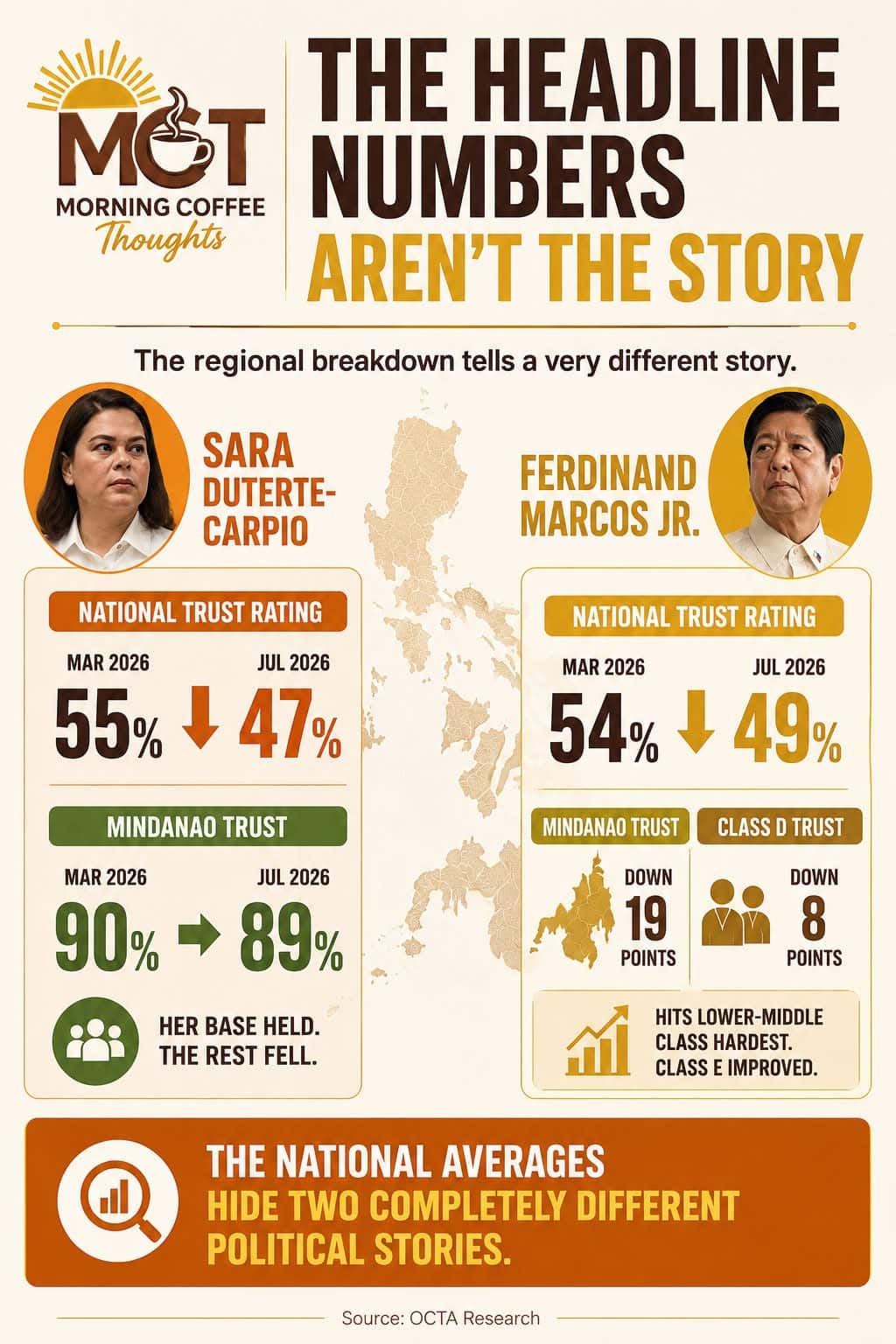
The headline was simple. President Ferdinand Marcos Jr. and Vice President Sara Duterte-Carpio both fell below majority trust and performance ratings in OCTA’s latest survey.
Marcos’ trust rating went from 54% in March to 49% in July. Satisfaction with his performance fell from 55% to 47%.
Duterte-Carpio’s trust rating dropped from 55% to 47%. Her performance rating fell from 50% to 45%, the lowest OCTA has recorded for her in the survey series available in the report.
Those numbers matter, of course. But once I looked at how the ratings moved across regions and income classes, it became clear that Marcos and Duterte-Carpio did not arrive below 50% in the same way.
SARA DUTERTE’S NATIONAL MAJORITY WAS NEVER EVENLY SPREAD
Sara Duterte-Carpio lost 8 points in national trust, from 55% to 47%. Read only that number and it looks like support for her fell everywhere at roughly the same time.
That is not what happened.
Her trust rating in Mindanao barely moved, from 90% in March to 89% in July. Her performance rating there actually rose from 83% to 90%.
Nine out of ten respondents in Mindanao still trusted her. Nine out of ten also said they were satisfied with her performance.
The damage came mostly from somewhere else.
Her trust rating in Metro Manila fell from 40% to 28%. Balance Luzon dropped from 40% to 27%. The Visayas went from 62% to 58%, a smaller decline that still left her with majority trust there.
Her performance numbers in Metro Manila were even worse. Satisfaction fell from 37% to 22%, while dissatisfaction rose from 40% to 61%.
That made me look at her old national majority differently.
In March, Duterte-Carpio had 90% trust in Mindanao, but only 40% in Metro Manila and 40% in Balance Luzon. The Visayas gave her 62%.
Put all those regions together and she ended up with a national trust rating of 55%. The national number looked healthy, but it was being pulled upward by extraordinary support from Mindanao.
Once Metro Manila and Balance Luzon fell even further, that national majority disappeared.
This does not mean her decline was fake. It means the national number was hiding how uneven her support had already become.
Mindanao remained firmly behind her. Metro Manila and Balance Luzon were not.
That difference tells us more than the phrase “record low” ever could.
THE DROP ALSO CROSSED EVERY INCOME CLASS
Duterte-Carpio’s trust rating fell by almost the same amount across all income groups.
Class ABC dropped from 55% to 46%. Class D went from 54% to 45%. Class E fell from 65% to 56%.
Each group lost around 9 points.
That caught my attention because rising prices and government assistance do not affect every income class in exactly the same way. Wealthier households, working-class families, and the poorest Filipinos do not carry the same financial burden or receive the same kind of help.
Yet the drop was almost identical.
The most obvious thing happening during the survey was the opening of Duterte-Carpio’s impeachment trial. OCTA conducted its fieldwork from July 4 to July 11, and the trial formally opened on July 6.
The proceedings were all over the news. Senator Rodante Marcoleta, one of Duterte-Carpio’s political allies, was also arrested that day.
Did the impeachment trial cause the drop? I cannot say that because OCTA did not ask respondents why their opinion changed.
Still, the timing makes it difficult not to wonder.
Her trust rating fell across every income class, but Mindanao stayed almost completely loyal. The way I see it, that looks less like a reaction limited to one economic group and more like a national political event that moved people who were not already firmly inside her base.
That is still an interpretation, not something the survey proved. But it is a reasonable question raised by the pattern.
MARCOS’ NUMBERS MOVED IN A MUCH MESSIER WAY
Marcos also fell below majority trust, but his decline looked different.
His national trust rating went from 54% to 49%. Satisfaction with his performance fell from 55% to 47%.
His biggest regional losses came from Mindanao and the Visayas.
Trust in Mindanao fell by 19 points, from 45% to 26%. Satisfaction with his performance dropped even further, from 51% to 26%.
In the Visayas, both trust and performance fell by 11 points. Metro Manila also moved downward, though the losses were smaller.
Balance Luzon went the other way. Trust rose from 59% to 63%, while satisfaction increased from 57% to 60%.
So Marcos did not lose support everywhere. He suffered badly in Mindanao and the Visayas while improving in Balance Luzon.
The income-class tables made the picture even stranger.
Class D gave him the biggest losses. Trust fell from 55% to 47%, while satisfaction dropped from 56% to 45%.
Class ABC barely moved in trust, falling only 1 point. Class E became more positive, with trust rising from 49% to 55% and satisfaction going from 48% to 52%.
That is an odd split.
The poorest group became more positive toward Marcos while Class D moved sharply against him.
Class D includes many families who are not officially among the poorest but are still one emergency, price increase, or lost paycheck away from serious trouble. They may earn too much to qualify for some forms of assistance, but not enough to feel financially secure.
During OCTA’s fieldwork, fuel prices were rising. Electricity rates had gone up, and the latest inflation report had just been released.
My first thought was that government aid may have softened the pressure for some Class E households while many Class D families carried the same higher costs without getting the same help.
But that is only one possible explanation.
OCTA did not ask respondents whether they received government assistance. It also did not ask whether fuel, electricity, food prices, or household expenses changed their view of the President.
So I cannot say that aid explains why Class E improved while Class D fell.
What I can say is that the difference is there, and it deserves more attention. Marcos lost the most ground not among the poorest respondents, but among the large group sitting just above them.
You do not need to be classified as poor to feel that your income is no longer enough.
MINDANAO IS THE BIG QUESTION FOR MARCOS
Marcos’ collapse in Mindanao is too large to ignore.
His trust rating fell from 45% to 26%. Satisfaction with his performance dropped from 51% to 26%.
The easiest explanation would be the worsening political war between the Marcos and Duterte camps. Mindanao remained overwhelmingly loyal to Sara Duterte-Carpio while Marcos’ ratings there collapsed.
That reading makes sense. It is also not something OCTA directly tested.
Respondents were not asked whether the impeachment trial, the conflict between the two families, economic problems, disaster response, or something else changed their opinion of Marcos.
I also wondered about the flooding and landslides that affected parts of the Visayas and Mindanao near the end of the survey period. But the overlap in timing is not enough to make disaster response a serious explanation yet.
For now, all I know is that Marcos’ Mindanao numbers fell hard while Duterte-Carpio’s stayed almost untouched.
That may be a sign that the political breakup between their camps is now showing up more clearly in public opinion. It may also be part of a wider regional dissatisfaction with the administration.
We need another survey round before pretending we already know the answer.
THREE POLLSTERS, THREE DIFFERENT NUMBERS
The OCTA result becomes more interesting when compared with Pulse Asia and Social Weather Stations.
Pulse Asia placed Duterte-Carpio’s trust rating at 58% and her approval rating at 56%. It described both ratings as largely unchanged from March.
A Social Weather Stations survey commissioned by Stratbase Group placed her “much trust” rating at 57%, also unchanged from March.
OCTA had her at 47%.
That is a gap of around 10 points. OCTA found that she had fallen below majority trust, while Pulse Asia and Social Weather Stations still placed her comfortably above it.
That does not mean one pollster must be lying or doing something wrong.
They use different questions, rating choices, fieldwork dates, sampling methods, and ways of counting responses. A trust rating from OCTA is not automatically the same thing as an approval rating from Pulse Asia or the “much trust” category used by Social Weather Stations.
But the gap is still too large to brush aside.
All three surveys were trying to tell us how Filipinos viewed the same Vice President during roughly the same period. Two found that her majority support remained stable. One found an 8-point drop to her lowest rating in its own series.
What does that tell us?
For me, it means Duterte-Carpio’s standing during that period cannot be reduced to a single percentage. The number changed considerably depending on which survey we looked at, how the question was asked, and when the interviews happened.
It also means the phrase “record low” needs context.
OCTA’s 47% was a record low for Duterte-Carpio in OCTA’s own survey series. It does not mean every major pollster saw the same collapse.
That difference deserved more attention than it got.
THE POLLSTERS AGREED MORE ABOUT MARCOS
Marcos also received very different ratings from OCTA, Pulse Asia, and Social Weather Stations.
OCTA placed his trust rating at 49%. Pulse Asia recorded 28% trust and 51% distrust, while Social Weather Stations placed his “much trust” rating at 34%.
The percentages cannot be lined up as though all three pollsters asked the same question in the same way. But the general direction is much easier to see.
All three showed Marcos struggling.
For Duterte-Carpio, the disagreement was about whether she had already fallen below majority support. For Marcos, the disagreement was mostly about how bad the situation had become.
That is an important difference.
WHAT THE NUMBERS SEEM TO BE SAYING
Sara Duterte-Carpio’s numbers are easier to read.
Mindanao remains her fortress. Trust there barely changed, performance satisfaction rose, and the large national drop came mainly from Metro Manila and Balance Luzon.
Her earlier national majority was real, but it was never spread evenly across the country. It depended heavily on Mindanao giving her numbers that no other region came close to matching.
Once support in Metro Manila and Balance Luzon fell further, even Mindanao’s overwhelming loyalty was no longer enough to keep her national trust rating above 50% in OCTA.
Marcos’ problem is harder to explain.
Mindanao and the Visayas moved sharply against him. Balance Luzon improved. Class D fell, while Class E went up.
There may be several things happening at once. Economic pressure may be hurting Class D. Government assistance may have helped some Class E households. The political war with the Dutertes may be damaging Marcos in Mindanao.
All of those explanations are possible. None of them can be proven using this survey alone.
And that may be the most useful thing I found after spending too much time staring at the tables.
Duterte-Carpio’s weakness is becoming easier to locate. She still has overwhelming support in Mindanao, but that support is carrying weaker numbers from Metro Manila and Balance Luzon.
Marcos’ weakness is harder to pin down because different regions and income classes moved in different directions.
One survey gave us a fairly clear picture of where Duterte-Carpio’s national rating was coming from.
For Marcos, it gave us more questions.
The next OCTA survey should tell us whether Duterte-Carpio’s fall below majority trust was the beginning of a lasting decline or whether this particular result was strongly affected by timing and survey design.
For Marcos, I will be watching Mindanao, the Visayas, and Class D. Those were the places where some of his biggest losses appeared.
The headline told us that both leaders fell below 50%.
The tables told us they did not get there the same way.
SOURCES
- OCTA Research, https://www.octaresearch.com/
- Pulse Asia Research, July 2026 Ulat ng Bayan Survey, https://pulseasia.ph/wp-content/uploads/2026/07/MR1-UB2026-2-MR-on-Ratings-and-Concerns-Final.pdf
- GMA News, Marcos trust rating dropped to 34%; VP Sara stable at 57% in SWS survey, https://www.gmanetwork.com/news/topstories/nation/995387/bongbong-marcos-sara-duterte-sws-survey-trust-rating/story/
- GMA News, Pulse Asia: Marcos trust rating drops to 28%; Sara Duterte steady at 58%, https://www.gmanetwork.com/news/topstories/nation/995468/pulse-asia-marcos-trust-rating-drops-to-28-sara-duterte-steady-at-58/story/
- BusinessWorld, Marcos’ Q2 approval and trust ratings slip amid graft and economic concerns, https://bworldonline.com/the-nation/2026/07/09/762482/marcos-q2-approval-and-trust-ratings-slip-amid-graft-and-economic-concerns/