
A new OCTA Research survey just dropped and this one is harder to dismiss.
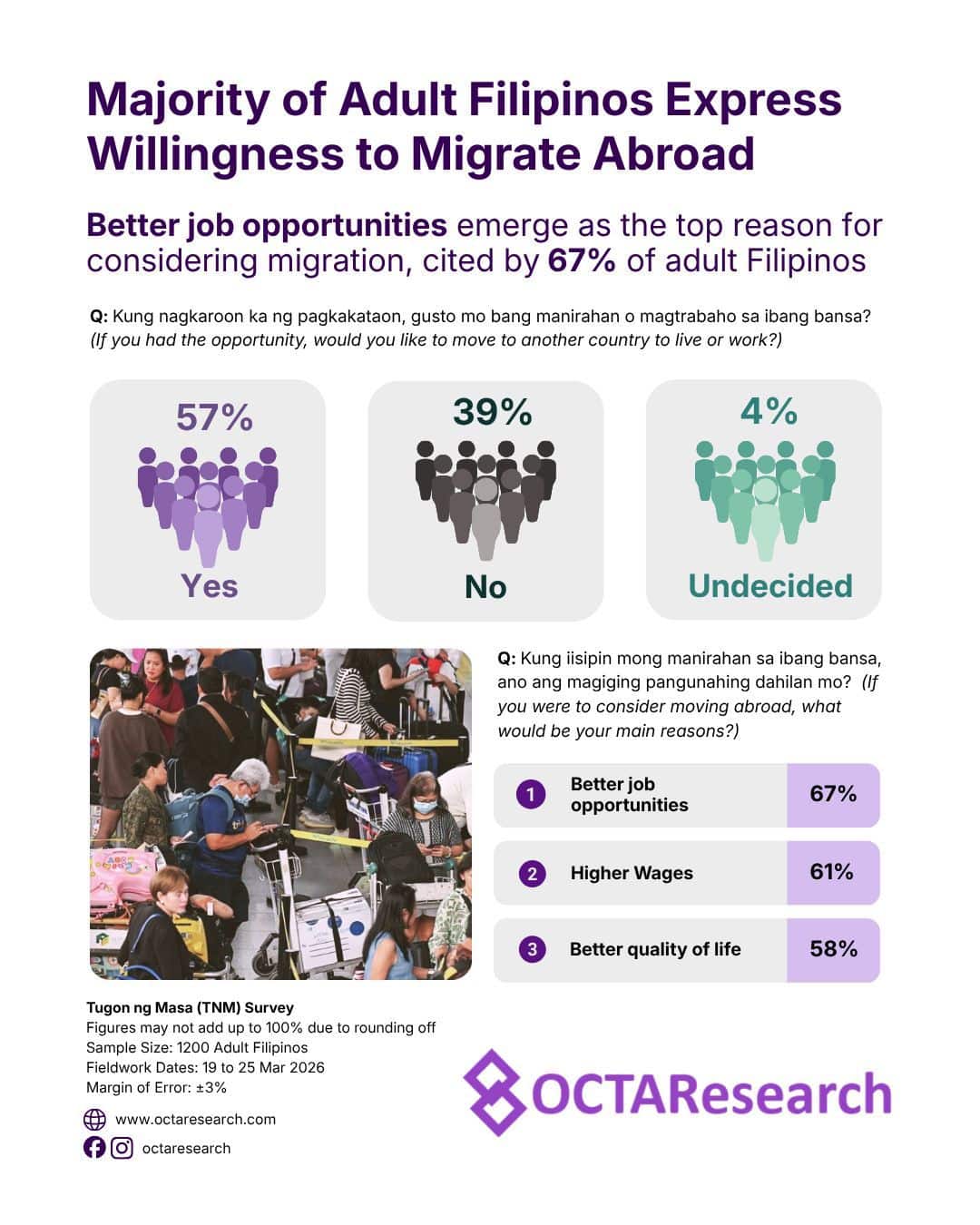
57% of adult Filipinos say they would leave if they could.
Not "thinking about it." Not "someday." Given the opportunity, more than half of us are already packed.
The Q1 2026 Tugon ng Masa survey — 1,200 respondents, nationwide, face-to-face — has numbers in it that have been hiding in plain sight for years.
FERDINAND MARCOS SR. BUILT THE PIPELINE. WE NEVER DISMANTLED IT.
The Philippines did not stumble into becoming the world's labor exporter. A decision was made. And it was made under martial law.
On May 1, 1974 — Labor Day — Ferdinand Marcos Sr. signed Presidential Decree No. 442, the Labor Code of the Philippines.
Buried inside it were two agencies that would change the country forever: the Overseas Employment Development Board and the National Seamen Board, both given a mandate to develop and promote "a systematic program for overseas employment of Filipino workers."
That is the origin point.
Government-designed. Government-promoted.
Signed into law by a dictator who needed to solve two problems at once: double-digit unemployment and a severe dollar shortfall.
The timing was not accidental.
Oil prices spiked in 1973. Gulf states — Saudi Arabia, Kuwait, the UAE — suddenly had money and construction projects but not enough workers.
The Marcos government saw the opening.
They sent recruiters. They licensed private agencies.
They built the machinery to move Filipino workers into the Middle East on a contractual, remittance-generating basis.
It was sold as a temporary fix. A stop-gap.
It became a permanent feature of the Philippine economy.
From 1975 to 1986 — the years of Marcos's full grip on power — the number of deployed workers grew from 36,035 to 266,243.
A 949-percent increase in eleven years.
Not organic migration. Engineered migration.
The Center for Migrant Advocacy traces Philippine migration in four waves.
The first goes back to 1417, when Sulu royalty traveled to China for trade diplomacy.
The second, during American colonial rule from 1906 to the 1940s, brought more than 100,000 Filipinos to Hawaii to work sugar plantations, with Filipinos classified then as US nationals.
The third wave followed World War II, when US immigration quotas slowed but did not stop the flow.
The fourth wave — the one we live in — began with Marcos and the 1974 Labor Code. This is the wave that institutionalized departure as a development strategy.
When Marcos fell in 1986 and Cory Aquino took over, she did not dismantle the system. She formalized it.
The overseas contract worker became a defined category.
OWWA was created.
The machinery of state-managed labor export was retained and expanded, rebranded with better worker protection language but the same underlying logic.
By the time Ramos came in during the 1990s, the program was already being called the Philippines' "winning edge" in global competition.
Every administration since — from Estrada to Arroyo to Aquino II to Duterte — inherited the structure, added more protective legislation around it, and sent more people out.
The Migration Policy Institute observed that what started as a response to Middle East labor demand became "a deeply rooted and pervasive culture of migration" — one where leaving is seen as common, acceptable, even desirable.
Fifty years since Marcos signed PD 442, the OCTA survey confirms that culture is alive and accelerating.
Which raises an uncomfortable question: is this still a policy choice, or has it become something the country can no longer choose its way out of?
THE NUMBERS TELL A STORY WE KEEP REFUSING TO READ
The survey asked a simple question: Kung nagkaroon ka ng pagkakataon, gusto mo bang manirahan o magtrabaho sa ibang bansa?
And the answers came in fast.
67% said they would leave for better job opportunities. 61% cited higher wages. 58% wanted a better quality of life.
Political instability and security concerns barely registered at 14%.
That detail is critical here, because it shows this is not an emotional stampede.
It is a rational decision by people comparing options and finding the Philippines uncompetitive on jobs, pay, and quality of life.
The most striking number: 81% of Filipinos aged 18 to 24 are willing to migrate.
Eight in ten of the country's youngest adults.
They are the fresh graduates, first-jobbers, the ones about to enter their peak productive years.
They are supposed to be the future of the Philippines, and they are mentally abroad.
THIS IS NOT A NEW STORY. IT IS A LONGER ONE.
The Philippines has been exporting people for a long time.
In 2024, the Philippine Statistics Authority estimated 2.19 million Overseas Filipino Workers — up from 2.16 million in 2023.
The Department of Migrant Workers projects the number will continue climbing into 2025 and 2026.
We turned labor export into policy, then into habit, then into something close to national identity.
But the profile of who is leaving has changed, and that change is where the damage to our labor and intellectual capital becomes clear.
Earlier phases of migration revolved around domestic helpers, seafarers, factory workers, and service staff.
They are still there, and still make up a significant share of deployed workers — around 43.6% of OFWs in 2022 were in elementary occupations, according to PSA data.
Beside that, another stream has strengthened: professionals.
The Philippines is now the world's top exporter of nurses, with roughly 240,000 to 277,000 Filipino nurses working in OECD and other high-income countries.
The Department of Health has warned of a local shortage of roughly 160,000 nurses, even as migration pipelines to the UK, Germany, the Middle East, and other destinations remain wide open.
From 2015 to 2022, more nurses left the country than were newly licensed, based on combined DOH and PRC data.
We are producing nurses faster than we can keep them.
The same pattern is appearing among engineers, IT workers, and teachers.
New Zealand, Canada, and Australia have created special visa channels specifically targeting Filipino professionals.
Back in 2000, analysts already counted over a million highly skilled Filipino emigrants in OECD countries, one of the largest skilled diasporas in the world.
That was the early warning. What OCTA is picking up now is acceleration.
WHO IS LEAVING NOW TELLS YOU EVERYTHING
The OCTA survey shows migration aspiration cutting across class.
Willingness to migrate sits at 57% among Classes D and E and 56% among Class ABC.
When rich and poor alike want to go, you are not just dealing with poverty. You are dealing with a system that fails people across the board.
Education pulls the pattern into focus.
Among Filipinos with college or postgraduate education, 73% say they are willing to migrate. Among those with no formal schooling or only elementary education, willingness drops to 44%.
The more educated you are, the more likely you are to plan your life somewhere else.
Earlier research already showed that more than 40% of OFWs hold college degrees, meaning a large portion of deployed workers are not just labor but skilled, trained professionals.
The OCTA numbers suggest that pipeline is about to grow.
Regionally, willingness to migrate hits 59% in Balance Luzon, 56% in Mindanao, 55% in the Visayas, and 53% in NCR.
The Cordillera Administrative Region tops regional willingness at 85%, with Western Visayas and Davao Region also high at 74% and 69% respectively.
Another detail worth naming, especially for those of us in Central Luzon: safety and political stability as a migration reason registers 21% in Region III and 34% in Region I — both well above the national 14%.
In parts of Luzon, governance and security concerns are quietly adding weight to the decision to leave.
So when you zoom out, the profile looks like this: cross-class, cross-region, especially strong among the young and educated.
A country whose future talent is already halfway out the door.
THE REMITTANCE ARGUMENT IS REAL — AND ALSO A TRAP
The common counter-argument goes like this: without OFWs, the Philippine economy collapses.
There is truth there.
Overseas Filipino remittances hit around 38.34 billion US dollars in 2024, equivalent to 8.7% of GDP.
BSP data places personal remittances at about 7.3% of GDP in 2025.
Those are large numbers and among the highest remittance-to-GDP ratios in ASEAN.
Remittances help millions of families eat better, send kids to school, and pay for healthcare.
They helped build foreign exchange reserves and cushioned the economy through crises, from the Asian financial crash to the pandemic.
But there is a catch.
Most studies show remittances go to consumption, housing, and education — not to long-term productive investments that transform the domestic job market. They raise living standards but do not fundamentally change the structure of the economy that pushed workers out in the first place.
An ISEAS (Institute of Southeast Asian Studies) analysis in early 2026 argued it is time to rethink how heavily the country leans on OFW money.
Growth in remittances has slowed, and their share of GDP has been declining from a peak of 12.8% in 2005.
The benefits are real, but they come with dependency.
And that dependency is built on the permanent absence of people we needed here.
We are maintaining the system, not fixing it.
THE LABOR MARKET IS THE ACTUAL PROBLEM
Look at the latest PSA labor force numbers.
In April 2026, the number of underemployed Filipinos rose to 7.4 million — up from 7.1 million a year earlier.
These are workers who have jobs but want more hours, better pay, or a different job entirely.
Unemployment also climbed to 4.7% in April 2026, translating to about 2.41 million unemployed persons, higher than the 4.1% recorded in April 2025.
The biggest jumps came from workers aged 15 to 24 and 25 to 34, meaning young workers are taking the hardest hit.
Set those numbers beside OCTA's 81% migration willingness among 18 to 24 year olds and 75% among 25 to 34 year olds.
You have a generation that struggles to find decent work or decent pay at home, watches nurses and engineers being recruited aggressively abroad, and sees relatives posting better salaries and more stable lives from other countries.
From there, the decision to leave becomes less emotional and more logical.
The EDCOM II Workforce Development Plan released in January 2026 names migration as a central issue in workforce planning, warning that many healthcare workers now treat migration as the ultimate goal, not a fallback.
It frames this as a talent retention crisis, not just a deployment success.
OCTA's own analysis calls their migration survey "a referendum on domestic labor conditions," saying directly that better jobs, wages, and quality of life are the dominant drivers — and that the policy response has to be about making local work competitive.
So the heart of the problem is not "too many people leaving." It is the poverty of domestic options.
WHAT GETS LEFT BEHIND
GDP will not tell you everything that is lost.
When nurses leave in bulk, public hospitals end up understaffed and overworked, with nurse-patient ratios far worse than international standards.
Studies on Philippine nurse migration describe how local hospitals become training grounds that prepare staff for departure instead of long-term careers.
When teachers, engineers, and IT professionals go abroad, schools and firms back home lose experienced mentors and problem-solvers.
That weakens the institutions that might have helped the next generation succeed without leaving.
At the community level, OFW literature has been documenting for years the emotional and social costs: long-distance parenting, children growing up with grandparents, marriages strained by time zones and distance.
Those costs rarely enter economic debates, but they shape the kind of society we grow into.
Then there is the loss that does not fit neatly into any statistic.
Start-ups not founded. Research not pursued. Local industries that never level up because the people who might have led that growth are in Toronto, Dubai, London, or Auckland solving problems for other economies.
The GlobalEconomy brain drain index for the Philippines fell to 4.6 in 2024, its lowest since 2007, with a long-term average of 6.14.
That might look like progress on paper. But a lower score coexists with high remittance dependence and a rising OFW stock.
It might simply signal that a large share of those who wanted to leave already have.
The OCTA survey, by focusing on aspiration, reminds us the pipeline has not dried up. It is refilling at the younger end.
THE QUESTION THE SURVEY LEAVES US WITH
OCTA ends its report with a line that sticks: the question is not why Filipinos leave, but whether the Philippines gives them a compelling reason to stay.
That question has been on the table since 1974.
Every administration has praised OFWs as "modern heroes."
Some promised to create jobs so Filipinos "won't need to leave." A few policies nudged wages up or expanded protections.
But the basic pattern has not changed: we keep educating people for export and then patch the budget with the money they send back.
Meanwhile, the 2026 survey shows:
- 57% of adult Filipinos are open to living or working abroad if given the chance - 67% are driven by better job opportunities, 61% by higher wages, 58% by a better quality of life - 81% of 18 to 24 year olds and 73% of college-educated Filipinos are prepared to go
Those numbers are not just about migration. They are a verdict on the quality of work, pay, and long-term prospects available here.
Until wage floors rise meaningfully, until contractualization is curbed, until career paths exist beyond "mag-abroad na lang," people will keep choosing the rational option. They will keep saying goodbye.
So maybe the real question after this OCTA survey is brutally simple:
If the country wants its people to stay, what exactly is it offering in return?
Bakit nga ba sila mananatili?
SOURCES
- OCTA Research, Tugon ng Masa Q1 2026 Migration Survey (Public Perceptions on Migration), https://www.octaresearch.com
- Philstar Life, “57% of Filipinos open to working or living abroad: OCTA,”, https://philstarlife.com/news-and-views/350514-57-of-filipinos-open-to-working-living-abroad-octa
- Instagram (OCTA Research card), “Nasa 57% ng mga adult Filipinos ang handang magtrabaho o manirahan sa ibang bansa,”, https://www.instagram.com/p/DZlk6KblIiY/
- Philippine Statistics Authority, Survey on Overseas Filipinos; Labor Force Survey releases, https://psa.gov.ph/statistics/survey/labor-and-employment/survey-overseas-filipinos
- Statista, “Overseas workers from the Philippines – statistics & facts,”, https://www.statista.com/topics/8943/labor-migrants-from-the-philippines/
- World Bank Data, “Personal remittances, received (% of GDP) – Philippines,”, https://data.worldbank.org/indicator/BX.TRF.PWKR.DT.GD.ZS?locations=PH
- Fulcrum / ISEAS–Yusof Ishak Institute, “Overseas Filipino Remittances and the Philippine Economy: Time for a Rethink,”, https://fulcrum.sg/overseas-filipino-remittances-and-the-philippine-economy-time-for-a-rethink/
- Bangko Sentral / PNA, “Cash remittances up 3.6% in November 2025,”, https://www.pna.gov.ph/articles/1267099
- TheGlobalEconomy.com, “Philippines: Human flight and brain drain index,”, https://www.theglobaleconomy.com/Philippines/human_flight_brain_drain_index/
- Migration Policy Institute, “Labor Export as Government Policy: The Case of the Philippines,”, https://www.migrationpolicy.org/article/labor-export-government-policy-case-philippines
- Center for Migrant Advocacy, “History of Philippine Migration,”, https://centerformigrantadvocacy.com/philippine-migration/history-of-philippine-migration/
- Presidential Decree No. 442, Labor Code of the Philippines, Supreme Court E-Library, https://elibrary.judiciary.gov.ph/thebookshelf/showdocs/26/25306
- PNA, “50th anniversary of PH overseas employment,”, https://www.pna.gov.ph/opinion/pieces/871-50th-anniversary-of-ph-overseas-employment
- Philstar Newslab, “Manpower and one man’s power” (31 Years of Amnesia series on OFWs), https://newslab.philstar.com/31-years-of-amnesia/ofws
- UP CIDS, “The Philippine Overseas Employment Program: Public Policy Management from Marcos to Ramos,”, https://cids.up.edu.ph/wp-content/uploads/2022/03/The-Philippine-Overseas-Employment-Program-vol.4.no.2-July-Dec-2000-3.pdf
- Center for Migrant Advocacy, “Nurse Outmigration and Its Impact on Philippine Healthcare System,”, https://centerformigrantadvocacy.com/2023/01/09/nurse-outmigration-and-its-impact-on-philippine-healthcare-system/
- Borgen Project, “Philippines’ Nurse Migration is Fueling a Health Care Crisis,”, https://borgenproject.org/philippines-nurse-migration/
- DOH / PNA, “DOH to address shortage of nurses due to migration,”, https://www.pna.gov.ph/articles/1198519
- UP Manila, “Issues affecting Filipino nurses’ migration discussed at international conference,”, https://www.upm.edu.ph/cpt_news/issues-affecting-filipino-nurses-migration-discussed-at-internatl-conference/
- The Global Economy, “Human flight and brain drain by country, around the world,”, https://www.theglobaleconomy.com/rankings/human_flight_brain_drain_index/
- EDCOM II, “Workforce Development Plan” (2026 Final Report), https://edcom2.gov.ph/media/2026/01/EDCOM-II_Y03_Workforce-Development-Plan.pdf
- NIH / PMC, “Emergent political remittances during the pandemic,”, https://pmc.ncbi.nlm.nih.gov/articles/PMC9304969/
- VoxDev, “Brain drain vs. brain gain: Does international migration deplete poor countries of skilled workers?”, https://voxdev.org/topic/migration-urbanisation/brain-drain-vs-brain-gain-does-international-migration-deplete-poor
- PNA, “DOH to address shortage of nurses due to migration” (PBBM directive to CHED and DOH), https://www.pna.gov.ph/articles/1198519
- ISEAS – Yusof Ishak Institute, About page, https://fundit.fr/en/institutions/iseas-yusof-ishak-institute-singapore