
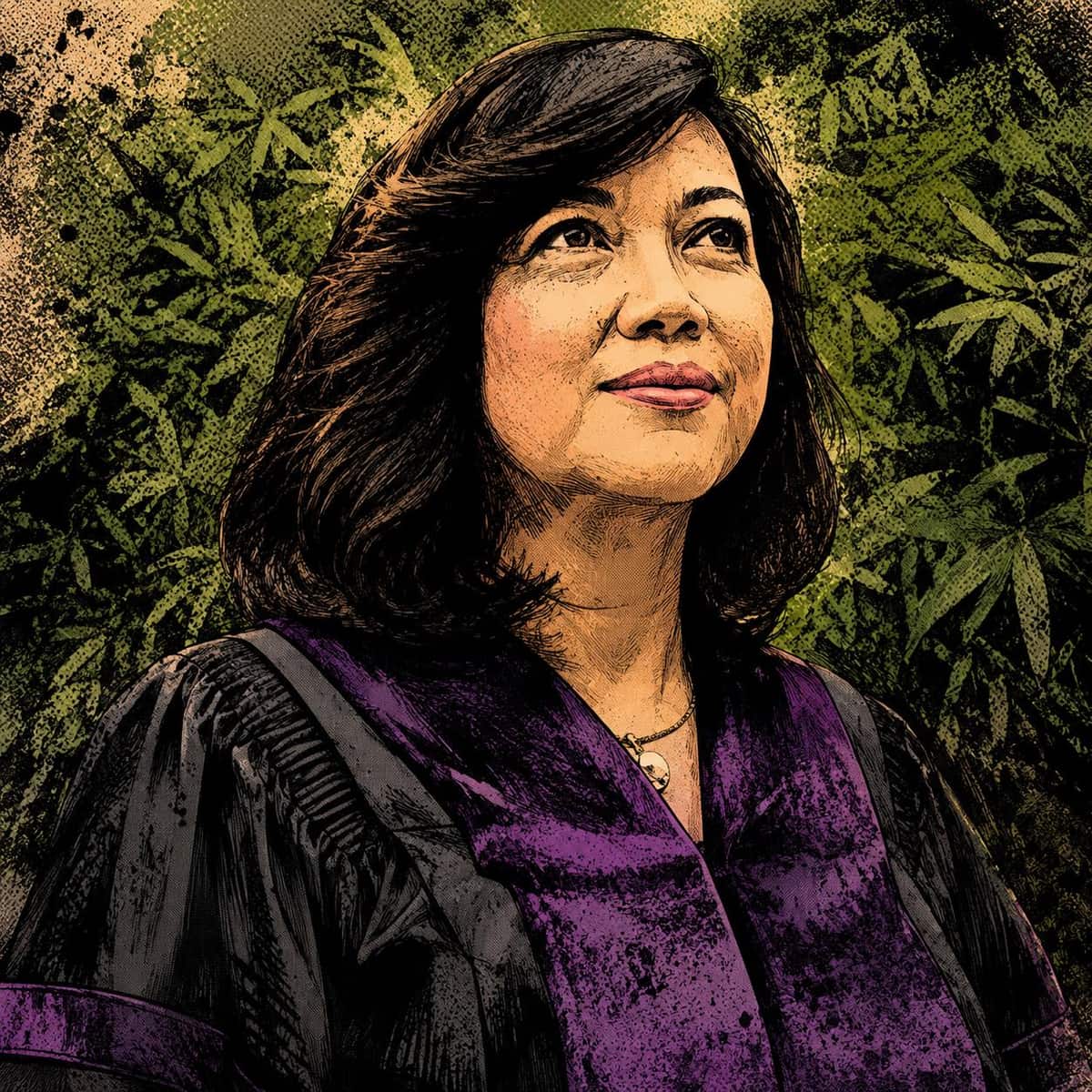
Eight years ago today, May 11, 2018, the Supreme Court of the Philippines removed its own Chief Justice.
Not through impeachment. Not through a Senate trial. Through a legal maneuver that most constitutional lawyers said was never meant for this purpose.
Maria Lourdes Sereno — the first woman to ever lead the judiciary in the Philippines, and the first woman to head any judicial branch in all of Southeast Asia — was gone by suppertime.
As she joined thousands of her supporters at a rally after the ruling, she raised her fist and said, in Filipino: ‘Panalo po tayo.’ We won.”
The Supreme Court had just declared her appointment void ab initio — as if she never existed. And she said, we won.
Eight years. I haven’t forgotten that statement.
WHO SHE WAS BEFORE THEY CAME FOR HER
She was not just a symbolic first. She was substantively different from the justices who came before her.
Appointed Associate Justice by President Noynoy Aquino in 2010, she was already the youngest ever at that rank under the 1987 Constitution.
When she was named Chief Justice in August 2012 — at 52 — she became the second youngest to ever hold that post.
She was poised to serve until 2030. Eighteen years as Chief Justice. That would have made her second only to Cayetano Arellano in length of service.
She didn't coast on the appointment. Under her leadership, the judiciary modernized in ways it hadn't for decades.
She co-founded the first annotated electronic legal research system in the Philippines.
She pushed eCourts, automated case tracking, continuous trial systems, expanded small claims courts.
The stuff that sounds boring until you realize it directly affects millions of ordinary Filipinos waiting years for case resolution.
She was, in the truest sense, a technocrat with a conscience.
And that made her dangerous to a president who needed the courts to stay quiet.
WHEN DUTERTE STARTED PAYING ATTENTION
The hostility didn't begin with the SALN issue. It started with the drug war.
When Duterte began releasing names of judges and government officials he alleged were involved in illegal drugs — without warrants, without due process, without evidence presented in court — Sereno pushed back.
She wrote him a letter in August 2016 telling judges named on the list not to surrender to police unless actual arrest warrants had been issued.
That was enough.
Duterte, speaking in front of soldiers in Cagayan de Oro, warned her: "I am giving you a warning. Do not create a crisis because I will order everybody in the executive department not to honor you."
She did not back down.
She kept questioning the rule of law. She kept calling for due process. She voted against martial law in Mindanao.
She voted against burying Ferdinand Marcos at the Libingan ng mga Bayani.
She was one of the only constitutional officers in the country's highest court consistently raising her hand to say: wait, this isn't right.
By April 9, 2018, Duterte had run out of patience.
At a press conference before flying to China, he told reporters: "I'm putting you on notice that I am now your enemy. And you have to be out of the Supreme Court."
He said she was "bad for the Philippines."
He then told Solicitor General Jose Calida to "do his best" on the quo warranto petition, and called on House Speaker Pantaleon Alvarez to fast-track her impeachment.
The President of the Republic publicly declared war on the Chief Justice of the Supreme Court.
The International Commission of Jurists condemned it immediately, calling it "direct intimidation of the Chief Justice" and an assault on judicial independence.
That condemnation meant nothing in Manila.
THE MAN DUTERTE SENT
Before you understand what happened to Sereno, you need to understand who Jose Calida is.
Calida and Duterte go back to the late 1970s in Davao.
They met when Duterte was a special counsel in the City Fiscal's Office and Calida was a young lawyer handling a murder case.
Four decades of friendship, shared legal battles, and shared politics.
Calida was one of the leaders of the Alyansang Duterte-Bongbong, the coalition that campaigned for Duterte as president and Marcos as vice president in 2016.
He pushed hard for the burial of Ferdinand Marcos at the Libingan ng mga Bayani.
Duterte himself once described Calida as "passionately pro-Marcos."
When Duterte won, he appointed Calida the 48th Solicitor General.
The Solicitor General is supposed to be the lawyer of the Republic. In Calida's hands, the office became something else.
He recommended the ABS-CBN franchise not be renewed.
He filed the quo warranto that took down Sereno.
He defended the Marcos burial.
He quietly filed a manifestation recommending the acquittal of alleged pork barrel scam mastermind Janet Lim-Napoles.
After Duterte left office, Ferdinand Marcos Jr. appointed Calida head of the Commission on Audit — the very body supposed to check government spending.
When Calida filed his quo warranto against Sereno, he said the ouster "augurs well for the country."
That sentence tells you everything.
THE TWO-FRONT ATTACK
This was not a legal proceeding that emerged organically. It was a coordinated political operation that used legal language as cover.
The first front was impeachment.
On August 30, 2017 — five years after Sereno's appointment as Chief Justice — lawyer Larry Gadon filed an impeachment complaint against her in the House of Representatives.
The core accusation: she failed to fully declare her Statement of Assets, Liabilities and Net Worth (SALN) during her 17 years as a law professor at UP College of Law.
Gadon was not a neutral actor. He was a former lawyer connected to political operators aligned with the administration.
By October 2017, the House justice committee voted 25-2 to find sufficient grounds to proceed.
By March 8, 2018, that same committee voted 38-2 to find probable cause to impeach her.
The House, under the Duterte administration's overwhelming majority, was moving.
But impeachment takes time. It goes to the Senate. The Senate is unpredictable. There's a trial. There's a vote. There's risk.
So they opened a second front.
On March 5, 2018 — while impeachment was still in process — Calida filed a quo warranto petition directly with the Supreme Court.
The argument: Sereno's appointment was void from the beginning because her incomplete SALNs meant she never had the "proven integrity" required under the Constitution.
Calida invoked the legal principle of nullum tempus occurrit regi — "time does not run against the king" — to get around the one-year limitation on quo warranto petitions.
The Supreme Court was being asked to remove its own Chief Justice.
Free Access to Legal Justice (FLAG), a legal advocacy group, said it clearly:
“Quo warranto was never intended to be a substitute for impeachment. Yet that is exactly what the Solicitor General did when he filed the quo warranto case against Chief Justice Sereno six years after she assumed office and on exactly the same grounds as her impeachment case. In doing so, he pre-empted her impeachment trial before the Senate, usurped the power of Congress to remove an impeachable official, and denied the Chief Justice the opportunity to defend herself in a public trial."
That analysis holds. The second front bypassed the safeguards the Constitution built into impeachment precisely for moments like this.
THE VOTE, AND THE SIX WHO STOOD WITH HER
On May 11, 2018, the Supreme Court voted en banc.
Eight to six.
Eight justices declared Sereno disqualified from holding office. They were: Noel Tijam (ponente), Teresita de Castro, Lucas Bersamin, Francis Jardeleza, Samuel Martires, Diosdado Peralta, Andres Reyes Jr., and Alexander Gesmundo.
Six justices dissented: Senior Associate Justice Antonio Carpio, and Associate Justices Presbitero Velasco Jr., Marvic Leonen, Estela Perlas-Bernabe, Mariano del Castillo, and Alfredo Benjamin Caguioa.
Those six names deserve to be said clearly. They are the ones who looked at this proceeding and said, no.
Carpio wrote in his dissent that Sereno's missing SALNs could constitute grounds for impeachment — but impeachment, not quo warranto.
His argument: even if she was wrong, the process being used to remove her was also wrong.
Leonen was sharper. He called the quo warranto petition "a legal abomination."
He wrote: "Even if the Chief Justice has failed our expectations, quo warranto, as a process to oust an impeachable officer and a sitting member of the Supreme Court, is a legal abomination."
Caguioa and Bernabe both argued the majority had allowed a constitutional officer to be removed without the political and procedural safeguards the Charter explicitly created.
The technical legal effect of the ruling: Sereno was not removed as the 24th Chief Justice. Under the decision, she was never Chief Justice at all.
Ab initio. From the beginning.
The court didn't just take her title. It tried to erase her from the record entirely.
DE CASTRO AND THE REWARD
De Castro, one of the eight who voted to oust Sereno, was appointed the new Chief Justice by Duterte on August 25, 2018 — three months after the ruling.
The appointment had been signaled before the JBC even submitted its shortlist. Malacañang announced his pick through Special Assistant Bong Go minutes after it was officially declared.
Her term lasted 46 days.
She was required to retire at 70 on October 8, 2018. Duterte had just made someone the Chief Justice of the Supreme Court for six weeks. She had also been one of the five sitting justices who had testified against Sereno in the House impeachment hearings before the quo warranto was even filed.
It was a reward wrapped in judicial protocol.
The same institutional apparatus that declared Sereno never existed then handed its highest title to a woman who helped make that happen.
THE ONLINE WAR NOBODY OFFICIALLY ADMITS
There was a third front, and it was not fought in courtrooms.
The Philippines had by 2018 already earned an uncomfortable distinction.
Facebook executive Katie Harbath described the country as Patient Zero of the disinformation age.
Troll farms had operated openly since the 2016 elections, and the campaign to push martial law narratives, the Marcos burial, and the drug war all benefited from coordinated online pressure.
When Sereno became a target, it showed on social media.
The SALN issue, which had legal and procedural dimensions that even the dissenters acknowledged, was flattened into a simple, shareable story online.
She was painted as corrupt, dishonest, and unfit in a way that fit the emotional logic of propaganda.
The 2018 study Architects of Networked Disinformation documented how these operations worked, with fake account operators, influencers, and political strategists amplifying narratives in coordinated phases.
Duterte himself had admitted paying people to promote him on social media during the 2016 campaign.
The Presidential Communications Operations Office denied that such activity continued after he took office.
In 2021, twelve senators signed a resolution calling for hearings into government-funded troll farms targeting administration critics.
Nobody was ever formally prosecuted for any of it.
But the effect was real.
By the time the Supreme Court voted, public opinion had already been softened by months of coordinated narrative.
The legal proceeding came after the social media court had already issued its verdict.
WHAT THE WORLD SAW
International organizations did not hedge.
Human Rights Watch called the ouster unprecedented and nefarious and said it was a frontal assault on human rights protections and democratic rule.
Carlos Conde of HRW warned that the ruling kicked open the door for wanton removals of members of other constitutional bodies, including the Commission on Human Rights.
He was not wrong. The Commission on Human Rights, which had also been publicly attacked by Duterte and had its budget slashed to one thousand pesos in a House vote the year before, was watching.#
The International Commission of Jurists said the proceedings had contributed to an overall deterioration in the rule of law in the country.
ASEAN parliamentarians from across the region also expressed alarm, calling the decision a violation of the principle of separation of powers and a serious threat to the rule of law.
Political analyst Richard Heydarian told Al Jazeera that Sereno had been one of the few independent voices at the highest levels of government, frequently questioning Duterte's approach to the rule of law and his war on drugs.
The Akbayan party said the Philippines had become a heartbeat away from the death of its democratic principles.
WHAT THE DUTERTE ADMINISTRATION TOOK FROM ALL OF US
This was not just about one woman's career.
What happened on May 11, 2018 sent a message to every judge, every justice, every public officer who might think of standing in the way.
The Supreme Court, the body supposed to be the last check on executive power, voted on the government's request to remove its own Chief Justice.
The executive declared war. The judiciary carried it out.
Human rights scholars have since described the Sereno ouster as one of the defining moments of democratic backsliding under Duterte.
Alongside the arrest of Senator Leila de Lima on what Human Rights Watch described as politically motivated drug charges, the shutdown of ABS-CBN, and the withdrawal from the International Criminal Court, it formed part of a broader pattern.
Silence the critics. Reshape the institutions. Control the courts.
Sereno had voted against martial law. She had voted against the Marcos burial. She had called for due process in the drug war. She had written that letter protecting judges from illegal detention.
And for all of that, the administration found a way to declare she had never existed.
WHERE SHE IS NOW
She did not disappear.
After the ruling, Sereno said she had refused to compromise her independence up to the end.
She pledged to continue fighting abuses of power and intimidation.
Before the 2022 elections, she warned publicly that there was a lot riding on the outcome for the country.
She continued in legal advocacy. She serves as Chairperson of the Legal Advisory and Public Policy Review Commission of the Philippine Council of Evangelical Churches.
She is also part of the National Coalition for the Family and the Constitution.
She did not run for office. She did not vanish.
The Court of Tax Appeals eventually voided a P8.8 million BIR tax assessment against her covering 2011 to 2016.
Even that pursuit, the taxman chasing a former official, ended without result.
Larry Gadon, who filed the impeachment complaint that opened the first front of the attack, was punished years later by the same Supreme Court he once tried to use.
In 2024, the Court found he had committed perjury in verifying his complaint against Sereno and acted with malicious intent to malign and defame her.
Calida went on to become COA chair under Marcos Jr.
The justices who voted to oust her retired. Some moved quietly. Some moved upward.
The eCourt system Sereno launched is still operational.
The automated case management systems she pushed through are still in courts across the country.
The expanded small claims courts she championed are still helping ordinary Filipinos get faster access to justice.
The woman they declared was never Chief Justice built things that lasted longer than their political careers.
THE RECORD SHE ACTUALLY LEFT
She was supposed to serve until 2030.
If they hadn’t interfered, we would be in the eighth year of her term by now. Instead, we spent years watching the institution she led slowly lose the independence she tried to give it.
Today is the anniversary of the day they voted her out.
She was the Chief Justice they tried to erase.
The legal record says one thing. What she built, what she stood for, and what she said when they tried to erase her, panalo po tayo, says another.
History will decide which one matters more.
SOURCES
- Inquirer, Sereno, 52, will have second longest tenure in High Court, https://newsinfo.inquirer.net/257522/sereno-52-will-have-second-longest-tenure-in-high-court
- Inquirer, First woman Chief Justice, https://newsinfo.inquirer.net/257098/first-woman-chief-justice-2
- Maria Lourdes Sereno, Wikipedia, https://en.wikipedia.org/wiki/Maria_Lourdes_Sereno
- Philippine Commission on Women, Sereno will make hopeful years for women's access to justice, https://pcw.gov.ph/sereno-will-make-hopeful-years-for-womens-access-to-justice/
- Inquirer, Ousted but unshaken: On the contrary, ‘We won’ – Sereno, https://newsinfo.inquirer.net/989469/we-won-sereno
- MindaNews, Duterte vs Sereno: from ‘I will order not to honor’ to ‘I am your enemy’, https://mindanews.com/top-stories/2018/04/duterte-vs-sereno-will-order-not-honor-august-2016-supreme-court-april-2018/
- Inquirer, Sereno slams Duterte, urges him to step down, https://newsinfo.inquirer.net/991977/sereno-slams-duterte-urges-him-to-step-down
- International Commission of Jurists, Philippines: President Duterte’s attack on the Chief Justice is an attack on the rule of law, https://www.icj.org/philippines-president-dutertes-attack-on-the-chief-justice-is-an-attack-on-the-rule-of-law/
- MindaNews, Calida and Duterte: a four-decade friendship as lawyers, gun enthusiasts, friends of Bongbong, https://mindanews.com/top-stories/2020/05/calida-and-duterte-a-four-decade-friendship-as-lawyers-gun-enthusiasts-friends-of-bongbong/
- Jose Calida, Wikipedia, https://en.wikipedia.org/wiki/Jose_Calida
- Inquirer, Calida goes from Duterte solgen to Marcos COA chief, https://newsinfo.inquirer.net/1619268/calida-goes-from-duterte-solgen-to-marcos-coa-chief
- ABS-CBN News, Sereno ouster ‘well for the country’: SolGen, https://news.abs-cbn.com/news/05/11/18/sereno-ouster-well-for-the-country-solgen
- Supreme Court of the Philippines, A.C. No. 13842 (Gadon gross misconduct, perjury in Sereno impeachment), https://lawphil.net/judjuris/juri2024/may2024/ac_13842_2024.html
- Philstar, Disbarred lawyer Gadon guilty of gross misconduct anew over falsehoods before SC, https://www.philstar.com/headlines/2024/05/23/2357344/disbarred-lawyer-gadon-guilty-gross-misconduct-anew-over-falsehoods-sc
- Quo warranto petition against Maria Lourdes Sereno, Wikipedia, https://en.wikipedia.org/wiki/Quo_warranto_petition_against_Maria_Lourdes_Sereno
- Supreme Court of the Philippines, G.R. No. 237428 (Republic v. Sereno), Motion for Reconsideration Decision, https://lawphil.net/judjuris/juri2018/jun2018/gr_237428_2018.html
- MindaNews, ‘Legal abomination’: SC votes 8–6 to oust CJ Sereno, https://mindanews.com/top-stories/2018/05/legal-abomination-sc-votes-8-6-to-oust-cj-sereno/
- Inquirer, Duterte’s choice: De Castro Chief Justice for 41 days, https://newsinfo.inquirer.net/1024976/dutertes-choice-de-castro-chief-justice-for-41-days
- Teresita de Castro, Wikipedia, https://en.wikipedia.org/wiki/Teresita_de_Castro
- Philstar, De Castro is new chief justice, but term to last 2 months, https://www.philstar.com/headlines/2018/08/25/1845768/de-castro-new-chief-justice-term-last-2-months
- Inquirer Opinion, Troll farm pandemic, https://opinion.inquirer.net/130552/troll-farm-pandemic
- Philstar, Senate probe into fake news, trolls sought, https://www.philstar.com/headlines/2017/01/18/1663404/senate-probe-fake-news-trolls-sought
- Philstar, Government-funded ‘troll farms’? Senators want closer look, https://www.philstar.com/headlines/2021/07/12/2111990/government-funded-troll-farms-senators-want-closer-look
- Human Rights Watch, Philippine Chief Justice Ouster an Assault on Rights, Democracy, https://www.hrw.org/news/2018/05/11/philippine-chief-justice-ouster-assault-rights-democracy
- Human Rights Watch, World Report 2019: Philippines, https://www.hrw.org/world-report/2019/country-chapters/philippines
- International Commission of Jurists, Philippines: Supreme Court decision removing its Chief Justice contributes to deterioration of the rule of law, https://www.icj.org/philippines-supreme-court-decision-removing-its-chief-justice-contributes-to-deterioration-of-the-rule-of-law/
- ASEAN Parliamentarians for Human Rights, Ouster of Philippine Supreme Court Chief Justice signals threat to rule of law, https://aseanmp.org/publications/post/ouster-of-philippines-cj-sereno
- Al Jazeera, Philippine chief justice Sereno, Duterte’s critic, removed, https://www.aljazeera.com/news/2018/5/11/philippine-chief-justice-sereno-dutertes-critic-removed
- Philippine News Agency, Ex-CJ Sereno sees self not as Senator but ‘fighting for democracy’, https://www.pna.gov.ph/articles/1035082
- Australian Institute of International Affairs, The 2022 Philippine Election: A Poll Over Democracy, https://www.internationalaffairs.org.au/australianoutlook/2022-philippine-election-poll-over-democracy/
- Lowy Institute, Philippines: justice removed, justice denied, https://www.lowyinstitute.org/the-interpreter/philippines-justice-removed-justice-denied