
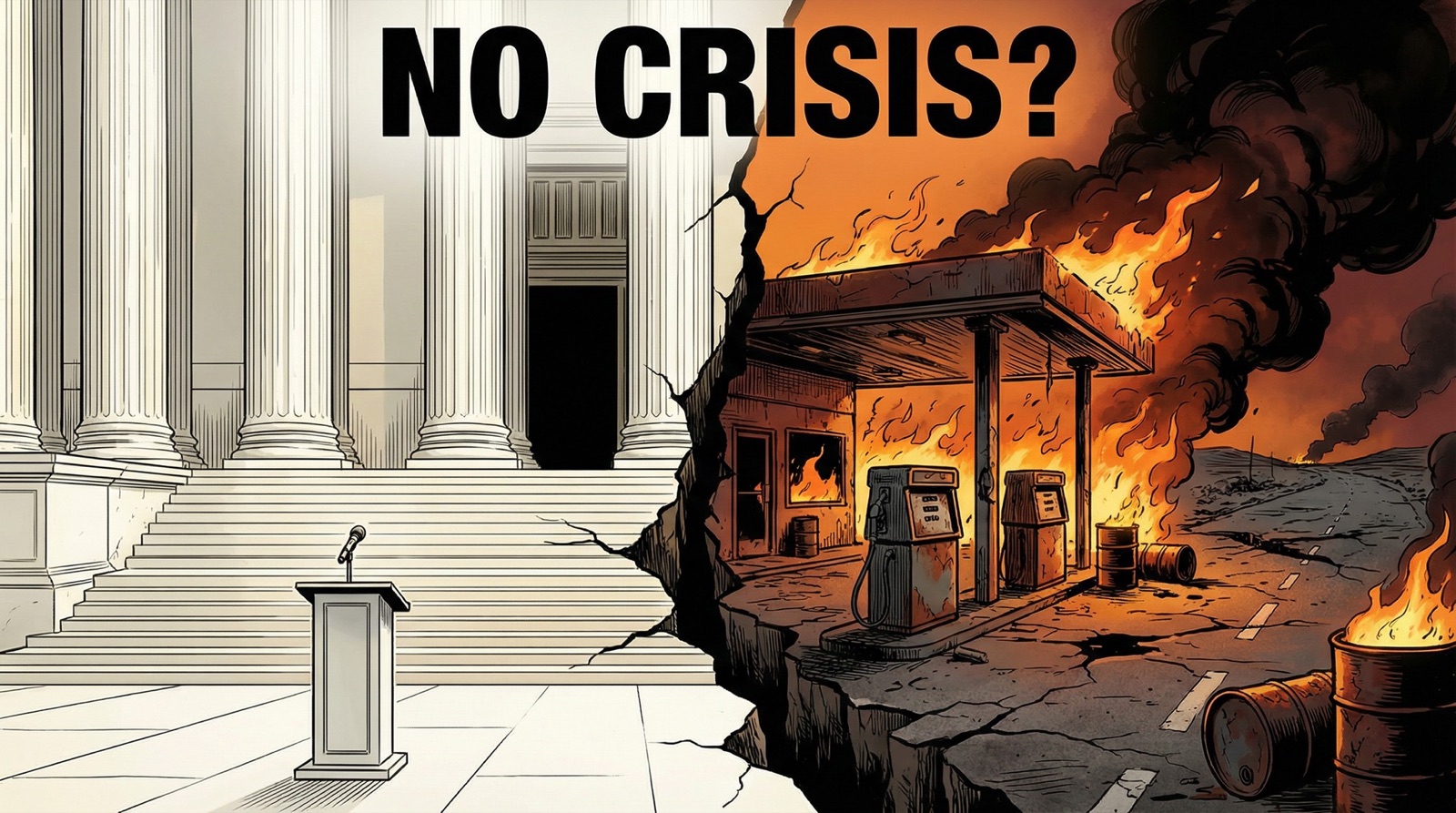
"The government needs broader powers to immediately address this crisis," Senator Bam Aquino said at a Senate hearing Monday. "Under a state of national emergency, we can implement measures to regulate the prices of essential goods and ensure adequate supply in our market."
He has been saying it since March 22. The country is in a crisis. The Palace disagrees.
WHAT THE SENATE SAID
The PROTECT committee — the Senate's newly formed ad hoc panel — held its first hearing on March 24 with a full row of Cabinet officials in attendance and a sharp message to the Marcos administration: stop pretending this is normal.
Senator Loren Legarda put it bluntly. "We are in a crisis. Until we define it as a crisis, we will not act in record time to save our people. Each agency represented here must act as if we're in a crisis because we are in a crisis." She listed what the current situation is doing to ordinary Filipinos: OFWs displaced, petroleum prices climbing, food costs rising, transport costs passed down the chain.
Senator JV Ejercito was just as direct. "We are in crisis already. Creation of the task force or crisis committee should have been done right when the conflict started."
Aquino first made the call public on March 22, saying Filipino families are already experiencing "emergency-level" hardship. He warned the government not to wait — especially since no one knows when the Iran conflict ends.
The PROTECT committee was created through Senate Resolution No. 350 before the Holy Week recess. Senator Sherwin Gatchalian chairs the panel and has set a two-week deadline for a contingency plan. Worst-case scenarios include the conflict stretching six months and crude reaching $200 per barrel.
THE PALACE'S POSITION
Palace Press Officer Claire Castro has not moved from her position. The Philippines faces a "price disruption," not an oil crisis.
Her logic: there are two types of oil crises — supply and price. Since the Department of Energy estimates roughly 50 days' worth of inventory (including shipments in transit), supply remains adequate. No supply crisis, no oil crisis. Castro repeated this on March 23 even as diesel approached P130 per liter and gasoline crossed P100 per liter.
"We are not downplaying anything — this is simply the real situation," she said. "Our supplies of crude, oil, fuel, and even food are complete."
Her framing has shifted over the weeks. In mid-March she dismissed calls from the Trade Union Congress of the Philippines for Marcos to invoke emergency powers. By March 18 she allowed a declaration was "possible" — only if widespread profiteering was observed. By March 23, the "price disruption" line had become the official Palace position, even as Marcos ordered the creation of a crisis committee in the same breath.
WHAT AN EMERGENCY DECLARATION WOULD ACTUALLY DO
Under Article XII Section 17 of the 1987 Constitution, a state of national emergency allows the government to temporarily take over or direct any privately owned business affected with public interest. Price controls and regulated supply are the core tools it unlocks.
Congress can grant broader powers under Article VI Section 23(2) — but the Supreme Court ruled in David v. Arroyo (G.R. No. 171390, 2006) that while the President can declare the emergency, extraordinary powers still require a congressional grant.
Section 14(e) of Republic Act 8479 — the Downstream Oil Industry Deregulation Act — grants the Department of Energy the authority to direct oil industry operations during a national emergency. That same provision was invoked by President Arroyo in 2009 via Executive Order 839 to freeze fuel prices following Typhoons Ondoy and Pepeng, and the Supreme Court upheld its constitutionality in 2023. Aquino has specifically cited price controls and supply guarantees as the practical justification for the declaration.
WHY MARCOS WILL NOT SAY THE WORD
Admitting a crisis means owning it. The Palace has invested weeks in the "price disruption" framing precisely to avoid the political liability of presiding over a declared national emergency. Calm competence is the brand.
There is also the deregulated oil market problem. Under RA 8479, the government cannot simply order rollbacks. Price controls would put Marcos in direct conflict with oil companies and send a signal to foreign investors at a time when the peso is already under severe pressure.
The Arroyo precedent is a warning, not a playbook. When Arroyo froze prices in 2009, oil companies stopped importing fuel they could not sell at a profit. Shortages followed within days. Marcos and his economic team know this.
Emergency declarations by a president named Marcos carry particular weight. His father declared martial law in 1972 under cover of emergency powers. Any broad emergency declaration by Marcos Jr. draws immediate comparisons, regardless of the legal differences. The Philippines is also already operating under Proclamation No. 155 — a separate, yearlong state of national emergency Marcos declared for a different purpose.
The word "crisis" is doing a lot of work. As long as the Palace avoids it, the agencies can avoid the urgency that comes with it. Legarda said as much herself at the March 24 hearing. That is the Senate's real argument — not just about nomenclature, but about what the nomenclature authorizes.
SOURCES
- Inquirer, https://newsinfo.inquirer.net/2199701/aquino-backs-emergency-declaration-to-ease-fuel-crisis
- ABS-CBN, https://www.abs-cbn.com/news/nation/2026/3/24/senators-urge-marcos-to-declare-national-emergency-due-to-oil-crisis-1203
- Manila Bulletin, https://mb.com.ph/2026/03/22/aquino-backs-declaration-of-state-of-national-emergency-to-curb-price-hikes
- Inquirer, https://newsinfo.inquirer.net/2199812/palace-ph-facing-price-disruption-not-yet-an-oil-crisis
- Philstar, https://www.philstar.com/headlines/2026/03/24/2516405/no-oil-crisis-crisis-committee-formed
- Daily Tribune, https://tribune.net.ph/2026/03/23/palace-insists-no-oil-crisis-as-diesel-nears-p130liter
- Inquirer, https://newsinfo.inquirer.net/2200188/ad-hoc-senate-panel-grills-cabinet-execs-on-middle-east-crisis-impact
- Philstar, https://www.philstar.com/headlines/2026/03/20/2515562/senate-panel-oversee-middle-east-crisis-contingency
- ABS-CBN, https://www.abs-cbn.com/news/nation/2026/3/18/senate-tasks-panel-to-forge-consensus-on-response-to-effects-of-west-asia-war-2155
- GMA Network, https://www.gmanetwork.com/news/topstories/nation/981156/senators-crisis-action-middle-east/story/
- GMA Network, https://www.gmanetwork.com/news/money/economy/980487/marcos-approval-only-needed-as-house-adopts-senate-version-of-powers-on-fuel-excise-tax/story/
- Inquirer, https://newsinfo.inquirer.net/2198729/dont-wait-30-days-consider-wealth-tax-policy-analyst-says-ph-already-in-economic-emergency-amid-fuel-price-surge
- Inquirer, https://newsinfo.inquirer.net/2200056/crisis-body-formed-to-act-on-fuel-food-shortages
- Inquirer, https://newsinfo.inquirer.net/2197901/marcos-may-declare-state-of-emergency-only-if-needed
- Philstar, https://www.philstar.com/business/2026/03/23/2516295/marcos-orders-crisis-committee-palace-denies-downplaying-oil-crisis
- Philippine News Agency, https://www.pna.gov.ph/articles/1271525
- 1987 Philippine Constitution, https://hrlibrary.umn.edu/research/Philippines/PHILIPPINE%20CONSTITUTION.pdf
- Republic Act No. 6826, https://elibrary.judiciary.gov.ph/thebookshelf/showdocs/2/7084
- Executive Order No. 839, https://elibrary.judiciary.gov.ph/thebookshelf/showdocs/5/62248
- Executive Order No. 845, https://elibrary.judiciary.gov.ph/thebookshelf/showdocs/5/37052