
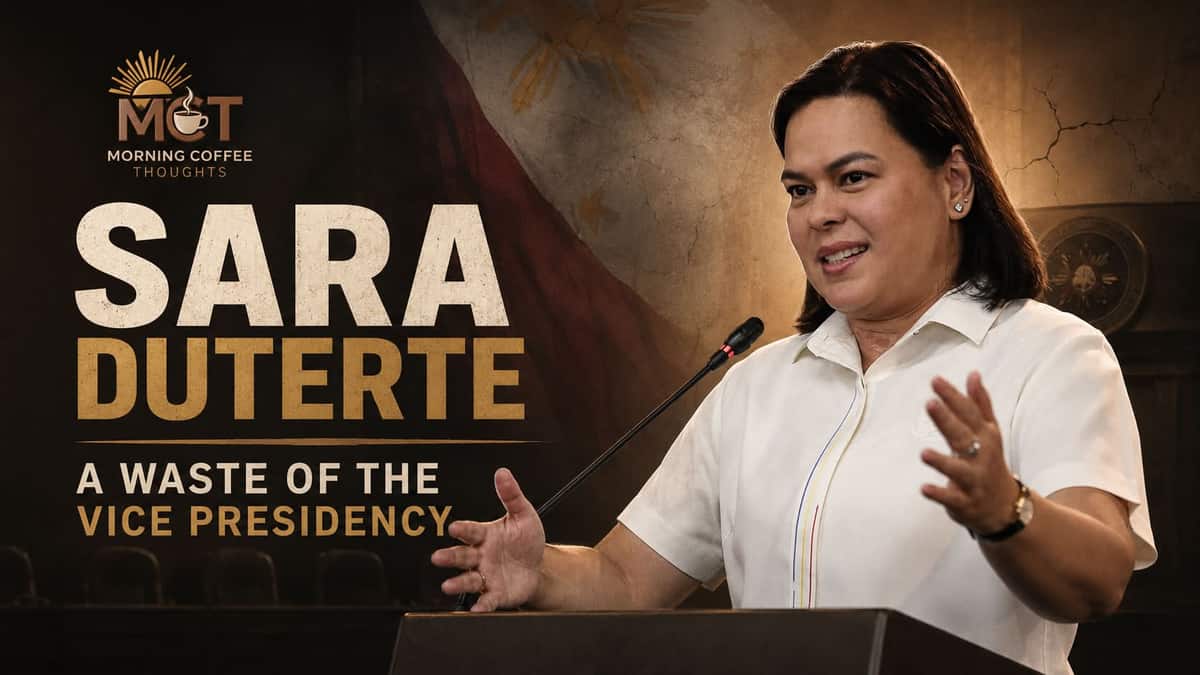
I could not publish an article about what I think of Bongbong Marcos without writing one about Sara Duterte too.
They ran and won under the banner of unity. UniTeam promised to end political division, even as the campaign that carried them to power benefited from an online environment saturated with misinformation, historical distortion, fake news, and trolls.
Marcos was the clearest beneficiary of the rewriting of his family’s history, but Sara was not standing outside that machinery. She was half of the ticket.
She brought the Duterte name and her father’s political base, and she benefited from an online political culture that had spent years attacking critics, journalists, human-rights advocates, opposition figures, and many of those who challenged the family.
They asked Filipinos to judge them as a team in 2022. It would be dishonest to scrutinize Marcos while giving Sara a pass simply because she is now fighting the administration she helped put in power.
Besides, Sara Duterte received even more votes than Marcos did.
The question is what she did with them.
THE BENEFICIARY-NUMBER ILLUSION
Sara Duterte received 32,208,417 votes in 2022. She entered office with a huge national mandate, a Cabinet seat, control of the Department of Education, support from Congress, and the political machinery of two powerful families behind her.
Four years later, the Office of the Vice President points to assistance programs as proof that she used that mandate well.
Its 2024 accomplishment report counted 1,780,079 beneficiaries. More than one million were reported under Libreng Sakay, while the rest included medical and burial aid, disaster relief, rice bags, school kits, livelihood grants, and other services.
The number looks impressive until you examine what went into it.
The total mixes reported Libreng Sakay passengers or users with food packs, school kits, medical-aid payments, burial grants, disaster assistance, rice distributions, and livelihood releases.
It combines different kinds of services, different kinds of recipients, and possibly repeat users.
The report proves that the office was busy, but the published figures do not establish that 1.78 million separate Filipinos were helped or that their lives improved after the distribution ended.
A taxpayer-funded office should be judged on more than whether it remained busy.
People who needed assistance should never be mocked for accepting it. Medical and burial aid can keep a struggling family from sinking deeper into debt. Free rides can help workers and students. Food packs matter when people are hungry.
My problem is with the political culture that gives an elected official personal credit for releasing money that already belonged to the public.
Any government office with a budget can distribute cash, bags, rice, rides, and relief packs. The harder work begins after the cameras leave.
Did the livelihood survive? Are children learning better? Did families become less vulnerable? Will the same people need the same ayuda again next year?
The OVP’s own budget document lists the number of people receiving services as an outcome indicator, along with partnerships, requests processed on time, projects completed as planned, satisfaction ratings, and official engagements.
Those figures can show activity. They cannot show whether the programs solved anything.
A politician can spend millions distributing school bags and count every child who received one. A serious evaluation would examine attendance, learning, household expenses, and whether those children were still unable to afford basic school supplies the following year.
I found no published independent evaluation showing that the OVP’s main assistance programs produced lasting gains across the people it counted.
More than half of the OVP’s reported 2024 beneficiaries came from Libreng Sakay.
Counting passengers or users does not prove that Sara fixed transportation, reduced household costs over time, or built a service that would survive her term. It proves that government vehicles carried people.
If this is already a high bar for someone preparing to become President, then we are fucked as a nation.
WHEN AUDITORS ASKED WHAT CHANGED
The OVP’s Mag Negosyo Ta ’Day livelihood program offers a clearer test because livelihood aid is supposed to create income, not merely provide temporary relief.
The Commission on Audit found that ₱3.42 million had been released to 138 beneficiaries from January through September 2024.
Auditors flagged questionable beneficiary selection, weak evaluation of business proposals, delayed liquidation, missing documents, and poor monitoring.
None of the proposals had been reviewed by the Department of Trade and Industry or the Philippine Deposit Insurance Corporation, even though the program manual assigned them a role.
Among 83 sampled beneficiaries, only 11 were visited or monitored within the prescribed period. Fourteen were not visited at all.
Auditors could not determine whether the grants created sustainable income or improved the recipients’ economic condition.
That finding captures the weakness of Sara’s record. The OVP could count every grant, but its files could not show whether the businesses survived.
Giving an individual recipient ₱15,000 and adding another name to an accomplishment report is easy. Returning months later to check whether the business is still alive takes planning, staff, records, and discipline.
Sara Duterte wants to govern an entire country. Her office struggled to show what happened after releasing a few million pesos through one livelihood program.
Her supporters point to the unmodified audit opinion the OVP received for its 2024 financial statements.
That opinion means the statements fairly presented the office’s financial position in all material respects.
It does not certify that every transaction was proper, every program was effective, or every peso produced a meaningful result.
The same audit period still contained findings about the livelihood program. An unmodified opinion is not a blanket certificate of clean and effective government.
DEPED WAS THE REAL TEST
The Constitution gives a vice president little independent executive power. Sara lost that excuse when she accepted the Department of Education.
DepEd gave her control over one of the country’s largest bureaucracies and placed her directly over a crisis affecting millions of children. She could work on literacy, classroom shortages, teacher workload, learning materials, nutrition, school safety, and the damage left by years of disruption.
This was her chance to prove that the Duterte brand could produce more than fear, loyalty, family power, and distribution politics.
Her DepEd tenure produced several serious policies. The MATATAG curriculum reduced overloaded content and emphasized foundational learning. Her department also introduced Catch-Up Fridays and ordered the removal of administrative work from teachers.
MATATAG deserves real credit.
A later study commissioned by the Second Congressional Commission on Education examined 70 public schools in seven regions and found large, statistically significant gains among Grade 2 pupils in reading, mathematics, and values education during the first year of the pilot.
The research also found selective gains in some higher-grade subjects. At the same time, it recorded delayed learning materials, uneven teacher training, longer planning demands, and declining physiological well-being among teachers covered by the study.
MATATAG may eventually become Sara Duterte’s strongest public legacy. Other officials, however, had to continue, adjust, fund, and implement it after she left DepEd.
The order removing administrative work from teachers also addressed a real problem, but later research found that 56.2 percent of teachers were still doing administrative tasks.
Schools lacked enough non-teaching personnel, while some of the work was simply transferred to already overburdened principals and administrative officers.
The policy identified the right problem. The execution lacked the staffing and money needed to fix it.
Catch-Up Fridays faced separate questions about its design, teacher preparation, and whether it delivered proper reading intervention to students who needed different levels of help.
The National Learning Camps had a participation problem. DepEd estimated that only about 10 percent of students requiring intervention attended.
Classroom construction remained dismal. As of January 2024, DepEd estimated that the country needed 165,443 additional classrooms. The Commission on Audit found that only 192 of the 6,379 classrooms targeted for completion in 2023 had been built.
Sara did not create that backlog, and DepEd was not the only agency responsible for construction. She nevertheless accepted the job, announced faster delivery, and left without breaking the bottleneck.
THEN SHE LEFT
Sara resigned as Education secretary on June 19, 2024, with her departure taking effect a month later.
Malacañang said she gave Marcos no reason. Sara linked the decision to concern for teachers and young people, but she did not explain which education policy, funding decision, or presidential interference made her resignation necessary.
Her departure came as the Marcos-Duterte alliance was collapsing.
She left before MATATAG’s national rollout, while teacher-workload reforms still lacked enough support staff, Catch-Up Fridays had not proved itself, and the classroom backlog remained massive.
Resignation was her right, but the unfinished work became part of the record the public must judge. A leader preparing for the presidency should be able to explain why walking away served the country better than finishing the work.
Maybe she had valid policy reasons. She did not properly explain them to the public, so from the outside, the country’s education crisis looked like collateral damage in a political divorce.
SECRET MONEY AND ACCOUNTABILITY
The other major choice was confidential spending.
The OVP spent ₱125 million in confidential funds in December 2022. The Commission on Audit later disallowed ₱73.287 million.
In April 2026, COA denied the petition asking it to review that ruling. The denial left Sara and the other officials identified in the decision obligated to return the disallowed amount, although her camp disputes the ruling and may still pursue available administrative or judicial remedies.
A disallowance requires repayment under audit rules. It is not the same as a criminal conviction.
The impeachment case contains wider accusations involving ₱612.5 million in confidential funds used by the OVP and DepEd. Those allegations remain unresolved and should not be described as proven theft.
My judgment does not depend on a future conviction.
Sara had more than 32 million votes, control of DepEd, Cabinet access, congressional support, and a chance to attach her name to a serious national reform.
She chose to make secret spending a major feature of both the OVP and the education department.
That choice consumed hearings, audits, investigations, and eventually impeachment proceedings.
Filipinos learned more about acknowledgment receipts, special disbursing officers, confidential expenses, names that government records could not verify and that prosecutors allege were fictitious, and questioned recipients than about any national project Sara completed.
The House was already at war with the Dutertes when it cut the proposed 2025 OVP budget from approximately ₱2 billion to ₱733 million.
Given the timing and the open conflict between the two camps, political punishment is a reasonable part of the explanation for the aggression of Marcos-aligned lawmakers.
Sara still had a duty to answer questions about the money she wanted from taxpayers.
She resisted detailed scrutiny during the first budget hearing, while she and OVP representatives did not attend some subsequent House hearings and the plenary budget deliberation.
A hostile Congress does not make oversight optional.
An official asking taxpayers for billions still owes answers, even when the lawmakers asking are hypocrites, rivals, opportunists, or obvious political operators.
Both things can be true.
The House may have weaponized oversight against a presidential rival, while Sara may also have failed the basic duty to explain how she used public money.
A vice president who wants credit for every bag, food pack, and free ride cannot suddenly demand that the public stop asking questions when the spending becomes secret.
TEMPERAMENT, FAMILY, AND 2028
In November 2024, Sara said she had instructed someone to kill Marcos, First Lady Liza Araneta-Marcos, and Martin Romualdez if she herself were killed.
She later said the remarks had been taken out of context and described them as a conditional act of revenge rather than an active threat.
The statement should not be inflated into a proven assassination plot, but it still came from the Vice President, the first person in line to assume the presidency.
Someone holding that position is judged on more than criminal liability.
Judgment, restraint, emotional control, and the ability to speak without creating a national security crisis are also part of readiness.
Sara’s defenders can call it anger, context, dark humor, or political exaggeration. None of those explanations makes the behavior presidential.
She formally announced in February 2026 that she would run for President in 2028.
She blamed Marcos for corruption, inflation, and failures in healthcare, then apologized for helping elect him.
Some of her criticism is deserved. Marcos has much to answer for.
What remains thin, in my view, is her own governing program.
She left the department where she could have proved her management ability.
Her most visible work afterward increasingly centered on the war with Marcos, the defense of her father, the impeachment case, and the preservation of the Duterte political base.
After Rodrigo Duterte was arrested and transferred to the International Criminal Court, Sara traveled to the Netherlands to help organize his legal support.
Defending her father was understandable personally, but voters were still entitled to ask what their Vice President was building for the country while her public role became tied to her family’s political and legal survival.
Her 2028 campaign tells us who she blames. It gives us far less detail about how she would repair healthcare, reduce prices, fight corruption, fund education, or govern Filipinos outside the Duterte political camp.
THE PREDECESSOR SHE COULD NOT IGNORE
Comparing Sara Duterte with Leni Robredo may sound unfair. They governed under different conditions and faced different crises.
The comparison is still unavoidable because Sara inherited an office whose previous occupant had already shown that its constitutional limits did not make it useless.
Robredo had a smaller mandate, little cooperation from Malacañang, and no lasting Cabinet role. Yet she used the OVP primarily as a convening platform.
Through Angat Buhay, her office worked with civil-society groups, private companies, donors, volunteers, local governments, and communities to direct outside resources toward education, health, nutrition, housing, rural development, and disaster response.
Robredo’s record should not be romanticized. Her reports also counted beneficiaries and projects, and those figures did not automatically prove lasting socioeconomic improvement.
The important difference was the institutional model.
Robredo tried to make a weak office larger by bringing other organizations and outside resources into the work.
Angat Buhay continued as a nongovernment organization after her term, showing that the network itself did not depend entirely on her remaining Vice President.
Sara began with much more: 32 million votes, the President’s support, congressional allies, a Cabinet portfolio, and control of DepEd.
Yet her vice-presidential record became dominated by direct, publicly funded assistance, confidential spending, political warfare, and preparation for 2028.
She did not need to copy Robredo. She could have chosen literacy, teacher welfare, child nutrition, classroom construction, Mindanao peace, or disaster preparedness as the defining cause of her vice presidency.
Her predecessor had already removed the excuse that the office was too weak to matter.
I cannot prove what Sara privately intended when she accepted the position. Her record suggests that she treated the vice presidency less as an institution to build and more as a political position to preserve.
The problem is not that she failed to become Leni Robredo. The problem is that someone before her had already demonstrated how partnerships, transparency, and a clear purpose could stretch the limits of the office, while Sara arrived with far more power and built far less of an institution.
THE WASTE
The OVP helped people. Many recipients undoubtedly valued the transportation, food, school supplies, medical aid, and burial assistance they received.
The problem begins when distribution becomes the main proof that a national leader performed well.
Politicians have trained Filipinos to experience government through favors. People line up, receive a fraction of public money through an official’s branded program, and are expected to remember who “gave” it.
The money came from the public, not Sara Duterte’s pocket.
A country with higher expectations would ask how many recipients no longer needed help the following year. It would demand evidence of better learning, stable income, improved health, stronger communities, and reduced dependence.
We received beneficiary totals instead.
When publicly funded assistance is branded around a politician, celebrated mainly through distribution counts, and left without proof of lasting impact, it begins to look like patronage with an accomplishment report.
Sara Duterte’s vice presidency has been busy, costly, visible, and politically useful to her. The waste lies in what she did with an opportunity few politicians will ever receive.
More than 32 million Filipinos gave her a national mandate. Marcos gave her DepEd. Congress initially gave her money and room to work. The UniTeam alliance protected her from serious political opposition.
MATATAG shows that she was capable of beginning serious reform. Her decision to leave before its larger test says just as much about her leadership.
She spent the remaining political capital defending secret funds, fighting the administration she helped elect, protecting the Duterte name, and preparing for the next presidential election.
Ilang red flags pa ba ang kailangan natin bago natin aminin that popularity is not proof of competence, and that anger is not a governing program?
The vice presidency should have shown what Sara Duterte would build with national power. Four years later, her record is crowded with distributions, unfinished education policies, audit disputes, threats, family warfare, and campaign positioning.
Sara Duterte may still become President in 2028. That possibility makes the waste even more troubling because the vice presidency was her chance to show us what she could build, yet we now know far more about who she is fighting than what she intends to fix.
SOURCES
- Senate of the Philippines, https://legacy.senate.gov.ph/lisdata/3761634065%21.pdf
- Philippine News Agency, https://www.pna.gov.ph/articles/1175224
- Department of Budget and Management, https://www.dbm.gov.ph/wp-content/uploads/NEP2026/OVP/OVP.pdf
- GMA News, https://www.gmanetwork.com/news/topstories/nation/952885/2m-passengers-served-under-ovp-s-libreng-sakay-spox/story/
- DZRH News, https://www.dzrh.com.ph/post/ovp-cites-no-loss-of-funds-after-coa-issues-unmodified-opinion
- The Philippine Star, https://www.philstar.com/headlines/2025/12/03/2491522/coa-flags-ovp-livelihood-program
- GMA News, https://www.gmanetwork.com/news/topstories/nation/968077/coa-flags-ovp-for-late-liquidation-of-livelihood-aid-funds/story/
- Commission on Audit, https://www.coa.gov.ph/FAQS/what-is-an-unmodified-opinion/
- GMA News, https://www.gmanetwork.com/news/topstories/nation/952086/ovp-scores-unmodified-opinion-from-coa-for-2024/story/
- GMA News, https://www.gmanetwork.com/news/topstories/nation/968468/ovp-on-2024-coa-report-no-wastage-of-gov-t-funds/story/
- Vera Files, https://verafiles.org/articles/fact-check-coa-unmodified-opinion-did-not-clear-vp-sara-ahead-of-impeachment-trial
- 1987 Philippine Constitution through Lawphil, https://lawphil.net/consti/cons1987.html
- Second Congressional Commission on Education, https://edcom2.gov.ph/large-learning-gains-among-grade-2-students-following-recent-curriculum-reforms/
- Second Congressional Commission on Education, https://edcom2.gov.ph/deped-should-ensure-removal-of-teacher-admin-tasks-in-60-days-edcom-2/
- Second Congressional Commission on Education, https://edcom2.gov.ph/media/2025/03/EDCOM2_Policy_Brief_Removing_the_Burden_of_Administration_from_Teachers.pdf
- Second Congressional Commission on Education, https://edcom2.gov.ph/deped-commits-to-deliver-80-of-textbooks-for-grades-1-4-and-7-students-by-july/
- Second Congressional Commission on Education, https://edcom2.gov.ph/national-learning-recovery-program-in-need-of-massive-reform-gatchalian/
- Second Congressional Commission on Education, https://edcom2.gov.ph/edcom-2-urges-deped-fix-delays-explore-ppp-to-ramp-up-classroom-construction/
- Reuters, https://www.reuters.com/world/asia-pacific/philippine-vp-resigns-education-minister-marcos-alliance-crumbles-2024-06-19/
- GMA News, https://www.gmanetwork.com/news/topstories/nation/910524/sara-duterte-quits-as-deped-chief/story/
- ABS-CBN News, https://www.abs-cbn.com/news/nation/2026/4/14/coa-denies-sara-duterte-petition-to-review-notice-of-disallowance-over-p73-m-confidential-funds-1905
- Philippine Daily Inquirer, https://newsinfo.inquirer.net/2213330/sara-duterte-claims-coa-denied-due-process-in-secret-fund-disallowance
- House of Representatives, https://www.congress.gov.ph/media/press-releases/9877
- GMA News, https://www.gmanetwork.com/news/topstories/nation/996538/live-updates-sara-duterte-impeachment-trial-july-29-2026/story/
- Reuters, https://www.reuters.com/world/asia-pacific/philippines-lower-house-slashes-vice-presidents-funding-proposed-2025-budget-2024-09-26/
- Reuters, https://www.reuters.com/world/asia-pacific/philippines-summons-vp-duterte-over-threat-have-marcos-killed-2024-11-26/
- Reuters, https://www.reuters.com/world/asia-pacific/philippine-vice-president-duterte-run-president-2028-elections-2026-02-18/
- Reuters, https://www.reuters.com/world/asia-pacific/philippines-vp-travels-hague-lawyers-explore-legal-remedies-arrested-ex-2025-03-12/
- The Philippine Star, https://www.philstar.com/headlines/2025/04/07/2434148/vp-sara-back-philippines-after-helping-build-dad-rodys-legal-team
- The Philippine Star, https://www.philstar.com/headlines/2016/05/28/1587724/its-vp-leni
- Angat Buhay, https://www.angatbuhay.ph/about-angat-buhay-full/
- Philippine Center for Investigative Journalism, https://pcij.org/2022/05/08/marcos-presidential-elections-massive-disinformation/
- Tsek.ph, https://www.tsek.ph/firehose-of-disinformation-floods-run-up-to-election/
- Tsek.ph, https://www.tsek.ph/disinformation-attempts-to-rehabilitate-the-marcoses-disparage-edsa/