
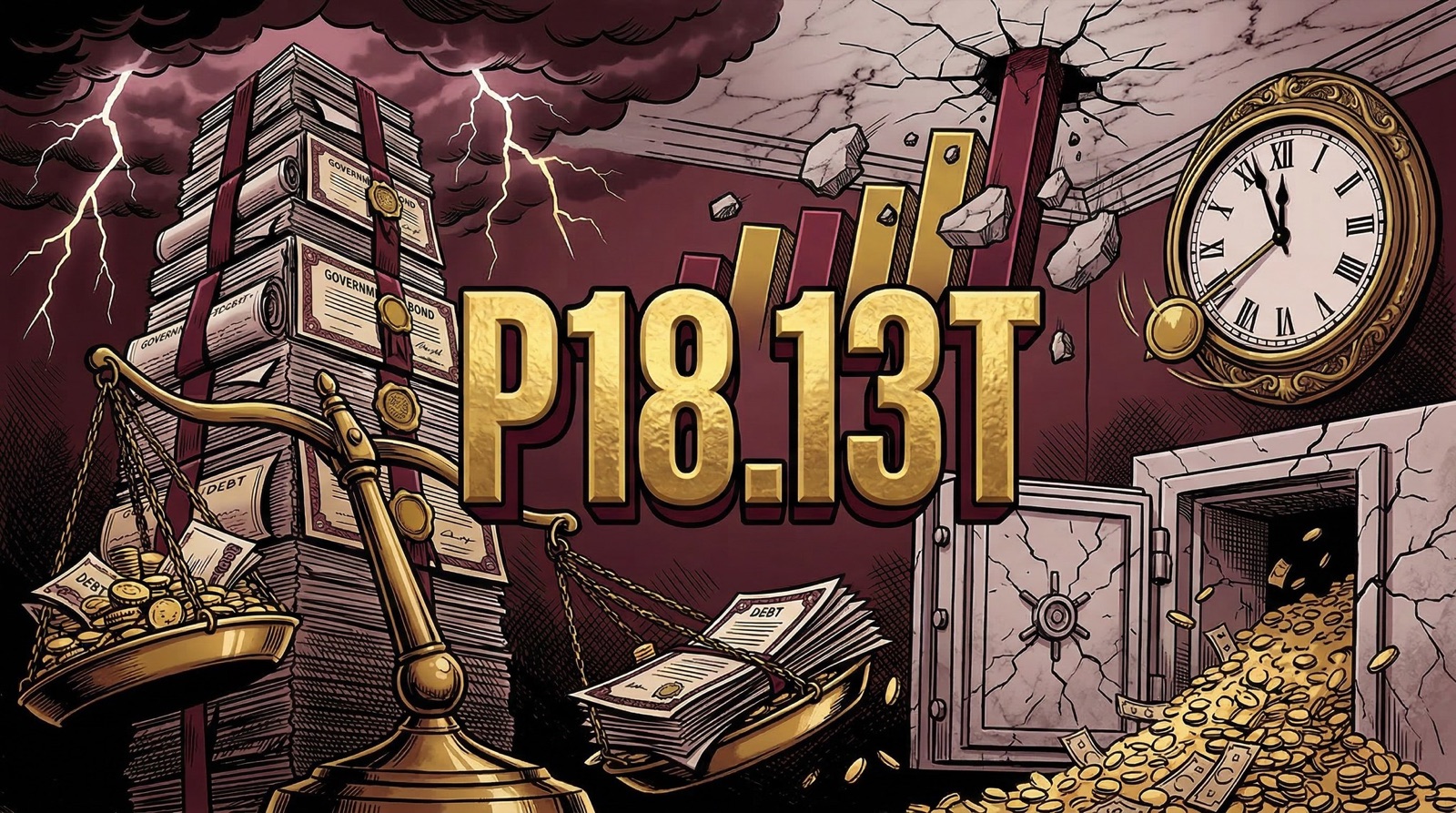
P18.13 trillion.
That is the outstanding debt of the Philippine national government as of end-January 2026, according to data released by the Bureau of the Treasury on March 4. It is the highest figure ever recorded in the country's history.
The number climbed P426.15 billion from December 2025's P17.707 trillion — a 2.41 percent jump in a single month. Year-on-year, it is up 11.16 percent from P16.312 trillion in January 2025.
Every Filipino's share of that debt: roughly P160,827, based on the country's estimated population.
HOW IT GOT THIS HIGH THIS FAST
The government did not stumble into this. It borrowed deliberately and early.
The Bureau of the Treasury called it a front-loading strategy — rushing domestic and external issuances before global market conditions could worsen and drive up borrowing costs further. In January alone, the Philippines raised USD 2.75 billion through a triple-tranche US dollar global bond deal, the largest such transaction in over three years.
That single bond offering — covering 5.5-year, 10-year, and 25-year maturities — drew roughly USD 5.95 billion in orders, more than double what was offered. Finance Secretary Frederick D. Go called it a sign of "the trust global investors place in the Philippines." National Treasurer Sharon P. Almanza described the tight pricing as proof of the country's standing as "a benchmark for high-quality emerging market credit."
The bond deal alone pushed external debt up by P217.63 billion month-on-month, with P191.02 billion coming from new issuances and loan availments, and an additional P26.61 billion added purely from the peso's depreciation against the dollar.
WHERE THE DEBT SITS NOW
Of the P18.13 trillion total, P12.324 trillion — about 68 percent — is domestic debt, meaning obligations owed to local creditors, mostly through government securities. The remaining P5.809 trillion, or 32 percent, is owed to external creditors: global bondholders, the Asian Development Bank, the Japan International Cooperation Agency, and other bilateral and multilateral lenders.
The government's full-year 2026 debt program projects total outstanding debt reaching P19.06 trillion by December. As of end-January — the first month of the year — the Philippines had already crossed 95 percent of that target.
The 2026 borrowing plan calls for P2.68 trillion in new gross borrowings: P2.05 trillion domestically and P627.1 billion from foreign sources. The 2025 budget deficit came in at P1.58 trillion, slightly above the P1.56 trillion program. The 2026 deficit target is P1.65 trillion, or 5.3 percent of GDP.
At end-2025, the debt-to-GDP ratio stood at 63.2 percent — the highest in 20 years, and above the 60 percent threshold that economists and credit rating agencies use as a marker for elevated risk. The last time the ratio was this high was 2005, when it reached 65.7 percent.
The Marcos administration inherited P12.79 trillion in debt in July 2022 and has added roughly P4.91 trillion since then, bringing the total to P17.71 trillion by end-2025 before January's additional surge. Former Budget Secretary Florencio Abad put the pattern plainly: between 2022 and 2025, national debt grew by over 9 percent annually while the economy expanded at only 5 to 6 percent.
WHAT IT COSTS TO CARRY
The question underneath all of this is not just how much the government owes, but how much it costs to service what it owes — every year, regardless of what else needs funding.
In 2025, interest payments alone reached approximately P628.3 billion. Principal amortizations — repaying the actual loan amounts coming due — added P943.6 billion on top of that. Combined debt service: around P2.05 trillion for the year.
In the past two years, roughly 48 to 51 percent of all government revenues went toward covering interest and principal on existing borrowings. That is before a single peso goes to building a road, hiring a teacher, or stocking a rural health clinic.
For every P100 in the P6.793 trillion 2026 national budget, approximately only P38 is available for discretionary spending after debt service, mandatory retirement benefits, government salaries, and other obligatory payments are subtracted.
RCBC chief economist Michael L. Ricafort noted that lower interest rates could help reduce debt service costs, but foreign exchange movements remain a persistent risk — as any further weakening of the peso inflates the peso value of the P5.809 trillion in external obligations. The peso already fell to a record low of P59.46 to the dollar on February 15, 2026.
The government insists the debt load is manageable. Senior adviser Jonathan L. Ravelas of Reyes Tacandong & Co. agrees, cautiously: the more significant risks, he said, come not from the number itself but from weaker economic growth or higher borrowing costs. GDP grew only 4.4 percent in 2025, the weakest since the COVID collapse of 2020.
The P19 trillion target is a few months away. The 2026 debt service bill is already running.
SOURCES
- Bureau of the Treasury (BTr), https://www.treasury.gov.ph/?p=74627
- BTr — National Treasurer Sharon P. Almanza profile, https://www.treasury.gov.ph/?page_id=62973
- Department of Finance — Bond Pricing Press Release (PDF), https://www.dof.gov.ph/wp-content/uploads/2026/01/Republic-of-the-Philippines-Prices-5.5-Year-10-Year-and-25-Year-US-Dollar-Global-Bonds.pdf
- BTr — Global Bond Launch Press Release (PDF), https://www.treasury.gov.ph/wp-content/uploads/2026/01/ROP-2026-Launch-of-5.5-Year-10-Year-and-25-Year-US-Dollar-Global-Bonds.pdf
- Inquirer, https://business.inquirer.net/577408/philippine-government-debt-climbs-to-p18-trillion-in-january
- Inquirer, https://cebudailynews.inquirer.net/702635/%E2%82%B118-13-trillion-national-debt-how-much-is-the-ph-govt-borrowing-per-filipino
- Inquirer, https://newsinfo.inquirer.net/2170421/ph-debt-stock-projected-to-hit-p19t-by-end-of-2026
- Inquirer, https://business.inquirer.net/578214/govt-borrowings-breached-25-target-climbed-to-p2-65t
- Philstar, https://www.philstar.com/business/2026/03/05/2512159/philippines-debt-pile-swells-record-p1813-trillion
- Philstar, https://www.philstar.com/business/2026/01/22/2502551/philippine-raises-275-billion-global-bonds
- Philstar, https://www.philstar.com/business/2026/02/04/2505484/government-debt-climbs-record-p177-trillion
- Philstar, https://www.philstar.com/business/2026/03/09/2512913/government-borrowings-exceed-program
- GMA News, https://www.gmanetwork.com/news/money/economy/978795/ph-debt-hits-p18-13t-in-january-2026-as-gov-t-frontloaded-borrowing/story/
- GMA News, https://www.gmanetwork.com/news/money/economy/975316/philippine-debt-burden-hits-20-year-high-at-63-2-of-economy/story/
- GMA News, https://www.gmanetwork.com/news/money/economy/973516/ph-returns-to-global-bond-market-with-triple-tranche-bond-sale/story/
- ABS-CBN, https://www.abs-cbn.com/news/business/2026/3/4/philippine-debt-climbs-to-p18-13-trillion-in-january-1823
- Manila Bulletin, https://mb.com.ph/2026/03/04/philippines-rushes-to-borrow-before-global-interest-rates-rise
- BusinessWorld, https://www.bworldonline.com/top-stories/2026/03/05/734278/frontloaded-issuance-pushes-phl-debt-to-p18-13-trillion/
- Philippine News Agency (PNA), https://www.pna.gov.ph/articles/1270348
- VERA Files, https://verafiles.org/articles/fact-check-claim-that-marcos-govt-has-more-debt-than-duterte-admin-needs-context
- Manila Bulletin (debt-to-GDP target), https://mb.com.ph/2025/08/18/marcos-admin-eyes-gg-debt-to-gdp-ratio-cut-to-54-by-2028-despite-2024-uptick
- Daily Tribune, https://tribune.net.ph/2025/12/03/philippine-debt-load-increases-under-marcos-administration
- The Diplomat, https://thediplomat.com/2025/11/breaking-down-the-philippines-2026-budget/
- Bloomberg, https://www.bloomberg.com/news/articles/2025-08-13/philippines-plans-to-borrow-47-billion-in-2026-government-says
- PCO, https://pco.gov.ph/news_releases/recto-go-take-oath-as-executive-secretary-finance-secretary/
- Xinhua, https://english.news.cn/20260305/016c165ffa1e42bd8d87423dd4620cb0/c.html