
I want to believe this is the right move.
Fake news in the Philippines is real, organized, and profitable.
People panicked over made-up fuel shortages.
AI-style "news" videos talked about COVID variants that don't exist.
A China-linked network spent millions running fake Filipino accounts to weaken support for defending the West Philippine Sea.
Those things don't just confuse people.
They change how we vote, how we panic, how we trust.
So when Malacañang says it wants to fight disinformation, part of me wants to say yes.
And then I look at how they're doing it.
WHAT MALACAÑANG HAS BUILT
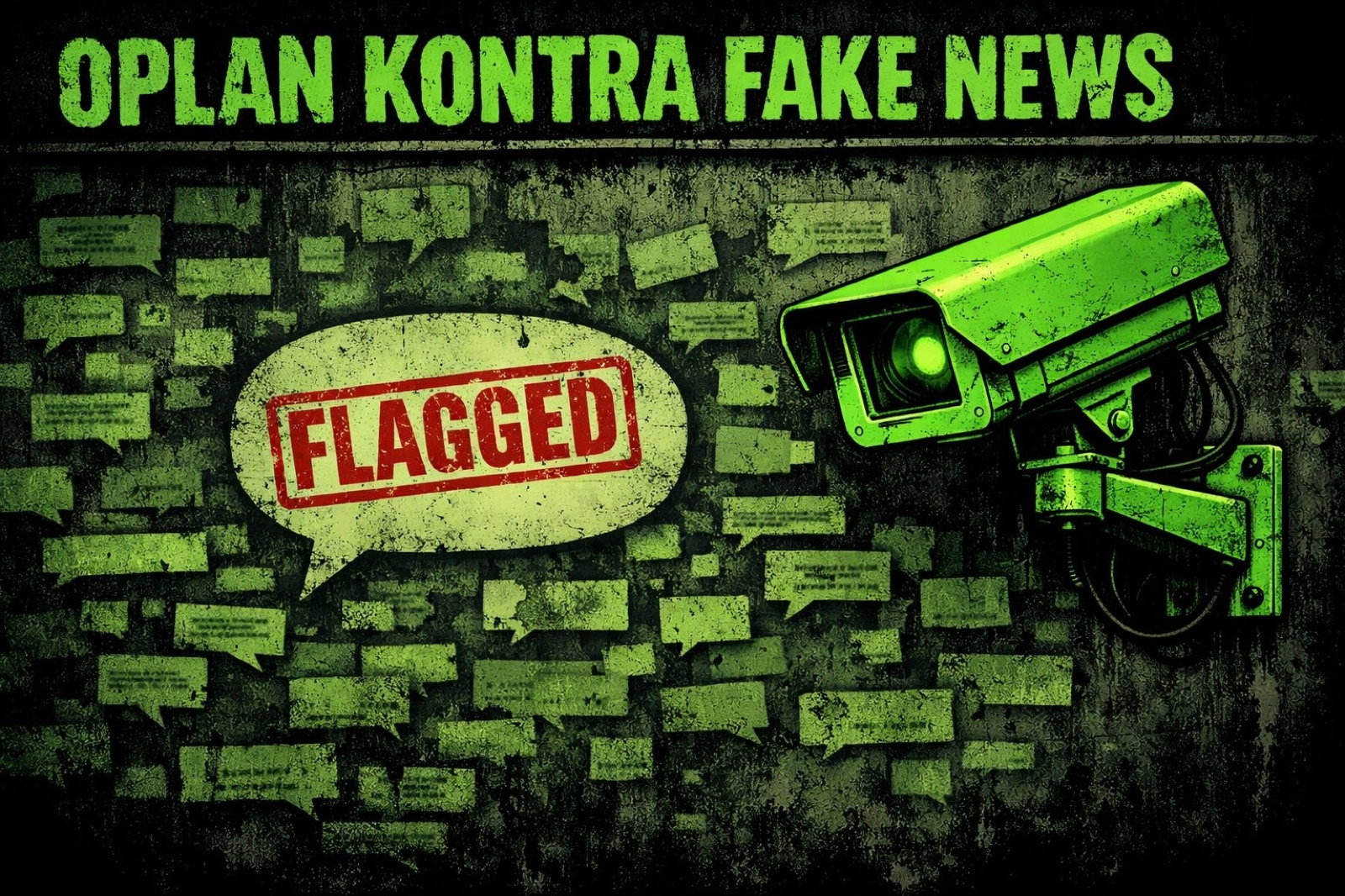
On March 4, 2026, the Presidential Communications Office (PCO) launched Oplan Kontra Fake News at Kalayaan Hall in Malacañang.
PCO Secretary Dave Gomez stood on stage and announced a campaign to "protect Filipinos from the dangers of fake news," backed by a new Anti-Fake News Desk and partnerships with big media and tech.
The first piece is the MOU with nine major newspapers: BusinessMirror, BusinessWorld, Daily Tribune, Malaya Business Insight, Manila Bulletin, Manila Standard, Philippine Daily Inquirer, The Manila Times, and The Philippine Star.
On paper, they commit to verified reporting, faster coordination during crises, and media literacy efforts, while still asserting editorial independence.
I wrote about this on a separate piece.
These same newspapers and major political influencers that signed up to fight fake news have something in common.
Their own comment sections are a warzone.
Trolls, bot accounts, coordinated attacks, and outright fabrications live underneath every political post on their pages.
The organizations pledging to fight disinformation at the top of the page have not cleaned up the bottom of it.
If you cannot moderate your own space, what does the partnership actually mean?
The second piece is the Anti-Fake News Desk inside the PCO.
This desk receives reports from the public and from media partners, screens them, and then forwards cases to the DICT and DOJ when they think there's basis for legal action.
Gomez has been very clear: they are now monitoring online posts that can be used as evidence in future cases.
The third piece is a public reporting website.
On April 10, 2026, the PCO said it would launch an online platform where citizens can report fake news, with particular focus on disinformation about President Marcos' health.
All of that sits beside the legislative track.
House Bill 2697 — the "Anti-Fake News and Disinformation Act" — is now a LEDAC priority measure.
It's authored by House Majority Leader Ferdinand Alexander "Sandro" Marcos, the president's son.
The proposal includes penalties of six to 12 years in prison and fines up to P2 million for those found to have "knowingly and maliciously" spread false information that causes harm.
Higher penalties kick in when the accused is a public official, a journalist, or a content creator with a large following.
In short: Malacañang didn't just give speeches about fake news.
It built an internal complaints desk, lined up major newspapers, promised a website, and pushed a bill that adds real prison time.
On paper, that sounds decisive.
That's exactly why I'm uneasy.
WHAT I SEE FROM THE OUTSIDE
I'm not a lawyer or a newsroom editor.
I'm just someone who spends a lot of time reading, cross-checking, and watching how power behaves.
From that vantage point, a few things stand out.
The PCO is a political office.
Its core function is to communicate for the President and to defend the administration's story.
That's normal for any government.
The problem begins when the same office is also the one deciding which posts are "fake news," building case files, and bringing those cases to the DOJ.
There is no independent fact-checking body built into Oplan Kontra Fake News.
No multi-stakeholder council, no legal ombudsman sitting between the PCO and the prosecutors.
Just one office inside Malacañang that screens, labels, and escalates.
We have seen this before.
Under Duterte, the National Task Force to End Local Communist Armed Conflict — NTF-ELCAC — was built as a whole-of-nation counterinsurgency program.
On paper, it targeted the armed wing of the CPP-NPA.
In practice, it became a labeling machine.
Government officials — most visibly Lorraine Badoy and Antonio Parlade — used NTF-ELCAC's platform to publicly tag activists, journalists, lawyers, labor organizers, indigenous leaders, and human rights defenders as communists or terrorist sympathizers.
The labels carried real consequences.
Human Rights Watch, Amnesty International, and the UN Office of the High Commissioner for Human Rights all documented the pattern: red-tag first, then threats, surveillance, arrest, or killing followed.
Karapatan recorded at least 427 activists killed after being red-tagged.
The structure was the same one forming now: a government body decides who gets the label, applies it publicly, and lets the consequences follow — with no independent check, no appeals process, and no accountability when it goes wrong.
NTF-ELCAC labeled people as communists.
Oplan Kontra Fake News labels content as disinformation.
The mechanism is identical.
The question is the same: who watches the office that does the watching?
Free speech advocates, journalists, and creators saw this problem immediately.
In one "In the Public Square" episode, HB 2697 was described as an "anti-fake news trap" that can easily corner critics and content creators, whatever the authors' stated intentions are.
Even the government's own talking points show they know this is sensitive: Palace officials keep repeating that the bill "must protect free speech," that freedom of expression will be "respected," as they push it through.
When an office whose job is to defend the president also decides what counts as punishable speech, I worry.
THE CREDIBILITY GAP
There's another layer here, and it's uncomfortable.
The Marcos Jr. campaign in 2022 rode on a massive wave of online disinformation.
Fact-check consortium Tsek.ph and PCIJ documented how Marcos content dominated false or misleading posts during the campaign — especially around martial law history and the image of the Marcos family.
TikTok was flooded with videos praising Ferdinand Marcos Sr. as a misunderstood genius while downplaying human rights abuses.
Scholars writing for East Asia Forum called it what it was: a disinformation-boosted comeback that turned social media into a rehabilitation machine for a political dynasty.
After Marcos won, his administration accredited political vloggers into the Malacañang press corps and maintained close ties with partisan influence networks.
Then came another layer: an OpenAI transparency report revealed that ChatGPT had been used in a coordinated influence operation in the Philippines, pumping out content favoring Marcos Jr. and targeting Sara Duterte, traced to a local PR firm. OpenAI rated the operation's reach as low-impact, but its existence was confirmed.
So when this same ecosystem now says it wants to clean up fake news, I can't pretend that history doesn't exist.
I want disinformation addressed.
I just don't forget who benefited from it.
WHO GETS TARGETED, WHO DOESN'T
Look at how the new system moved in its first big test.
When fake posts about an "energy lockdown," fuel hoarding, and an invented COVID "Cicada variant" went viral, the PCO filed cybercrime complaints against the Facebook page "Malasakit News Pilipinas."
The page had around 13,000 followers, many of them bots and dormant accounts, and had existed for barely a month.
When rumors about Marcos' supposed late-stage cancer spread using AI-generated "anchors," the Palace condemned a "sudden and coordinated surge" and announced that legal action would follow.
These reactions make sense on one level.
The posts were fabricated, inflammatory, and meant to cause panic or speculation.
But then compare this to what has not been targeted.
Rappler traced a P3.7-million China-linked campaign that used fake Filipino personas to attack critics and push pro-Duterte and pro-Beijing viewpoints around the West Philippine Sea.
Researchers and watchdogs have mapped pro-Marcos and pro-Duterte influence networks and troll farms operating for years, not weeks.
Where are the cases against those networks?
So far, Oplan Kontra Fake News has gone after a small, newly created page and posts that directly hurt the current administration's image or governance story.
The bigger, older ecosystems that helped bring this government to power and continue to shape opinion in its favor remain untouched.
As an observer, that pattern bothers me.
It looks less like a neutral system and more like a shield.
THE BILL WITH A FAMILY NAME
HB 2697 deserves its own section.
The main version moving in the House is authored by Sandro Marcos.
It criminalizes the "knowing and malicious" creation or spread of false information that causes public disorder, undermines elections, threatens national security, or damages a person's reputation.
There are exemptions: satire, parody, opinion pieces, and honest errors are supposedly protected.
Palace spokespeople keep saying the measure will not curtail free speech and that "freedom of speech will still be respected."
But the Commission on Human Rights has already raised flags.
In separate statements, the CHR called for stronger protection of journalists and reminded government that any attempt to address fake news must not become a tool to limit critical expression or intimidate the press.
Rappler's breakdown of "Sandro's anti-fake news trap" warned that the bill, once passed, could be used against journalists, creators, and ordinary citizens who speak out — especially when those in power decide that what was said is harmful to them.
That's not a foreign think tank saying that.
That's a local newsroom and local lawyers analyzing the text and the politics around it.
The combination of steep penalties, broad definitions, and a complainant that sits inside Malacañang is exactly why so many people in media and civil society are on edge.
WHAT THIS LOOKS LIKE FROM WHERE I STAND
From my spot — just a Filipino watching institutions — this is the picture that forms.
The problem is real.
Disinformation here is sophisticated, sometimes foreign-funded, and deeply rooted.
The effort is real too.
The state is actually putting structure — a desk, an MOU, a website, bills — around its response.
The risk is also real.
The effort is led by offices and political actors who directly benefited from the very ecosystem they now say they want to regulate.
That mix is dangerous.
I want AI-generated fake newscasts about imaginary lockdowns to be stopped.
I want rumor-mongering about anyone's health — even a president I disagree with — to be called out and corrected.
I want troll farms gone.
But I also want the same system to have guardrails.
Independent oversight.
Clear, narrow definitions.
Public reporting of who gets targeted and why.
A serious attempt to investigate the funders and architects of disinformation, not just the front accounts.
Right now, Oplan Kontra Fake News doesn't offer that.
What it offers is a faster, more organized way for government to label something "fake," call the DOJ, and let the chilling effect do its work — with a bill written by the president's son waiting in the background.
That's why I'm worried.
SOURCES
- PCIJ — Rewriting Reality: The Information War That Defined 2025, https://pcij.org/2025/12/31/rewriting-reality-the-information-war-that-defined-2025/
- East Asia Forum Quarterly, https://eastasiaforum.org/wp-content/uploads/2025/05/East-Asia-Forum-Quarterly-Volume-17-Number-2.pdf
- RTVM — Launching of Oplan Kontra Fake News, https://www.youtube.com/watch?v=GD-ZNDPshAA
- PIA — PCO's Oplan Kontra Fake News gains support from major news orgs, https://pia.gov.ph/news/pcos-oplan-kontra-fake-news-gains-support-from-major-news-orgs/
- SunStar — PCO, 9 dailies unite vs fake news, https://www.sunstar.com.ph/cebu/pco-nine-dailies-unite-vs-fake-news
- Inquirer — PCO signs MOU with print media publishers, https://newsinfo.inquirer.net/2190339/pco-signs-mou-with-print-media-publishers-to-combat-fake-news
- Philstar — The STAR, 8 other broadsheets join Oplan Kontra Fake News, https://www.philstar.com/headlines/2026/03/05/2512149/star-8-other-broadsheets-join-oplan-kontra-fake-news
- PCO — Oplan Kontra Fake News gains support, https://pco.gov.ph/news_releases/pcos-oplan-kontra-fake-news-gains-support-from-major-news-orgs/
- ABS-CBN — PCO establishes Anti-Fake News Desk, https://www.abs-cbn.com/news/nation/2026/3/4/pco-establishes-anti-fake-news-desk-1823
- Inquirer — Palace slams coordinated surge of fake news about Marcos health, https://newsinfo.inquirer.net/2209244/palace-flags-coordinated-surge-of-fake-news-vs-marcos-health-vows-charges
- PCO — Palace warns vs fake news exploiting energy situation, https://pco.gov.ph/news_releases/palace-warns-vs-fake-news-exploiting-energy-situation-vows-legal-action/
- PNA — PCO to launch website vs fake news, https://www.pna.gov.ph/articles/1272672
- ABS-CBN — PCO to launch website against fake news, https://www.abs-cbn.com/news/nation/2026/4/10/pco-to-launch-website-against-fake-news-2013
- Congress.gov.ph — Anti-disinformation bill added to LEDAC priority measures, https://www.congress.gov.ph/media/press-releases/view/?content=9608
- GMA — Palace: Marcos wants balanced measure in fight vs fake news, https://www.gmanetwork.com/news/topstories/nation/976047/palace-marcos-wants-balanced-measure-in-fight-vs-fake-news/story/
- Rappler — Sandro's anti-fake news trap, https://www.facebook.com/rapplerdotcom/posts/what-is-shaping-up-to-be-the-main-version-in-the-house-hb-2697-authored-by-major/1436869788475085/
- Manila Bulletin — Up to P2-M fine against fake news peddlers, https://mb.com.ph/2025/11/20/up-to-p2-m-fine-against-fake-news-peddlers-pushed-in-house
- Philstar — Anti-fake news bill seeks up to 12-year jail time, https://www.philstar.com/headlines/2025/06/02/2447659/anti-fake-news-bill-seeks-12-year-jail-time-p2m-fine-disinfo-peddlers
- Inquirer — Anti-fake news bill seeks harsher penalties, https://newsinfo.inquirer.net/2100369/anti-fake-news-bill-seeks-harsher-penalties-vs-erring-govt-officials-journos
- Inquirer — PCO files raps vs Facebook users spreading energy misinformation, https://newsinfo.inquirer.net/2208157/pco-files-complaints-vs-facebook-users-spreading-energy-misinformation
- YouTube — In the Public Square: Sandro's anti-fake news trap, https://www.youtube.com/watch?v=dbgmJPdNrts
- PNA — Palace: Priority anti-fake news bill must protect free speech, https://www.pna.gov.ph/articles/1268738
- PCIJ — Marcos leads presidential race amid massive disinformation, https://pcij.org/2022/05/08/marcos-presidential-elections-massive-disinformation/
- East Asia Forum — Press freedom under Bongbong is fake news, https://eastasiaforum.org/2022/10/10/press-freedom-under-bongbong-is-fake-news/
- East Asia Forum — The disinformation paradox gripping the Philippines, https://eastasiaforum.org/2025/06/28/the-disinformation-paradox-gripping-the-philippines/
- Al Jazeera — A masterclass in propaganda: political vloggers in the Philippines, https://institute.aljazeera.net/en/ajr/article/1966
- Influence Industry — Influence Campaigns in the Philippines: 2025 Midterm, https://influenceindustry.org/en/explorer/case-studies/philippines-2025-influence/
- Inquirer — Palace sues Malasakit News Pilipinas over fake lockdown report, https://newsinfo.inquirer.net/2208528/palace-sues-malasakit-news-pilipinas-over-fake-lockdown-report
- GMA — PCO seeks DOJ charges vs fake news peddlers amid energy issues, https://www.gmanetwork.com/news/topstories/nation/982911/pco-files-charges-vs-fb-page-spreading-false-info-amid-energy-crisis/story/
- PNA — Marcos govt files criminal charges vs fake news peddlers, https://pia.gov.ph/news/marcos-govt-files-criminal-charges-vs-fake-news-peddlers-exploiting-energy-emergency/
- CHR — Calls for stronger protection of journalists, https://www.facebook.com/chrgovph/posts/read-chr-calls-for-stronger-protection-of-journalists-during-national-press-week/1312230960931485/
- Inquirer — CHR: Free speech has limits but govt must not infringe on it, https://newsinfo.inquirer.net/2046351/chr-free-speech-has-limits-but-govt-must-not-infringe-on-it
- Inquirer Opinion — Fighting fake news: Follow the money, https://opinion.inquirer.net/190294/fighting-fake-news-follow-the-money
- Democratic Erosion — Democracy Six Feet Under: How Disinformation is Burying Philippine Democracy Alive, https://democratic-erosion.org/2025/05/07/democracy-six-feet-under-how-disinformation-is-burying-philippine-democracy-alive/