
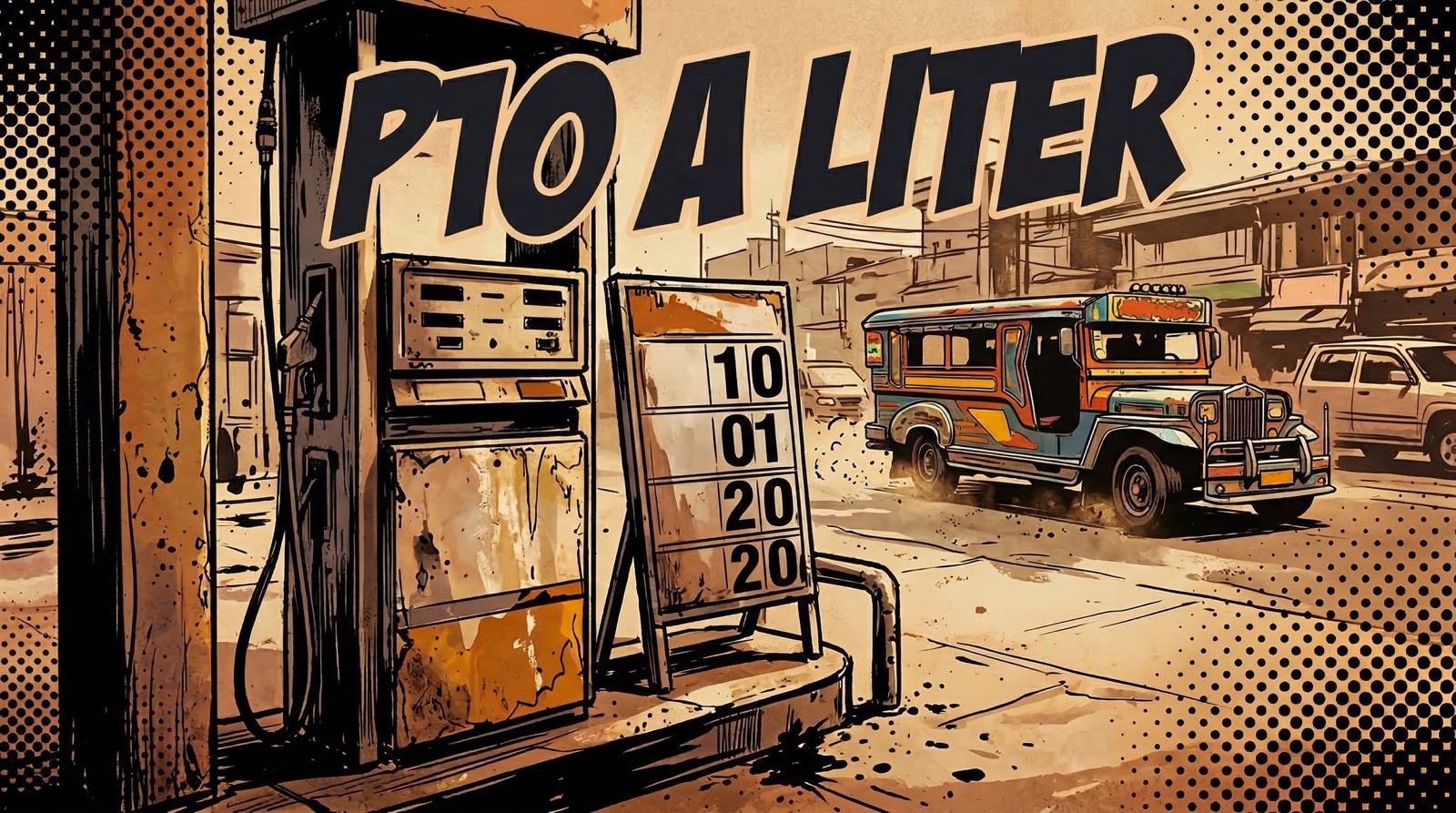
Fuel prices just jumped P10 a liter and Congress is moving fast.
On March 11, the House of Representatives approved on second reading House Bill 8418, which would give the President the power to suspend or reduce excise taxes on petroleum products during economic emergencies. The following day, President Marcos sent a letter to Speaker Faustino "Bojie" Dy III certifying the bill as urgent.
That certification is significant. It allows Congress to bypass the constitutional requirement of three readings on separate days, letting the bill move straight to third reading — and fast.
WHAT THE BILL ACTUALLY DOES
HB 8418 amends Section 148 of the National Internal Revenue Code. Under current law, diesel carries an excise tax of P6 per liter. Gasoline and other fuels carry P10 per liter.
The bill would allow the President to suspend or reduce those rates under two specific conditions.
First: if the average price of Dubai crude oil reaches or exceeds $80 per barrel for three consecutive months. Second: if the President declares a national emergency accompanied by significant domestic fuel price increases, with the declaration certified by the Secretary of Energy.
Marcos described any suspension as temporary. The consolidated bill incorporates proposals from Committee chair Rep. Miro Quimbo, Speaker Dy's own HB 829, and a bill filed by Majority Leader Ferdinand Alexander Marcos.
WHY THIS IS HAPPENING NOW
The Strait of Hormuz carries roughly one-fifth of the world's oil supply. Iran has blocked portions of the strait, and the effects landed almost immediately at Philippine pumps — diesel, gasoline, and kerosene all rose roughly P10 per liter this week.
That is not a small number for a country that imports more than 90 percent of its fuel.
DEPDev has already warned that a prolonged Middle East conflict could push diesel prices to P96 per liter. Oxford Economics has separately projected that oil at $100 per barrel could push Philippine inflation to around 4 percent — already near the upper edge of the Bangko Sentral ng Pilipinas target range.
THE INFLATION NUMBERS
NEDA Secretary Arsenio Balisacan laid out the projections clearly.
Without any excise tax suspension, the baseline scenario puts March 2026 inflation between 4.5 and 5.1 percent. April would come in between 4.5 and 4.8 percent. For the full year, the range is 4 to 4.2 percent.
With a suspension applied from March through May, those numbers drop. March would fall to 3.6 to 4.2 percent. April to 3.6 to 3.9 percent. Full-year to 3.9 to 4.1 percent.
The worst-case scenario — oil spiking to $140 per barrel and staying above $80 through September — puts March inflation between 6.3 and 7.5 percent.
Balisacan put it plainly: "Soaring pump prices will stoke inflation, eroding Filipinos' purchasing power and weighing on economic activity."
He added: "With this kind of inflation, if you don't do anything, that's going to be hard on consumers and substantially reduce household consumption spending."
The Iran conflict could also trim 0.2 to 0.3 percentage points from GDP growth in 2026. The government's target is 5 to 6 percent. Last year's actual growth came in at 4.4 percent, so that buffer is not large.
THE REVENUE COST
Suspending the excise tax is not free.
A three-month suspension would cost the government an estimated P43.3 billion in foregone revenue. Extending the suspension through September pushes that figure to P106 billion. The Department of Finance's own projection places foregone revenue at P136 billion.
Balisacan acknowledged the trade-off directly: "While the effects on revenue is quite a bit, the net effect of not doing anything is even worse."
THIS HAS BEEN TRIED BEFORE
The $80-per-barrel threshold in HB 8418 is not new. A 2017 law set the same trigger — $80 per barrel for three consecutive months. That law ultimately lapsed without ever being used because prices never sustained that level long enough to activate it.
The conditions are different now. The Strait of Hormuz disruption is an active geopolitical flashpoint, not a passing price spike, and the government is moving to get the legal authority in place before the situation worsens rather than after.
WHERE IT GOES NEXT
The bill still needs a third reading vote in the House, then Senate passage, before it reaches Marcos for signing. The urgent certification accelerates the House side. The Senate's timeline will depend on how it prioritizes the measure.
For now, the administration is betting that protecting purchasing power and keeping inflation within range is worth P43 billion — or more — in revenue.
SOURCES
- House of Representatives, https://www.congress.gov.ph/media/press-releases/view/?content=9677
- ABS-CBN News, https://www.abs-cbn.com/news/business/2026/3/12/marcos-certifies-urgent-bill-allowing-fuel-tax-suspension-cuts-1708
- Inquirer, https://newsinfo.inquirer.net/2194731/marcos-on-oil-excise-tax
- Inquirer, https://newsinfo.inquirer.net/2194171/house-oks-bill-suspending-excise-tax-on-fuel-on-second-reading
- ABS-CBN News, https://www.abs-cbn.com/news/business/2026/3/11/house-oks-on-2nd-reading-emergency-powers-to-suspend-fuel-excise-tax-1810
- Manila Bulletin, https://mb.com.ph/2026/03/12/marcos-certifies-as-urgent-bill-allowing-suspension-of-fuel-excise-tax
- Bernama, https://www.bernama.com/tv/news.php?id=2533740
- BusinessWorld, https://www.bworldonline.com/top-stories/2026/03/11/735381/oil-shock-to-bring-inflation-above-4/
- Manila Bulletin, https://mb.com.ph/2026/03/10/global-oil-spike-could-push-philippine-inflation-higher-in-q2oxford-economics