
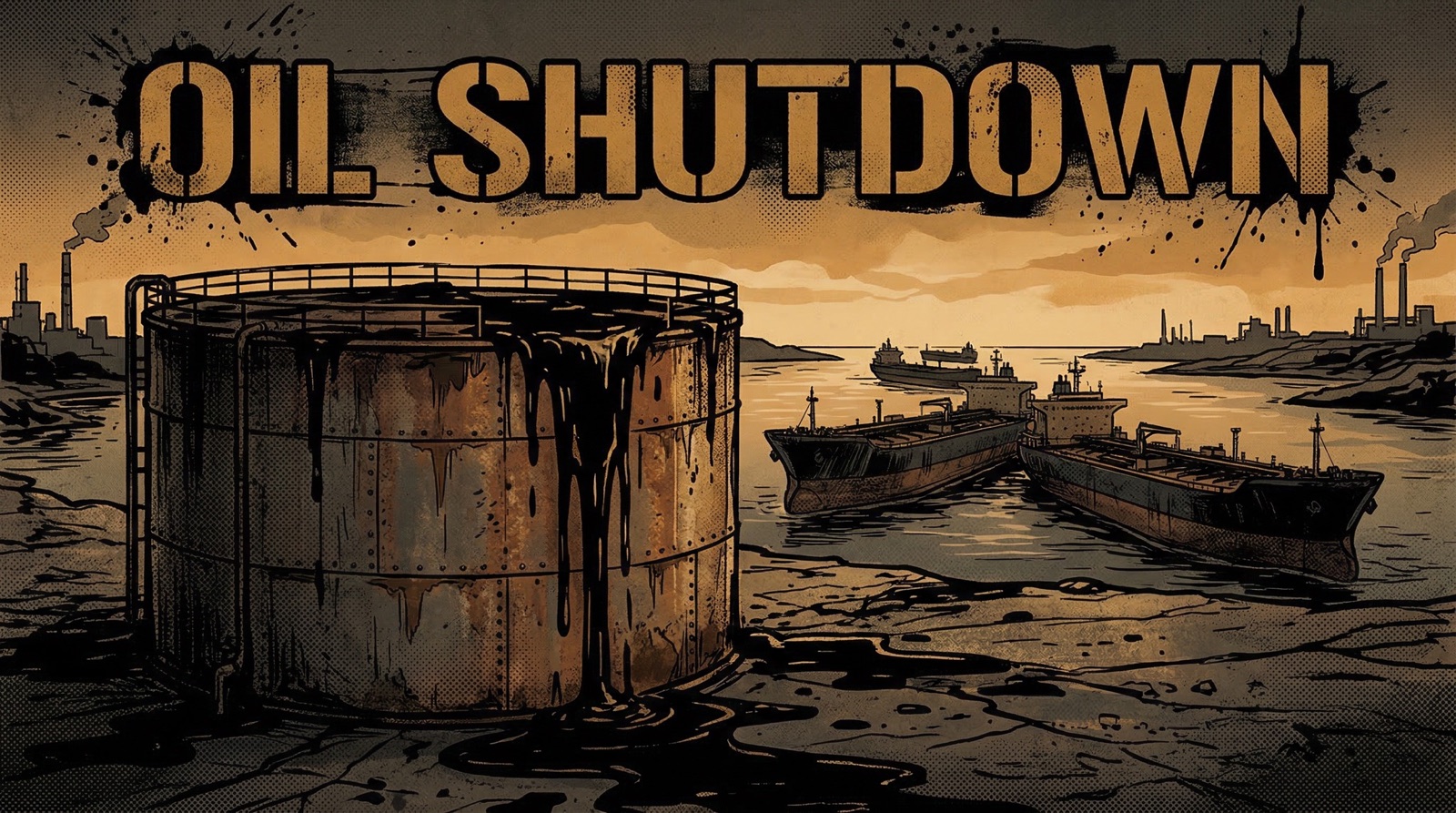
Three million barrels per day. Gone.
Iraq, the second-largest producer in OPEC, has seen crude output from its main southern oilfields fall from 4.3 million barrels per day to just 1.3 million, according to Reuters, citing three industry sources on Sunday, March 8.
That is a 70 percent collapse in the span of ten days.
The oil fields are intact. The wells work. Iraq has nowhere to send what it pumps.
STORAGE IS FULL. EXPORTS HAVE STOPPED
An official from Iraq's state-run Basra Oil Company told Reuters that crude storage has reached maximum capacity. Whatever production remains is being redirected entirely to domestic refineries.
In February, Iraq exported 3.334 million barrels per day from its southern terminals. By Sunday, that figure had cratered to roughly 800,000 barrels per day, according to Reuters. Only two tankers, the Hong Kong-flagged Cospearl Lake and the China-flagged Yuan Hua Hu, managed to load. Each took on approximately 2 million barrels.
After those ships finished loading around 8 p.m. local time, no new vessels arrived. Three oil officials and a shipping agent confirmed to Reuters that export flows from southern terminals had completely halted.
A senior Iraqi oil ministry official called it "the most significant operational challenge Iraq has encountered in over two decades."
THE STRAIT OF HORMUZ CHOKEPOINT
Every barrel of Iraqi crude from the south must pass through the Strait of Hormuz, the waterway between Iran and Oman that carries approximately 20 percent of the world's oil and liquefied natural gas, according to Reuters.
Since the United States and Israel launched military operations against Iran on February 28, the strait has been effectively closed. Iran's Revolutionary Guards warned they would target any vessel attempting passage. Tanker traffic fell from 37 vessels on February 27 to zero, according to Reuters.
Bloomberg reported on March 3 that Iraq had already begun shutting down its Rumaila field, the country's largest, along with the West Qurna 2 project. By March 8, Bloomberg estimated the production drop at roughly 60 percent. Hours later, Reuters confirmed the situation had worsened to 70 percent.
UAE, KUWAIT, AND QATAR ARE NEXT
Bloomberg reported on March 8 that the United Arab Emirates and Kuwait have also started reducing output as their own storage fills. Kuwait's petroleum corporation confirmed "precautionary reductions" tied to "Iranian threats against safe passage of vessels through the Strait of Hormuz," according to CNBC.
JPMorgan estimated that actual production cuts across the region reached approximately 2 million barrels per day and warned that cuts could exceed 4 million barrels per day by March 13, according to TradingKey.
Qatar's Energy Minister Saad al-Kaabi told the Financial Times that all Gulf oil-producing nations could cease production entirely within weeks if the blockade persists, potentially pushing prices to $150 per barrel.
WHAT THIS MEANS FOR THE PHILIPPINES
According to MUFG Research, 95 percent of the crude oil the Philippines imports comes from the Middle East. BusinessWorld, citing Department of Energy data, places the figure at roughly 98 percent.
Nearly all of the Philippines' imported crude passes through or originates from the zone now under blockade.
Brent crude breached $111 per barrel on Sunday. West Texas Intermediate climbed past $114. U.S. crude surged approximately 35 percent last week, the largest single-week gain in futures trading history since 1983, according to CNBC.
For Filipino consumers, the pipeline from Iraq's collapse to the gas station is direct.
On March 10, Philippine oil companies will begin implementing the largest fuel price increases in the country's history. Diesel is set to rise by P17 to P24 per liter across companies, gasoline by P7 to P13 per liter, and kerosene by P32 to P38.50 per liter, according to the Department of Energy and multiple Philippine outlets.
MUFG Research estimated that every $10 per barrel increase in oil prices widens the Philippines' current account deficit by 0.4 to 0.5 percent of GDP. At $100 per barrel sustained, GDP growth could fall to 3.7 percent in 2026. At $130, it could drop below 3.4 percent.
Around 2.1 million Filipinos live across the Middle East. The Department of Migrant Workers has declared the Strait of Hormuz and the Persian Gulf a "War Risk Operations Area," giving Filipino seafarers the legal right to refuse boarding vessels transiting the zone.
THE CLOCK
Iraq relies on oil revenue for over 90 percent of its national income, according to Reuters. With exports halted and production gutted, the fiscal pressure on Baghdad is acute.
Goldman Sachs warned on March 6 that if Strait flows remain sluggish through March, oil prices could surpass their historical peaks from 2008 and 2022.
The wells in Basra are still there. The oil is still underground. The refineries still work. It is the passage out that is gone.
SOURCES
- Reuters, https://www.reuters.com/business/energy/iraqi-oil-production-collapses-with-strait-hormuz-blocked-by-conflict-sources-2026-03-08/
- Bloomberg, https://www.bloomberg.com/news/articles/2026-03-08/oil-market-chaos-set-to-deepen-as-more-gulf-giants-cut-output
- Bloomberg, https://www.bloomberg.com/news/articles/2026-03-03/iraq-starts-shutting-oil-output-at-rumaila-as-storage-fills-up
- Bloomberg, https://www.bloomberg.com/news/articles/2026-03-08/iraq-oil-output-plunges-about-60-as-iran-war-blocks-tankers
- CNBC, https://www.cnbc.com/2026/03/08/crude-oil-prices-today-iran-war.html
- CNBC, https://www.cnbc.com/2026/03/08/stock-market-today-live-updates.html
- Wall Street Journal, https://www.wsj.com/livecoverage/iran-war-news-updates-2026/card/iraqi-oil-production-falls-below-one-third-of-normal-rate-cBQosNXpKR9VK1T2pnRH
- OilPrice.com, https://oilprice.com/Latest-Energy-News/World-News/Iraqs-Oil-Output-Plunges-70-as-Gulf-Shipping-Crisis-Deepens.html
- Times of Israel, https://www.timesofisrael.com/liveblog_entry/iraqi-oil-production-collapses-as-hormuz-still-blocked-by-iran-war-sources-say/
- Daily Sabah, https://www.dailysabah.com/business/energy/iraqi-oil-output-plunges-as-iran-war-blocks-strait-of-hormuz
- CommBank, https://www.commbank.com.au/articles/newsroom/2026/03/iraq-oil-production-collapses-strait-of-hormuz-blocked.html
- TradingKey, https://www.tradingkey.com/analysis/commodities/oil/261659068-oil-wti-brent-price-100-strait-of-hormuz-tradingkey
- MUFG Research, https://www.mufgresearch.com/fx/philippines-strait-of-hormuz-closure-impact-of-higher-oil-prices-and-more-9-march-2026/
- ING Think, https://think.ing.com/articles/asias-outlook-under-higher-oil-prices/
- BusinessWorld, https://www.bworldonline.com/top-stories/2026/03/09/734961/philippines-eyes-alternative-oil-suppliers-as-middle-east-war-stokes-fuel-concerns/
- Al Jazeera, https://www.aljazeera.com/news/2026/3/5/will-the-us-benefit-from-the-oil-crisis-sparked-by-the-war-on-iran
- Reuters, https://www.reuters.com/business/energy/why-is-asia-so-reliant-middle-eastern-oil-2026-03-04/
- Iran International, https://www.iranintl.com/en/202603039583
- Sunday Guardian, https://sundayguardianlive.com/world/iraq-oil-production-crashes-70-as-hormuz-blockade-chokes-southern-fields-faces-worst-crisis-in-20-years-why-cant-iraq-export-3m-bd-anymore-174956/
- Fortune, https://fortune.com/2026/03/06/strait-hormuz-expert-analysis-understanding-oil-crunch-90-per-barrel-inflation-iran-war/
- BBC, https://www.bbc.co.uk/programmes/p0n4vndq
- Egypt Oil and Gas, https://egyptoil-gas.com/news/iraqs-southern-oil-output-drops-70-as-hormuz-disruption-halts-exports/