
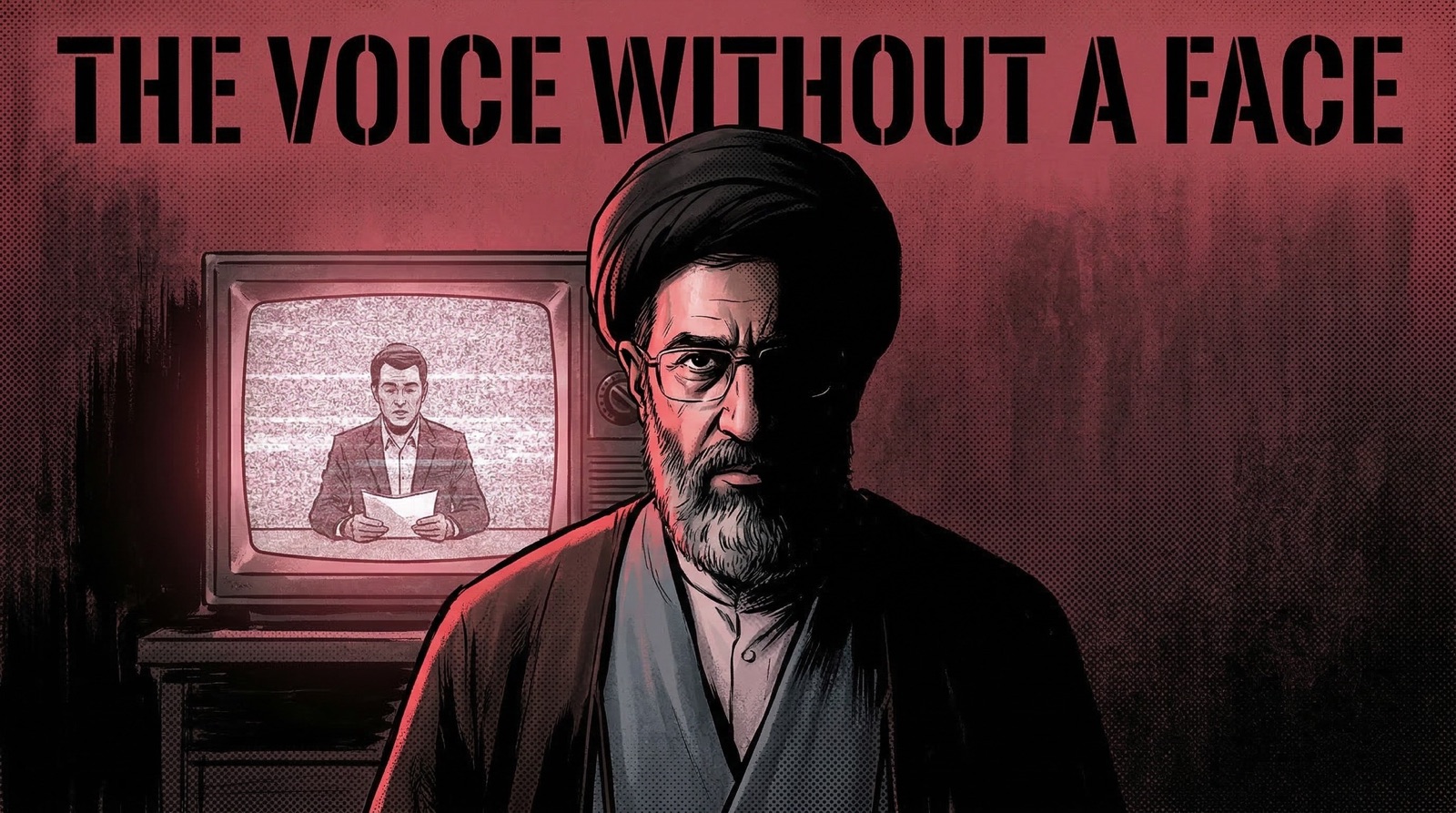
Nobody saw his face.
On Day 13 of the Iran war, Mojtaba Khamenei — the man who now holds the title of Supreme Leader of Iran — issued his first public statement since taking office. It was broadcast on Iranian state TV. But he was not on screen. A news anchor read his words aloud.
That detail alone tells a story. Whether Mojtaba is injured, hiding, or simply choosing not to be seen, the regime decided a disembodied message was enough. His father, Ali Khamenei, was killed in an Israeli airstrike on February 28 — the opening day of this war. Mojtaba succeeded him under circumstances that are still not fully clear from outside Iran.
Earlier reports had placed Mojtaba in a coma. Some outlets reported his leg had been amputated. Reuters reported on March 11 that he was "lightly injured" but still active. His statement, released through state media, was framed as a message of defiance and continuity.
The words were unambiguous.
WHAT HE SAID
"The leverage of blocking the Strait of Hormuz must continue to be used," the anchor read, quoting Mojtaba directly.
He then addressed the Gulf states — specifically those hosting American military bases — with a warning that doubled as an ultimatum: "I recommend that they shut down those bases as soon as possible, because by now they must have realized that the United States' claims of providing security and peace have been nothing more than a lie."
On the subject of retaliation, he said: "I assure everyone that we will not refrain from avenging the blood of your martyrs. A limited portion of this retaliation has already taken tangible form, but until it is fully achieved, this file will remain open above other cases."
A spokesman for Tehran's Khatam al-Anbiya command echoed the position on the strait, according to reports: Iran "will never allow even a single liter of oil to pass through the Strait of Hormuz for the benefit of the United States, the Zionists, or their partners."
Iranian state media also reported the IRGC launched what it called its "most intense and heaviest operation" in the same period.
WHAT IS HAPPENING IN THE WATER
The statement came against the backdrop of a rapidly deteriorating situation in the Gulf.
At least 6 tankers have been struck in the Gulf and Strait of Hormuz in the past two days. The United Kingdom Maritime Trade Operations reported 3 separate vessel strikes overnight. Two ships were struck by "unknown projectiles" five nautical miles from the port of Basra, Iraq. The Hapag-Lloyd charter ship Source Blessing was struck by shrapnel Thursday morning. A Thai-owned container vessel called Mayuree Naree was targeted 13 miles north of Oman — the Omani navy rescued 20 crew members after a fire broke out on board.
The US announced it destroyed 10 mine-laying boats and struck 28 Iranian mine-laying vessels on Wednesday alone.
Export volumes from the region have fallen to less than 10 percent of pre-conflict levels, according to available data. Gulf oil prices have risen 40 to 50 percent since the war began on February 28.
OIL AT $100 A BARREL — AND CLIMBING
Oil crossed the $100-per-barrel threshold on Thursday. It had already reached $117 per barrel on Monday.
The International Energy Agency, whose 32 member countries have agreed to release 400 million barrels of emergency reserves, warned this is creating what it called "the biggest oil supply shock in history," according to Al-Monitor.
An Iranian military figure separately warned of a prolonged war that would "destroy" the world economy.
President Trump, asked about rising oil prices, responded: "The United States is the largest oil producer in the world, by far, so when oil prices go up, we make a lot of money." He also vowed to strike Iran "twenty times harder" if it blocks oil flow.
THE PHILIPPINE SIDE OF THIS
For the Philippines, the Strait of Hormuz is not a distant geopolitical flashpoint.
Approximately 6,000 Filipino sailors remain trapped near the strait, according to previous reporting. One Filipino seafarer remains missing after a tugboat attack in the area.
The Department of Migrant Workers has expanded the war risk zone to cover the entire Persian Gulf. There are an estimated 2.1 million Filipinos working in the Middle East.
On fuel: diesel prices in the Philippines have already seen increases of P17 to P24 per liter since the conflict began. The Energy Regulatory Commission has warned that power rates could spike by P2 to P4 per kilowatt-hour in April.
Congress is currently processing a bill to suspend fuel excise taxes. The Philippines is one of the most oil-dependent economies in Asia, with almost no domestic crude production of its own.
The new Supreme Leader's first words were about keeping that strait closed. The effects are already registering in fuel prices at every gas station in this country.
SOURCES
- BBC, https://www.bbc.com/news/articles/cdxg599655vo
- Reuters, https://www.reuters.com/world/middle-east/irans-new-supreme-leader-lightly-injured-still-active-iranian-official-tells-2026-03-11/
- The New York Times, https://www.nytimes.com/2026/03/12/world/middleeast/khamenei-statement.html
- NPR, https://www.npr.org/2026/03/12/nx-s1-5745689/iran-war-israel-us
- CNBC, https://www.cnbc.com/2026/03/12/strait-of-hormuz-closure-iran-oil-prices-mojtaba-khamenei.html
- Time, https://time.com/article/2026/03/12/iran-new-supreme-leader-vows-revenge-blocks-strait-of-hormuz/
- CBS News, https://www.cbsnews.com/live-updates/iran-war-us-israel-gulf-allies-strait-of-hormuz-attacks-oil-prices-stocks/
- NBC News, https://www.nbcnews.com/world/iran/live-blog/live-updates-iran-war-oil-ship-attacks-hormuz-trump-israel-lebanon-rcna263101
- France 24 (video report), https://www.youtube.com/watch?v=3A5RoxeYuik
- Al-Monitor, https://www.al-monitor.com/originals/2026/03/war-creating-largest-oil-shock-history-iran-hits-new-gulf-targets
- CNN, https://www.cnn.com/world/live-news/iran-war-us-israel-trump-03-12-26