
I almost scrolled past it.
Sara Duterte showed up at the Senate on July 7, 2026, said one line to the media, and walked off.
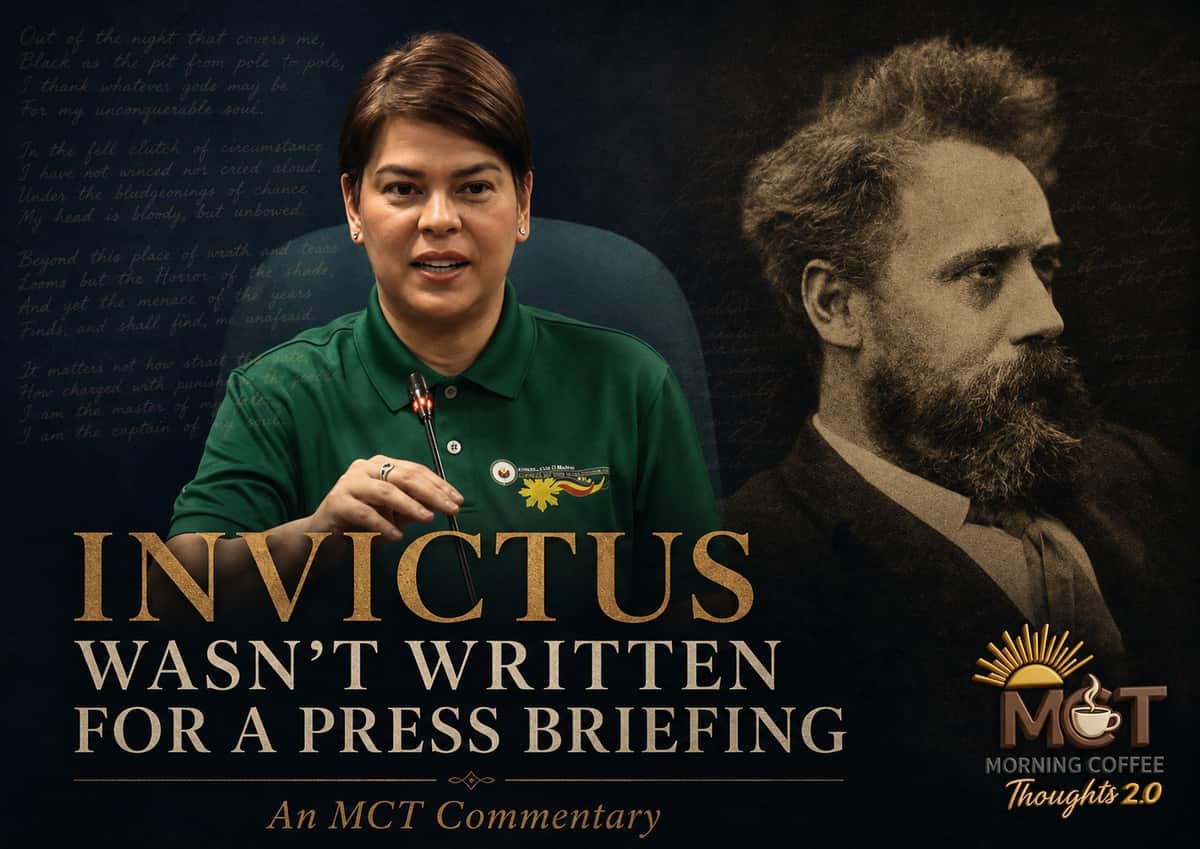
"In this bloodbath and bludgeoning, I will be bloodied but unbowed."
Then she skipped her own impeachment trial.
Most people probably nodded along or ignored it entirely. The line sounds strong. It sounds literary. And if you don't know where it comes from, it works exactly the way it was designed to: as a signal of defiance, masked in borrowed dignity.
But I know where it comes from. And I think William Ernest Henley deserves better than this.
THE MAN WHO ACTUALLY EARNED THOSE WORDS
Henley was twelve years old when tuberculosis invaded his bones. Not his lungs. His bones. Tubercular arthritis is the kind of disease that eats at your skeleton from the inside. By the time he was sixteen, doctors had no choice. They amputated his left leg below the knee.
That should have been the end of it. It wasn't.
A few years later, the disease came back for his right foot. Local surgeons told him the other leg had to go. Henley refused.
He had heard about a surgeon in Edinburgh named Joseph Lister, who was pioneering a then-radical idea: that infection could be controlled through antiseptic techniques.
In 1873, Henley packed up and traveled to the Royal Infirmary of Edinburgh, alone, to find this man and beg him to save what was left.
Lister saved the leg. But it took twenty-one months.
Henley lived in that hospital ward for nearly two years. He watched people come in and not come out. Gangrene was common. Death was the expected outcome for most amputees of the era.
He wrote an entire collection of poems from that ward, documenting the smells, the sounds, the faces of the nurses and the other patients, the dread of every morning. One of those poems was Invictus.
He wrote it in 1875, at twenty-six years old, with one leg already gone and the other still uncertain. He never published it immediately. It sat for over a decade before appearing in his first volume, Book of Verses, in 1888.
He was not writing it for anyone. He was writing it to hold himself together.
One more detail worth knowing: Henley became close friends with Robert Louis Stevenson during his hospital stay. Stevenson later modeled the character of Long John Silver on him. A one-legged man who refused to be diminished, and who carried himself with a kind of reckless, full-bodied defiance. That was Henley. In real life.
Here's the actual line from the poem: "My head is bloody, but unbowed."
Sara said bloodied. The poem says bloody. Small difference on the surface.
THE POEM AND WHAT IT ACTUALLY SAYS
Invictus is Latin for "unconquered."
The whole poem is about one thing: enduring suffering without drama. Henley wasn't performing for anyone. He was in a hospital bed, in real physical pain, writing something private and defiant just to stay sane.
The poem opens with Henley in darkness, thanking "whatever gods may be" for his "unconquerable soul."
Second stanza: he has not winced, has not cried aloud, even under the "bludgeonings of chance."
Third stanza: death looms, and he is still unafraid. The last lines are the ones everyone quotes: "I am the master of my fate, I am the captain of my soul."
That closing is not a rallying cry. It is a statement of accountability. It says: whatever happens, I own it. No excuses. No blame. No one else to point to.
WHAT SARA'S VERSION ACTUALLY REVEALS
Henley's defiance was quiet and inward. He wrote from a hospital bed, not from a Senate hallway with cameras rolling. The poem does not ask for witnesses. The whole point is that you face your situation alone, without needing an audience to validate your endurance.
Sara's version was a performance. She walked in, said the line, and walked out without attending the proceedings.
She called the impeachment trial a "bloodbath," the same word she has used repeatedly in recent weeks.
She borrowed the poem's imagery of being battered, but left out the part where Henley accepts accountability and faces what is in front of him.
The line she left out, "I am the master of my fate, I am the captain of my soul," is the poem's whole point. You are responsible. You own the outcome. You do not deflect.
Invoking Invictus while framing your legal proceedings as something being done to you is a contradiction. The poem does not allow for victims. That is the whole design of it.
THE DUTERTE FAMILY AND THIS POEM
This is not the first time Invictus has appeared in Duterte family politics.
After the International Criminal Court (ICC) upheld its jurisdiction over Rodrigo Duterte's crimes against humanity case in April 2026, his daughter Kitty Duterte quoted the same poem outside the ICC detention facility.
She relayed that her father's message to supporters was simply: "Invictus." He emphasized "I am the master of my fate, I am the captain of my soul," and described his head as "bloodied but unbowed."
The poem has become a Duterte family symbol of political defiance. The question is whether the usage holds up to the poem's actual standards.
Henley wrote about accepting suffering without complaint, without performance, without pointing fingers at who caused the bludgeoning.
Rodrigo Duterte is at the ICC facing crimes against humanity charges. Sara Duterte is at an impeachment trial.
Both have described their situations as persecution. Both reached for a poem that, at its core, tells you to stop making excuses and own your fate.
Private prosecutor Lorna Kapunan, after Sara's Senate appearance, described the statement as inappropriate given the context.
WHAT IS ACCURATE AND WHAT IS NOT
The paraphrase is close but not exact. The original says "bloody." Sara said "bloodied." One is an adjective describing a state of being. The other implies something was done to you. One word. That's where the whole thing falls apart.
Henley chose bloody because it was descriptive. He was describing his own condition, not assigning blame for it.
"Bloodied" subtly shifts responsibility outward. Someone bloodied you. Something was done to you. The poem does not work that way.
The entire poem is built on the opposite premise: you are not a victim. You are the author of your own endurance. Stripping that out and replacing it with grievance politics is not just a misquote. It's a rewrite of what the poem stands for.
The Malaya Business Insight editorial wrote: "Quoting poetry does not make one profound. Memorizing a famous line does not make one resilient. And invoking Invictus without grasping its core does not make one unbowed."
William Ernest Henley spent twenty-one months in a hospital ward earning the right to write those lines. He had already lost one leg. He was staring at the possible loss of the other. He wrote without an audience, without cameras, without a press briefing.
The least anyone can do is get the words right.
SOURCES
- GMA Network, https://www.gmanetwork.com/news/topstories/nation/994006/sara-duterte-on-impeachment-trial-i-will-be-bloodied-but-unbowed/story/
- Inquirer, https://newsinfo.inquirer.net/2259052/sara-duterte-on-impeachment-bloodbath-i-will-be-bloodied-but-unbowed
- Manila Bulletin, https://mb.com.ph/2026/07/07/blooded-but-unbowed-vp-sara-duterte-arrives-at-senate-but-skips-day-2-of-impeachment-trial
- Philippine Star, https://www.philstar.com/headlines/2026/07/07/2540466/bloodied-unbowed-vp-sara-arrives-senate-day-2-impeachment-trial
- Politiko, https://politiko.com.ph/2026/07/07/bloodied-but-unbowed-sara-duterte-swings-by-senate-for-a-statement-but-skips-day-2-of-impeach
- Daily Tribune, https://tribune.net.ph/2026/04/23/kitty-duterte-cites-invictus-after-icc-ruling
- Malaya Business Insight, https://malaya.com.ph/opinion/editorial/the-misreading-of-invictus/
- Wikipedia, Invictus, https://en.wikipedia.org/wiki/Invictus
- Poetry Foundation, https://www.poetryfoundation.org/poems/51642/invictus
- Poetry Foundation, William Ernest Henley biography, https://www.poetryfoundation.org/poets/william-ernest-henley
- LITFL, https://litfl.com/invictus/
- NYC Parks, Invictus Triangle history, https://www.nycgovparks.org/parks/invictus-triangle/history
- Science Direct, The Poet, His Poem, and the Surgeon, https://www.sciencedirect.com/science/article/abs/pii/S1931720414002025
- Health and Humanities, Royal Infirmary of Edinburgh and Long John Silver, https://hekint.org/2020/11/23/the-royal-infirmary-of-edinburgh-and-the-legacy-of-long-john-silver/
- Marc J. Sims literary analysis, https://marcjsims.com/2022/08/24/invictus-by-william-ernest-henley/
- Reddit Poetry thread, https://www.reddit.com/r/Poetry/comments/1osg0b/can_someone_explain_the_first_two_lines_of_the/
- Rappler, https://www.facebook.com/rapplerdotcom/posts/william-ernest-henleys-1875-poem-invictus-is-widely-referenced-to-express-resili/
- Philippine Star (Kapunan), https://www.facebook.com/PhilippineSTAR/posts/i-thought-its-inappropriateprivate-prosecutor-lorna-kapunan-deemed-inappropriate/
- ABS-CBN News, https://www.abs-cbn.com/news/nation/2026/7/7/duterte-security-team-at-senate-no-confirmation-if-vp-to-attend-trial-1127
- Poets.org, Invictus, https://poets.org/poem/invictus