
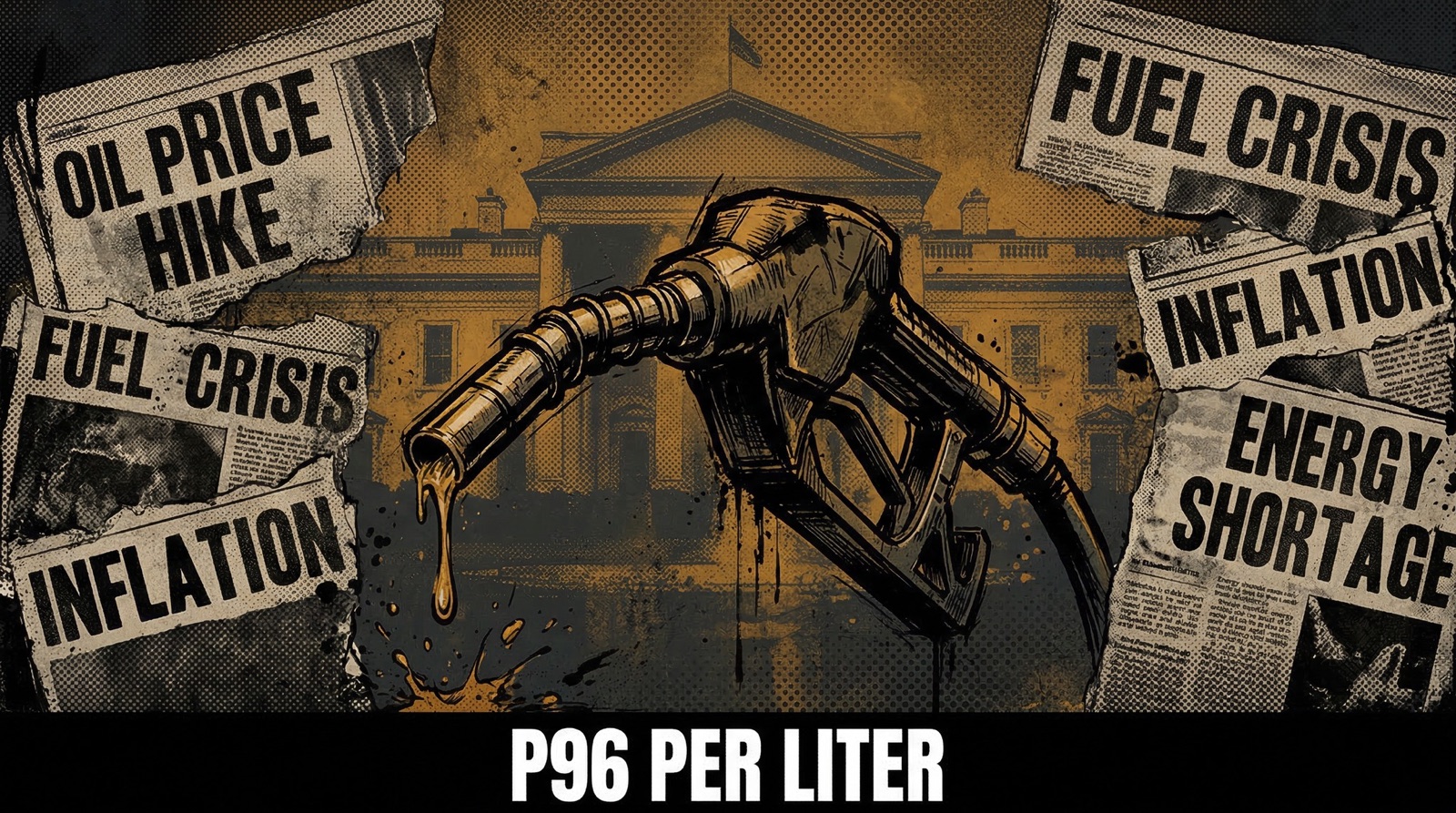
How fast can the Philippine government move when fuel hits P96 per liter?
On Tuesday, March 10, the House committee on ways and means approved an unnumbered substitute bill that would allow President Ferdinand Marcos Jr. to temporarily suspend or reduce excise taxes on fuel products during national emergencies.
The committee vote came one day after the bill was filed. Manila Representative Rolando Valeriano proposed its adoption. Committee chairman Rep. Miro Quimbo of Marikina endorsed the motion after receiving no objections, then approved a second motion to advance the measure to the plenary for immediate action, according to Inquirer.
"We have to fast-track this," Quimbo said on Monday. "We're waiting for the presidential certification so we can actually approve it as soon as possible."
WHAT THE BILL DOES
House Bill No. 8292 was filed on Monday by Speaker Faustino "Bojie" Dy III and Majority Leader Ferdinand Alexander "Sandro" Marcos. It proposes an amendment to Section 148 of the National Internal Revenue Code of 1997.
Under the bill, the President may suspend or reduce excise taxes on specific petroleum products based on the recommendation of the Secretaries of Finance and Energy. Two conditions must be met.
First, the average price of Dubai crude oil must reach or exceed $80 per barrel for at least three consecutive months prior to the suspension order.
Second, the President must have declared a national emergency or calamity resulting in significant increases in domestic fuel prices, as certified by the Secretary of Energy.
Any suspension or reduction would last for a maximum of six months, unless Congress extends or terminates it earlier through a joint resolution. The total duration may not exceed one calendar year. Once the conditions are resolved, the original excise tax rates automatically apply, according to Inquirer.
Currently, the excise tax on diesel stands at P6 per liter. Gasoline is taxed at P10 per liter.
THE FISCAL COST
The Department of Finance has warned that eliminating the fuel excise tax from May through December 2026 would cost the treasury an estimated P136 billion in lost revenue.
Finance Undersecretary Karlo Fermin Adriano broke the figure down during a committee hearing on Monday: P121.4 billion from lost excise tax collections and P14.6 billion from reduced value-added tax revenues, according to Inquirer.
For every peso removed from the P6 per liter diesel excise tax, the government loses P9 billion to P10 billion. For every peso removed from the P10 per liter gasoline excise tax, the loss is P5 billion to P6 billion.
The DOF, in a separate statement, placed the total foregone revenue from suspending all fuel excise taxes and VAT at P147.1 billion, according to ONE News.
TWO SCENARIOS ON THE TABLE
The Department of Economy, Planning, and Development presented two scenarios during Monday's hearing through Undersecretary Rosemarie Edillon.
Under Scenario 1, the Middle East conflict de-escalates and Dubai crude settles at around $80 per barrel. Diesel would drop from P74.22 per liter to P67.50 per liter with the excise tax suspended.
Under Scenario 2, the Strait of Hormuz stays closed and oil spikes to $140 per barrel. Diesel surges to P96 per liter. Suspending the excise tax brings it down to P90.04. Gasoline reaches P82.20 per liter without suspension, dropping to roughly P72 if the tax is removed.
Full-year inflation under Scenario 1 projects between 3.9 and 4.2 percent. Under the worst case, it climbs to between 4.5 and 4.8 percent without intervention, according to Rappler.
THE SENATE IS MOVING TOO
The House is not alone. Senate President Vicente Sotto III confirmed that the upper chamber has been in continuous communication with the Office of the Executive Secretary on the fuel excise legislation since the weekend, according to Philstar.
"We will prepare for it. The Senate is committed to providing any assistance possible to the executive branch," Sotto said.
The Senate's ways and means, finance, and energy committees are scheduled to begin hearings on the fuel excise suspension proposals, according to Philstar.
Presidential Undersecretary Claire Castro told Philippine media during Marcos' working visit to New York that the Department of Energy plans to formally request Congress to grant the President special powers to lower the excise tax, according to Philstar.
FROM HEARING TO VOTE IN 24 HOURS
What took years of debate during the TRAIN law's original passage in 2017 is now moving through committee in a single day. The difference is context. Oil has been above $80 per barrel for months. Brent crude spiked above $120 per barrel before pulling back. The Strait of Hormuz has been functionally closed since late February.
Monday's hearing saw officials from the DOF and DEPDev lay out the numbers. Tuesday's committee session approved the bill.
The next step is plenary approval in the House, followed by Senate deliberations. Both chambers appear to be operating under the assumption that Marcos will certify the bill as urgent.
SOURCES
- Inquirer, https://newsinfo.inquirer.net/2193410/panel-oks-bill-giving-marcos-powers-to-suspend-excise-tax-on-fuel
- Philstar, https://www.philstar.com/headlines/2026/03/10/2513194/congress-palace-move-cut-fuel-excise-tax
- Inquirer, https://newsinfo.inquirer.net/2192959/house-leaders-to-grant-president-power-to-suspend-fuel-excise-tax
- Inquirer, https://newsinfo.inquirer.net/2192719/ph-may-lose-p136-b-in-2026-if-excise-tax-suspended-starting-may
- ONE News (Facebook), https://www.facebook.com/ONENewsPH/posts/the-department-of-finance-dof-warned-that-suspending-the-fuel-excise-tax-startin/1457425163079497/
- Congress.gov.ph, https://www.congress.gov.ph/media/press-releases/view/?content=9665
- PNA, https://www.pna.gov.ph/articles/1270715
- Rappler (MEXC), https://www.mexc.com/news/885568
- Inquirer, https://newsinfo.inquirer.net/2189841/2-senators-back-marcos-fuel-tax-cut-push-amid-tension-in-middle-east