
WHAT THE NEW SURVEY ACTUALLY SHOWS
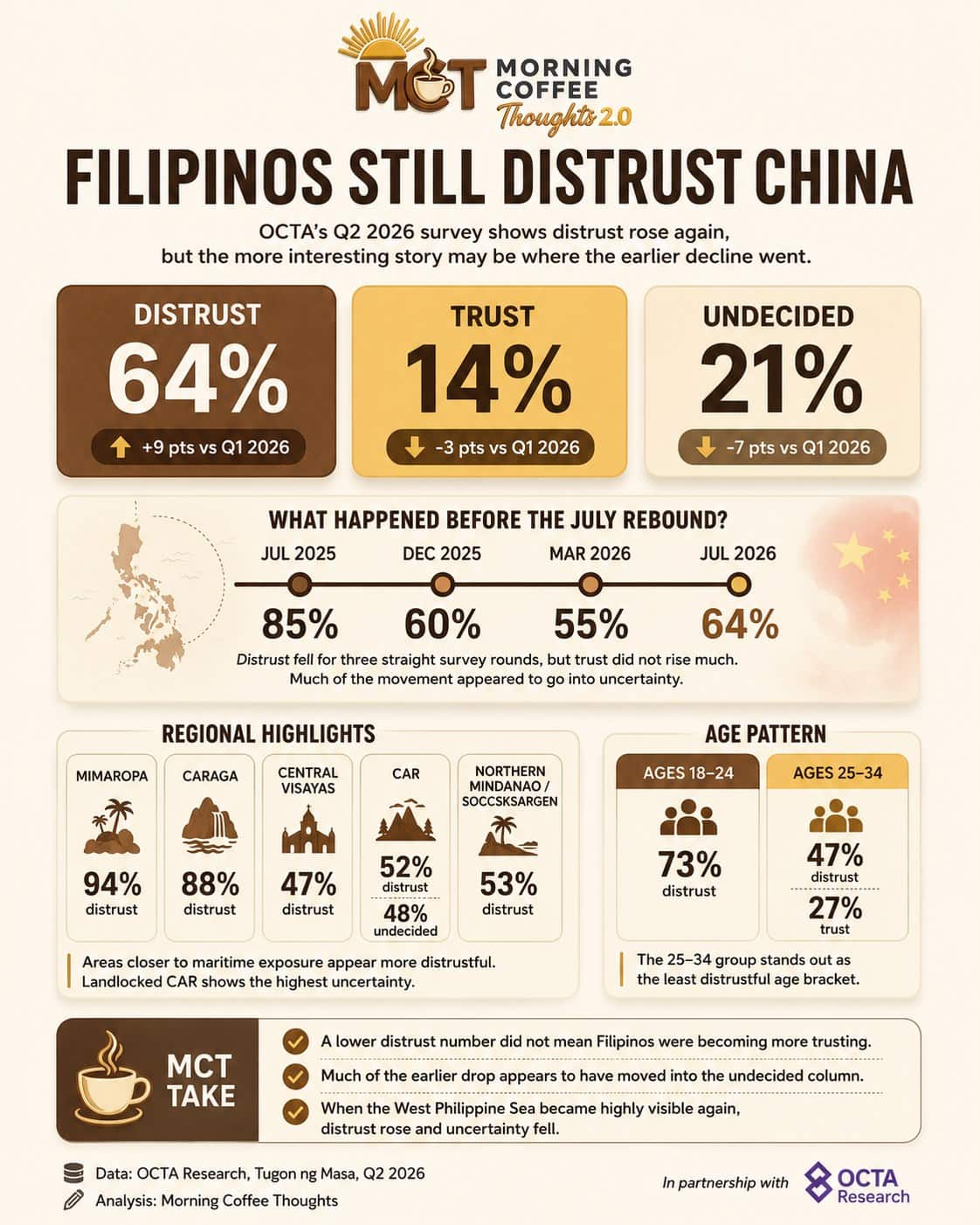
OCTA Research's latest Tugon ng Masa survey found that 64 percent of Filipinos say the country should distrust China, up from 55 percent in March 2026. Trust barely moved, slipping from 17 percent to 14 percent, while the undecided group fell from 28 percent to 21 percent.
OCTA points to renewed attention on the West Philippine Sea (WPS) as one possible reason. The survey was conducted from July 4 to 11, during the buildup to the 10th anniversary of the 2016 arbitral ruling against China's sweeping claims in the South China Sea, with the anniversary falling on July 12.
That explanation makes sense, but I think there is a more interesting question buried in the numbers: where did all that distrust go before it came back?
LOOK AT THE UNDECIDED NUMBER
Distrust of China stood at 85 percent in July 2025. It fell to 60 percent in December, then dropped again to 55 percent by March 2026.
You could look at that and think Filipinos were slowly becoming more comfortable with China. The problem is that the trust numbers do not show that. Trust stayed relatively low, while the number of Filipinos who were undecided kept growing.
That is the part I find more interesting. People were leaving the distrust column, but they were not rushing into the trust column. Many of them were ending up somewhere in between.
Then July came around. Distrust jumped nine points, while the undecided number fell seven points.
I cannot say those were exactly the same people moving from one answer to another because the survey does not track individual respondents that way. But when one number rises sharply while the other falls almost as sharply, I think it is fair to ask whether some of that distrust was never really gone in the first place.
Perhaps some Filipinos simply became less certain for a while. Then the West Philippine Sea became impossible to ignore again.
THE ANNIVERSARY EXPLAINS PART OF IT
The timing clearly supports OCTA's explanation. The survey happened just before the 10th anniversary of the arbitral ruling, when the West Philippine Sea was getting renewed attention.
But this is where I start to hesitate.
Chinese Coast Guard and maritime militia activity did not suddenly stop during the months when Filipino distrust was falling. The problems at sea continued, yet fewer people were telling OCTA they distrusted China.
So what changed? It could simply be attention.
Perhaps when the West Philippine Sea dominates the news, Filipinos become more certain about how they feel toward China. When it fades from the headlines for a while, some people move back into uncertainty.
I do not think this survey alone can answer that. I also do not think we should look at a falling distrust number and assume China is becoming more acceptable to Filipinos, because the trust numbers never really showed that.
WHERE YOU LIVE MAY ALSO AFFECT HOW YOU SEE THIS
The regional results gave me another reason to pause. Distrust reached 94 percent in MIMAROPA and 88 percent in Caraga, while it was 47 percent in Central Visayas, 52 percent in the Cordillera Administrative Region (CAR), and 53 percent in both Northern Mindanao and SOCCSKSARGEN.
MIMAROPA includes Palawan, which is much closer to the West Philippine Sea, both geographically and in terms of fishing, security, and repeated confrontations involving Chinese vessels. CAR, on the other hand, is landlocked, and 48 percent of respondents there were undecided, the highest undecided number in the survey.
I do not want to force a conclusion from that because there could be many reasons for the regional differences. But I do wonder whether distance changes how urgent the issue feels.
For someone whose livelihood depends on the sea, China may not feel like an abstract foreign-policy question. For someone living far from the coast, the West Philippine Sea may feel much farther removed from daily life.
That does not explain everything, but it does make me question whether national media coverage is the whole story behind these numbers. Geography, livelihood, and direct exposure may also be shaping how people answer.
THE AGE NUMBERS ARE EVEN STRANGER
The age breakdown surprised me. Distrust is highest among Filipinos aged 18 to 24, at 73 percent.
Then you move one age group up, to 25 to 34, and distrust drops to 47 percent. That is the only age group where fewer than half say the country should distrust China, and it also has the highest combined trust rating in the survey, at 27 percent.
Why the gap?
I honestly do not know, and the survey does not answer it. The easy explanation would be social media, but that does not really work because both groups are heavily online.
There may be something about economic experience, work, political memory, or the events each generation remembers most clearly. Filipinos now in their early twenties grew up politically during years when water cannon incidents and confrontations in the West Philippine Sea became regular national news.
That is only one possibility. The survey gives us the difference, but not the reason behind it.
WHAT I THINK THE NUMBERS ARE REALLY TELLING US
I think we have been looking at distrust of China too simply. Distrust goes down and people assume Filipinos are warming toward China. Distrust goes up and people assume public anger has suddenly returned.
But look at where the numbers actually moved.
Trust barely changed, while the biggest movement happened between distrust and uncertainty. That tells me Filipino opinion toward China may not be moving neatly between liking and disliking Beijing. A significant part of the public may instead be moving between having a strong opinion and not being quite sure what to think.
Visibility may have something to do with it. When the West Philippine Sea is everywhere, the confrontations are on television, fishermen are speaking publicly, and the arbitral ruling is back in the national conversation, people have something immediate in front of them.
When attention fades, some of that certainty may fade with it.
I think that is the question the next OCTA survey should help answer. Was this nine-point jump a temporary reaction to renewed attention around the arbitral ruling anniversary, or are Filipinos beginning to settle back into the much higher distrust levels we saw before?
For now, I would be careful about saying Filipinos had started warming up to China and then suddenly changed their minds. The numbers do not really show that.
What they show is that trust remained low while uncertainty grew. Then, when the West Philippine Sea became highly visible again, distrust rose and uncertainty fell.
To me, that is the more interesting story.
SOURCES
- OCTA Research, Q2 2026 Tugon ng Masa Survey Report on Public Sentiment Toward China (PDF, user-provided document)
- Philippine Star, https://www.philstar.com/headlines/2025/08/25/2467962/85-filipinos-distrust-china-octa-survey
- GMA News, https://www.facebook.com/gmanews/posts/on-this-day-philippines-wins-arbitral-case-vs-chinatoday-july-12-2026-marks-the-/1600426802128971/
- Rappler, https://www.rappler.com/philippines/view-manila-trust-china-survey-2024/
- ABS-CBN News, https://www.abs-cbn.com/news/nation/2026/7/11/filipino-fishermen-see-no-victory-a-decade-after-landmark-south-china-sea-ruling-0758
- YouTube, https://www.youtube.com/watch?v=AIlKjOgCSek
- YouTube, https://www.youtube.com/watch?v=cOkaxw__xxo
- Asia News Network, https://asianews.network/survey-filipinos-trust-us-most-to-help-protect-west-philippine-sea/