
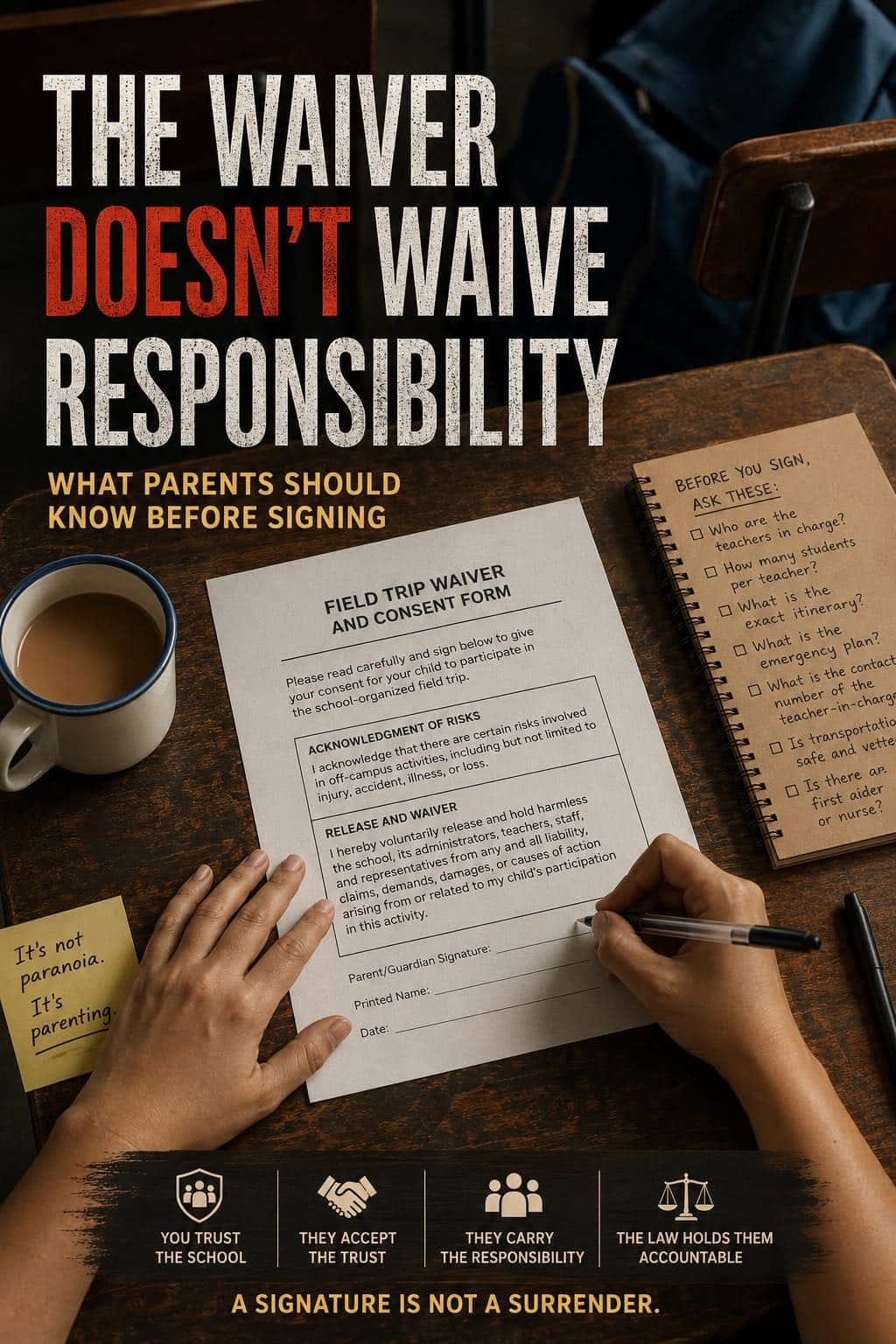
What happened in Dipaculao brought back one of my oldest fears as a parent: that quiet apprehension every time my daughter came home from school with a field trip waiver.
“Dad, please sign this. We have a field trip.”
That was usually how it started.
As parents, we read it. Sometimes carefully. Sometimes quickly. Sometimes we sign because our child is excited, the classmates are already going, and we do not want our child to be left behind.
But somewhere in the form, there is usually a line that says something like:
The school shall not be held liable for any injury, accident, or loss.
That is where I stop.
I only have one child. Just one. And ever since she was a baby, I have always been paranoid about her safety. Not because I am being dramatic. Because I am a parent.
So when she became a student and told me she had a field trip, I automatically became apprehensive. I did not just ask, “Where are you going?” or “What time are you leaving?”
I asked:
Who is going with you?
How many teachers will be there?
Will there be a nurse?
What bus are you taking?
Is there an emergency contact?
For good measure, I always asked for the phone number of the teacher joining them on the trip. I also made sure my daughter’s phone had mobile data and call credits so she could reach me anytime, for whatever reason, even if it was just because she felt uncomfortable.
Because to a child, a field trip is an adventure.
To a parent, it is a responsibility.
And when a school asks parents to sign a waiver, it can sometimes feel like the message is this:
You agreed. If something happens, we are out.
But it is not that simple.
WHAT IS A FIELD TRIP WAIVER?
A field trip waiver is a consent form.
Schools ask parents to sign it before allowing a student to join an off-campus activity.
On paper, its purpose is simple.
You allow your child to join. You acknowledge that there are risks. You agree that your child is participating voluntarily. And usually, there is a part where the school appears to be released from liability if something goes wrong.
A waiver is not automatically wrong.
Consent is necessary. The school needs to know that the parent allowed the child to join. The form should clearly state where the students are going, when they are leaving, when they are returning, who will accompany them, and what activity will take place.
That part is reasonable.
But there is a big difference between consent and immunity.
You may allow your child to join a field trip.
That does not mean you have allowed the school to be careless.
Your signature is consent.
It is not surrender.
WHAT DOES THE LAW SAY?
I am not a lawyer.
But I studied this a long time ago, not to pretend to be an expert, but to understand as a parent what a school’s responsibility really is if something goes wrong during a field trip.
Because when your child is involved, “just sign this” is not enough.
You want to know how far the school’s responsibility goes.
You want to know what rights your child has.
And you want to know whether the waiver protects the child, or merely protects the institution.
Under Philippine law, there is a concept called special parental authority.
Under Article 218 of the Family Code, schools, administrators, and teachers exercise special parental authority over students under their supervision.
In simple terms, while the child is under their care, they have a responsibility to act like parents.
That responsibility does not end at the school gate.
If the field trip, excursion, immersion, outreach, competition, retreat, or any other off-campus activity is an authorized school activity, the school carries its duty of care with it.
The school cannot simply say:
“We were already outside campus, so the child is no longer our responsibility.”
That is not how it works.
If it is a school activity, the student remains under school supervision.
Article 219 of the Family Code also says that those exercising special parental authority may be principally and solidarily liable for damages caused by or to the minor student.
Solidary liability means the school, administrator, and teacher may be held responsible together, depending on the facts.
Then there is Article 2180 of the Civil Code, which deals with vicarious liability. If a child’s injury is connected to the negligence of a teacher, staff member, or school personnel, the school may also be held liable.
And this is not only about statutes.
DepEd Order No. 66, s. 2017 sets guidelines for off-campus activities. Schools are required to observe safety and security protocols before, during, and after the activity.
There are requirements for supervision.
Venue whecking.
Documentation.
Parent consent.
Risk assessment.
Emergency planning.
In other words, it is not enough for a school to say that a waiver was signed.
The school still has work to do.
WHEN CAN A SCHOOL BE HELD LIABLE?
When something happens during a field trip, the question is not only:
Was there a waiver?
The more important question is:
Did the school fail in its duty?
That is where negligence comes in.
For example:
Poor supervision.
Unsafe venue.
Not enough teachers for the number of students.
No clear emergency plan.
The bus was not properly checked.
The child was not properly monitored.
DepEd guidelines were not followed.
The student was ignored despite an obvious risk.
If the injury happened because of negligence, a waiver is not enough to erase responsibility.
In St. Francis High School v. Court of Appeals, the parents had signed a permission slip allowing the child to join a picnic. But even with that consent, the teachers’ responsibility to supervise the students did not disappear.
That is the important point.
A parent’s signature does not erase the school’s duty.
There is also a legal principle called volenti non fit injuria. In simple terms, if you knew the risk and accepted it, it becomes harder to claim injury later.
Schools may try to use that argument.
But the situation is different when children are involved.
A child cannot fully understand risk the way an adult can. And even if a parent signs a waiver, that does not automatically waive the child’s right to seek accountability if there was negligence.
That is why the facts matter.
The waiver is not the end of the discussion.
The evidence will decide.
IT IS NOT AUTOMATICALLY THE SCHOOL’S FAULT EITHER
Fairness matters.
It does not mean that whenever something happens during a field trip, the school is automatically at fault.
Schools are not automatic insurers of every student.
They also have legitimate defenses.
If the school can prove that it took all reasonable precautions, provided proper supervision, vetted the venue, ensured safe transportation, had an emergency plan, and acted with the diligence of a good father of a family, it may be absolved.
If the incident was caused by force majeure, a truly unforeseeable and unavoidable event, liability may not attach.
If the student violated clear rules, wandered away from the group, hid from supervision, or did something clearly prohibited, contributory negligence may also be considered.
So yes, schools have defenses.
But those defenses must be legal and factual.
Not simply:
“There was a waiver.”
WHAT SHOULD PARENTS DO?
Read the form.
Do not just sign because you are in a hurry.
Ask for details.
Do not be embarrassed to ask questions.
Who are the teachers joining the trip?
How many students will each teacher supervise?
What bus company will be used?
Will there be a first aid kit?
Will there be a nurse?
What is the exact venue?
What is the emergency protocol?
What is the cellphone number of the teacher-in-charge?
And yes, make sure your child can contact you.
Mobile data.
Call credits.
Battery.
Clear instruction: if something does not feel right, call immediately.
This is not paranoia.
This is parenting.
Because a field trip is not just a school activity.
It is a temporary transfer of trust.
You are lending your child to the school for the day.
And when you do that, the school does not merely receive a signed paper.
It receives responsibility.
THE BOTTOM LINE
A field trip waiver has a purpose.
It proves that the parent gave consent.
It shows that the school informed the parent about the activity.
It records that the child was allowed to join.
But it does not erase the school’s duty of care.
It does not excuse negligence.
It does not turn a parent’s signature into a shield against accountability.
So yes, sign the waiver if you want your child to go.
But understand what you are signing.
You are giving permission.
You are not giving the school absolution.
Your signature is consent.
It is not surrender.
SOURCES
- Husband and Wife Law Team — Liability for Field Trip Injuries, https://husbandandwifelawteam.com/blog/are-schools-liable-for-injuries-on-field-trips
- Respicio & Co. — Liability of Schools for Injuries During School Activities, https://www.respicio.ph/commentaries/liability-of-schools-for-injuries-during-school-activities
- TeacherPH — Teachers’ Liability on Students’ Injury in Schools, https://www.teacherph.com/teachers-liability/
- Jur.ph — DepEd Order No. 66, s. 2017, https://jur.ph/law/facts/implementing-guidelines-off-campus-activities
- Bataspinoy — Article 218 and 219, Family Code of the Philippines, https://bataspinoy.wordpress.com/2011/04/17/if-the-person-under-custody-is-a-minor-those-exercising-special-parental-authority
- Vocare Law — The Effectiveness of Waivers in Schools, https://vocarelaw.com.au/schools-education/the-effectiveness-of-waivers-in-schools
- Justia — Field Trip Injuries & Potential Premises Liability Lawsuits, https://www.justia.com/child-safety/school-safety/field-trip-injuries