
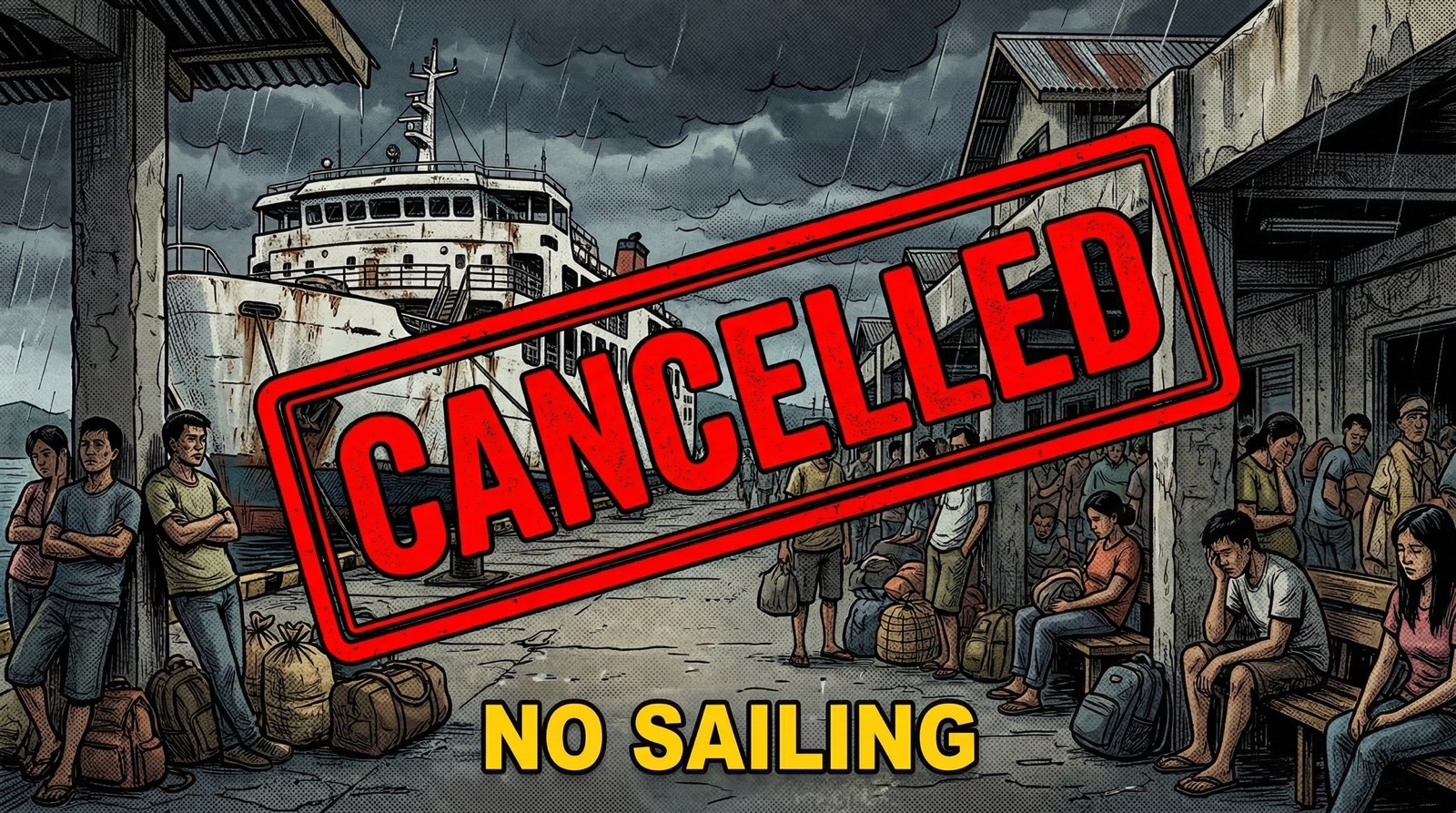
The oil shock is no longer an abstraction on a commodities chart. It has arrived at Philippine ports, airports, and ferry terminals.
Multiple inter-island shipping operators have begun slashing routes and imposing emergency surcharges of up to 20 percent. At least 48 flights to the Middle East have been canceled. Jet fuel costs in Asia have surged 77 percent. And this is happening just weeks before Holy Week, when millions of Filipinos travel by sea.
THE SHIPPING LINES
OceanJet, one of the largest fast-craft operators in the Visayas, halted eight daily sailings until at least March 20. Affected routes include Cebu to Dumaguete, Cebu to Tagbilaran, Cebu to Guiuan, and connections to Palompon and Bicol. The company cited the need to "control fuel expenditures amid global uncertainties."
SeaCat by Grand Ferries indefinitely removed its Cebu-Atabayan and Cebu-Baybay routes and raised fares on remaining connections to Ormoc and Calbayog. The company issued a statement acknowledging passenger impact and said fares would be reassessed "once prices stabilize."
Montenegro Shipping Lines announced fare increases of 10 to 25 percent starting March 23, directly attributing the hike to a 40 percent surge in fuel costs. Jomalia Shipping Corp. imposed a 20 percent fuel surcharge on both passenger and freight services. Super Shuttle Ferry added an extra 20 percent charge across its fleet to maintain operations.
The Philippine Ports Authority recorded a 37 percent rise in passenger volume to 2.29 million during Holy Week 2025. If current cancellations and fare hikes hold through the next few weeks, this year's travel season could see significant disruption.
THE AIRLINE SIDE
Cebu Pacific and Philippine Airlines have already canceled a combined 48 flights to the Middle East, with more cancellations possible depending on how the conflict develops.
Domestic airfares may be next. The Civil Aeronautics Board is considering adjusting fuel surcharges for the first time in eight months. The current Level 4 surcharge, in place since August 2025, ranges from P117 to P342 for domestic flights and P385 to P782 for international routes, depending on distance.
The trigger is jet fuel. According to the International Air Transport Association, jet fuel prices surged 58 percent to $157 per barrel as of March 6, up from $99.40 per barrel on February 27 — the day before U.S. and Israeli strikes on Iran triggered the current conflict. In Asia specifically, the increase has been even steeper: a 77 percent jump, with monthly and yearly escalation rates reaching 85 and 90 percent respectively, driven by the region's heavy dependence on Middle Eastern crude.
By April, if jet fuel remains at or above current levels, travelers should expect noticeably higher airfares on both domestic and international routes.
THE GROUND-LEVEL REALITY
The numbers tell the story of a supply chain under strain.
Diesel is projected to reach P80 per liter or higher. The Department of Energy has imposed price caps — premium gasoline at P76.50 per liter, regular gasoline at P64.70, diesel at P66.59 — and warned that without staggered implementation, diesel could climb to P80 or P90 per liter in the coming weeks.
President Ferdinand Marcos Jr. ordered all government agencies to cut fuel and electricity consumption by 10 to 20 percent and shifted the public sector to a four-day work week. Police have been deployed to monitor for fuel hoarding at gas stations.
Inter-island shipping carries a disproportionate share of Philippine domestic logistics. Goods, agricultural products, construction materials, and people move between the archipelago's 7,641 islands overwhelmingly by sea. When ferry operators cut routes or raise freight charges, the cost ripple reaches grocery store shelves, farm gate prices, and construction sites across the Visayas and Mindanao.
The Armed Forces of the Philippines confirmed on Tuesday that military operations in the West Philippine Sea will continue unaffected, with AFP WPS spokesperson Rear Admiral Roy Vincent Trinidad stating: "All activities of the AFP for this year that are operational in nature will continue. We could not afford to have a letdown in performing our mandate."
The fuel conservation directives, Trinidad said, would be handled at the institutional level.
SOURCES
- Philstar, https://www.philstar.com/headlines/2026/03/11/2513500/shipping-lines-cut-trips-raise-fares-airfare-hikes-loom
- SunStar, https://www.sunstar.com.ph/cebu/shipping-operators-axe-routes-hike-fares
- InsiderPH, https://insiderph.com/inter-island-ferries-hike-fares-cut-routes-amid-fuel-price-spike
- Inquirer, https://www.inquirer.net/470027/afp-says-west-ph-sea-operations-to-continue-despite-oil-crisis/
- Manila Times, https://www.manilatimes.net/2026/03/11/news/national/afp-military-operations-to-continue-despite-oil-crisis/2297147
- GMA News, https://www.gmanetwork.com/news/topstories/nation/979433/wps-operations-oil-crisis/story/
- Philstar, https://www.philstar.com/business/2026/03/10/2513299/how-philippines-its-asian-neighbors-are-limiting-the-mideast-wars-impact-at-home
- PNA, https://www.pna.gov.ph/articles/1270702
- Inquirer, https://business.inquirer.net/578611/oil-prices-dive-as-iea-eyes-emergency-release