
THE NUMBERS
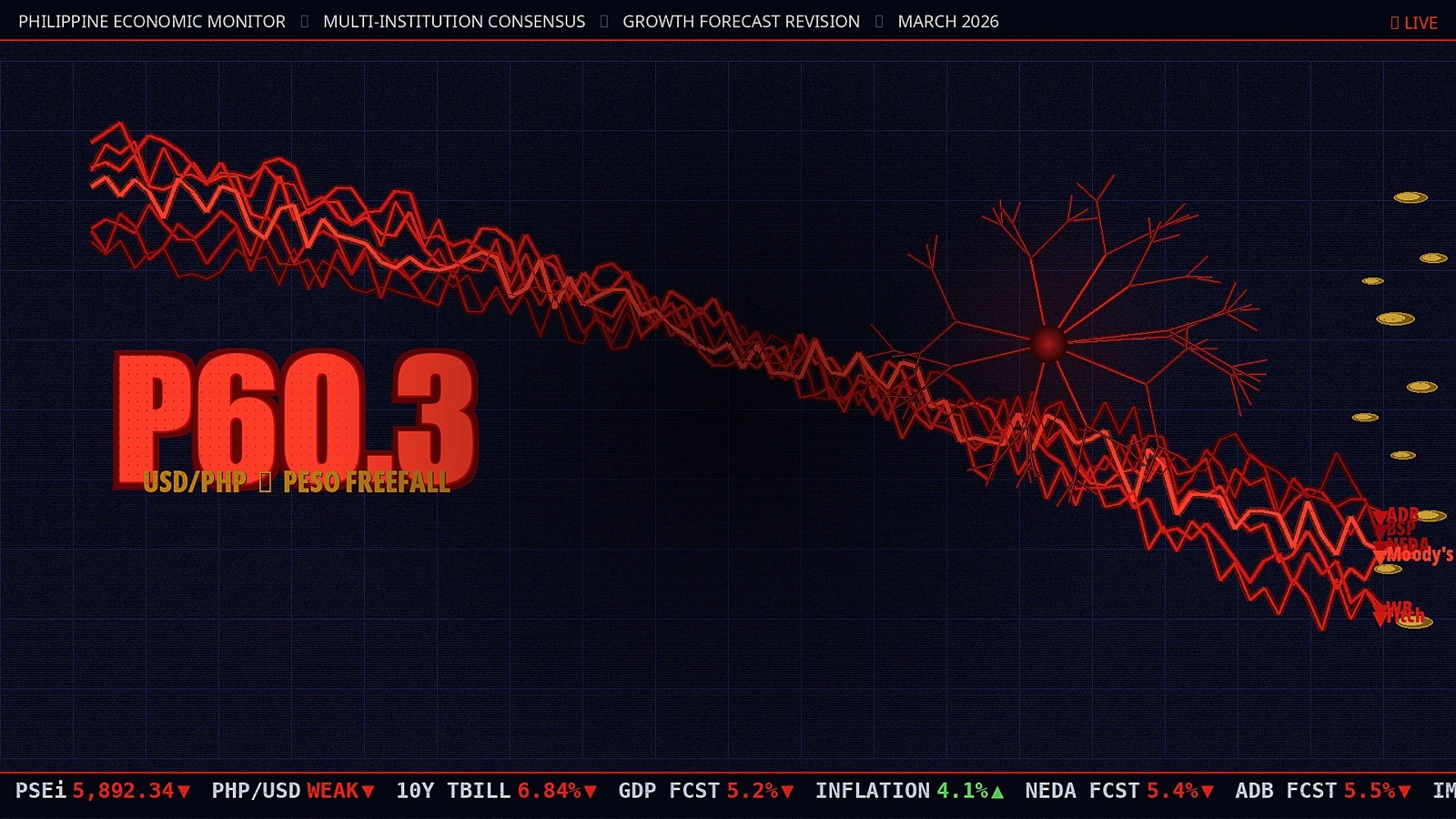
This is where every major institution stands on Philippine GDP growth in 2026:
Capital Economics — 3.8% (cut from 4.5% on March 20, 2026)
Bank of America — 4.6% (cut, described as "below sustainable growth rate")
Nomura — 4.3% (cut from 5.4% on March 12, 2026)
S&P Global Ratings — 4.4% (cut from 5.6% on March 17, 2026)
Fitch Solutions (BMI) — 4.4% (cut from 5.6% on March 17, 2026)
Moody's Analytics — 4.7% (cut from 5.5% on March 18, 2026)
Asian Development Bank — 4.5% (cut from 5.6% on March 19, 2026)
World Bank — 4.6% (cut from 5.3% on March 20, 2026)
International Monetary Fund — 4.8% (cut from 5.6% on March 21, 2026)
Bangko Sentral ng Pilipinas — 4.5% to 5.5% range (revised from 5.5% to 6.5%)
Philippine government — 4.5% to 5.5% range (revised from 6.0% to 7.0%)
Not one major forecaster is still at 6%. Not one.
WHAT CHANGED
The trigger was the closure of the Strait of Hormuz in early March 2026.
The Philippines imports almost all of its oil. About 70% comes from the Middle East. When the strait closed, oil prices surged, shipping costs rose, and the peso weakened.
Higher fuel prices feed into everything: transport, electricity, food, manufacturing, construction, and household spending.
The institutions did not all use the same model. But they reached the same conclusion: the oil shock will slow growth, raise inflation, and force the government and the central bank to choose between supporting the economy and controlling prices.
WHY THE CUTS ARE SO LARGE
Before the crisis, the economy was already weaker than the government wanted to admit.
GDP growth in 2025 was 5.4%, below the official target. Household consumption was slowing. Investment was uneven. Government spending was carrying more of the load.
Then the energy shock arrived.
Every $10 increase in oil prices adds pressure to inflation and the trade deficit. The Philippines buys fuel in dollars, so a weaker peso makes the same shipment more expensive.
Businesses pass part of the cost to consumers. Families cut non-essential spending. Interest rates stay higher for longer. Projects are delayed.
That chain reaction is why the forecasts fell by as much as 1.2 percentage points within days.
WHAT 4% GROWTH MEANS
Four percent growth is not a recession. The economy is still expanding.
But for a country with a young population, persistent poverty, and millions of workers entering the labor force, 4% is not enough to generate the jobs and income gains people expect.
Growth below 5% makes it harder to reduce poverty, raise wages, and fund public services without borrowing more.
It also exposes the difference between headline GDP and lived experience. The economy can grow while families feel poorer because prices rise faster than income.
THE GOVERNMENT'S PROBLEM
The Marcos administration has lowered its growth target to 4.5% to 5.5%. That brings the official range closer to outside forecasts, but the lower end may still be optimistic if the fuel disruption lasts.
The government is cutting fuel taxes, providing subsidies, and seeking alternative oil suppliers. Those measures can cushion the shock but they also cost money.
Lower fuel taxes mean lower revenue. Subsidies increase spending. Higher borrowing costs make debt more expensive.
The administration now has less room to stimulate the economy without worsening the fiscal deficit.
THE FULL PICTURE
The forecast cuts are not isolated opinions. They are a consensus.
Capital Economics is the most pessimistic at 3.8%. The IMF is the most optimistic among the major institutions at 4.8%. The government is still hoping for as much as 5.5%.
But the center of gravity is now around 4.4% to 4.6%.
That is the number policymakers should plan around, not the target they announced before the crisis.
The Philippines is not collapsing. But it is entering a slower, more expensive year than the government promised.
Every major institution has now said so.
SOURCES
- Capital Economics, https://www.capitaleconomics.com/publications/asia-economics-update/philippines-growth-forecast-cut-oil-shock
- BusinessWorld, https://www.bworldonline.com/top-stories/2026/03/23/741127/capital-economics-cuts-philippine-growth-forecast-to-3-8/
- Bank of America, https://business.bofa.com/en-us/content/philippines-economic-outlook-2026.html
- Inquirer.net, https://business.inquirer.net/513924/bofa-cuts-philippine-growth-forecast-to-4-6-percent
- Nomura, https://www.nomuraconnects.com/focused-thinking-posts/philippines-growth-outlook-after-hormuz-shock/
- Philippine Star, https://www.philstar.com/business/2026/03/13/2513772/nomura-cuts-philippines-growth-forecast-43-percent
- S&P Global Ratings, https://www.spglobal.com/ratings/en/research/articles/260317-asia-pacific-economic-outlook-oil-shock-clouds-growth-13478152
- ABS-CBN News, https://www.abs-cbn.com/news/business/2026/3/17/s-p-cuts-philippine-growth-forecast-to-4-4-percent-1545
- Fitch Solutions, https://www.fitchsolutions.com/bmi/country-risk/philippines-growth-forecast-lowered-oil-price-shock-17-03-2026
- GMA News, https://www.gmanetwork.com/news/money/economy/981552/fitch-cuts-philippines-growth-forecast-to-4-4/story/
- Moody's Analytics, https://www.moodys.com/web/en/us/insights/economic/philippines-outlook-march-2026.html
- Manila Bulletin, https://mb.com.ph/2026/03/18/moodys-cuts-philippine-growth-forecast-to-47-percent
- Asian Development Bank, https://www.adb.org/publications/asian-development-outlook-march-2026
- Philippine News Agency, https://www.pna.gov.ph/articles/1269901
- World Bank, https://www.worldbank.org/en/country/philippines/publication/philippines-economic-update-march-2026
- Reuters, https://www.reuters.com/world/asia-pacific/world-bank-cuts-philippines-growth-forecast-oil-shock-2026-03-20/
- International Monetary Fund, https://www.imf.org/en/News/Articles/2026/03/21/pr26081-philippines-imf-revises-growth-outlook
- Bloomberg, https://www.bloomberg.com/news/articles/2026-03-21/imf-cuts-philippine-growth-forecast-as-oil-shock-bites
- Bangko Sentral ng Pilipinas, https://www.bsp.gov.ph/SitePages/MediaAndResearch/MediaDisp.aspx?ItemId=7595
- Department of Economy Planning and Development, https://depdev.gov.ph/government-revises-2026-growth-target-amid-global-energy-crisis/
- Department of Finance Philippines, https://www.dof.gov.ph/government-adjusts-macroeconomic-assumptions-for-2026/
- Philippine Statistics Authority, https://psa.gov.ph/content/gdp-posts-54-percent-growth-2025
- National Economic and Development Authority, https://neda.gov.ph/philippine-economy-grows-5-4-percent-in-2025/
- U.S. Energy Information Administration, https://www.eia.gov/international/analysis/country/PHL
- International Energy Agency, https://www.iea.org/reports/oil-market-report-march-2026
- Asian Development Bank, https://www.adb.org/news/adb-warns-prolonged-hormuz-disruption-hit-asian-economies
- World Bank, https://www.worldbank.org/en/news/press-release/2026/03/20/oil-shock-threatens-import-dependent-economies
- Official Gazette of the Philippines, https://www.officialgazette.gov.ph/2026/03/18/proclamation-no-1246-s-2026/
- Presidential Communications Office, https://pco.gov.ph/news_releases/pbbm-economic-team-announces-revised-growth-targets/
- Senate of the Philippines, https://legacy.senate.gov.ph/press_release/2026/0324_gatchalian2.asp