
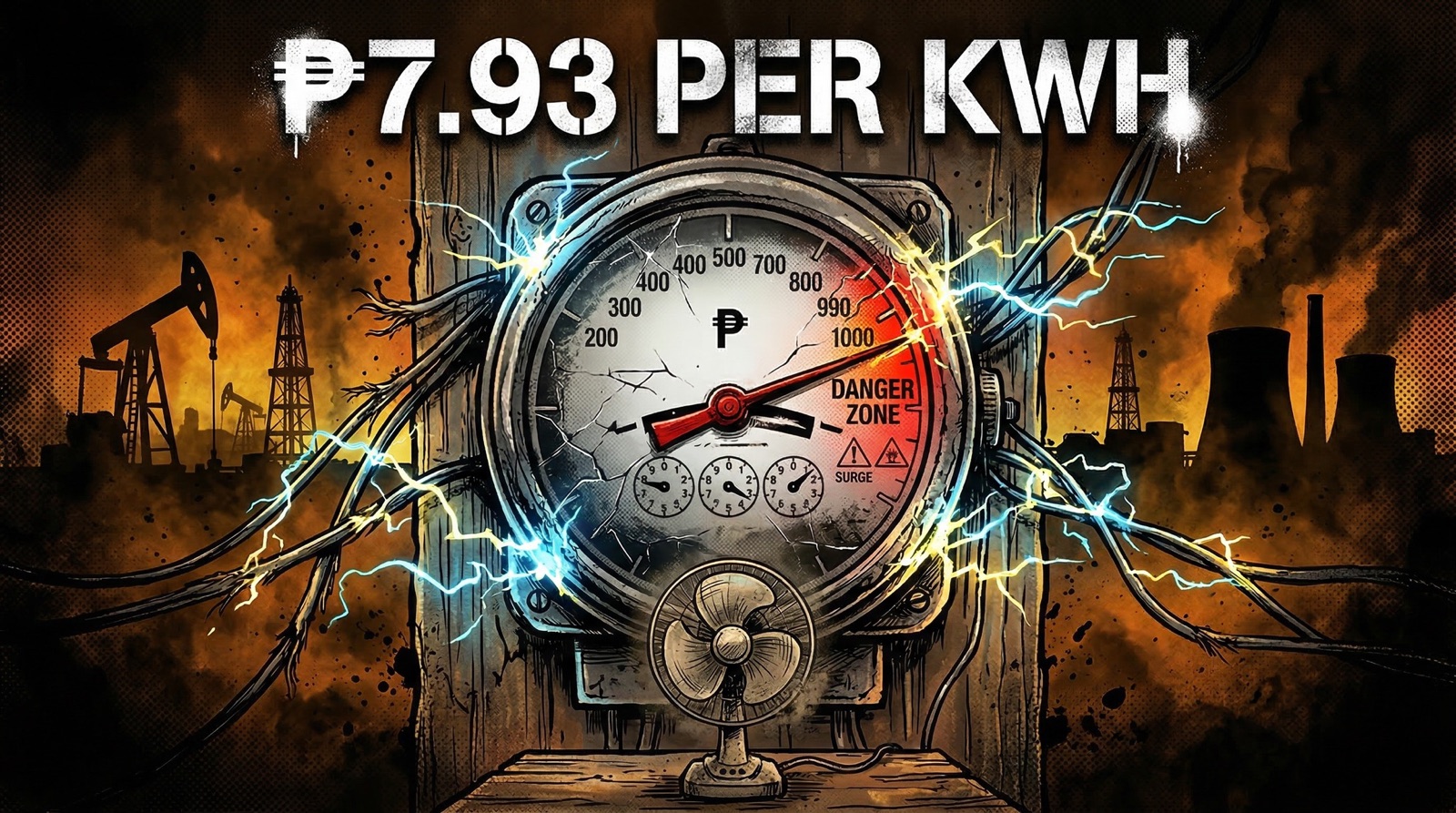
P7.93 per kilowatt-hour.
That is the upper-end scenario from IEMOP simulations of what market-clearing prices could reach in the Wholesale Electricity Spot Market (WESM) in April. The current baseline in those simulations is P4.98/kWh. The jump — if it materializes — would be 59%.
ERC Chairman and CEO Francis Saturnino Juan laid out the numbers at the 2026 Philippine Electric Power Industry Forum on Thursday.
He said spot market prices could rise by P2 to P4 per kilowatt-hour next month, driven by the ongoing Middle East conflict and the seasonal surge in electricity demand as summer sets in.
"The effect will be that the marginal plant will operate on oil, so if oil prices remain at this level, we can expect offers to reflect that," Juan said.
For context, the average WESM price in February was P3.50/kWh. At the highest estimate, April could see more than double that.
WHY OIL NOW CONTROLS THE PRICE
When cheaper power plants — coal, natural gas, renewables — cannot fully meet demand, the grid calls on more expensive peaking plants. In the Philippines, those are predominantly oil-fired.
The last plant dispatched to meet demand sets the clearing price for all electricity transacted in the spot market at that interval. If oil-based generators are setting that price, their fuel costs become the market-clearing price.
Oil prices have climbed 40 to 50 percent since US and Israeli forces struck Iran on February 28, pushing Brent crude past $100 per barrel for the first time in over three years. Iran's response was to close the Strait of Hormuz, through which nearly one-fifth of global oil and LNG shipments pass.
The supply shock is rippling through every energy input: coal faces upward pressure, LNG is volatile, and oil-based generators are repricing their market offers accordingly.
THREE FACTORS CONVERGING IN APRIL
The ERC's warning points to three simultaneous pressures.
First, higher global fuel costs for oil, coal, and LNG. Second, rising temperatures in April that push residential and commercial air conditioning demand upward — historically the peak demand period in the Philippines. Third, scheduled plant maintenance in the first quarter, which reduces available capacity just as demand is climbing.
IEMOP's simulation examined scenarios involving increases in international coal, oil, and LNG prices combined with possible supply constraints. If large generating units experience forced outages on top of elevated fuel costs, the P7.93/kWh ceiling reflects that worst-case combination.
THE BUFFER THAT IS STILL IN PLACE
Juan emphasized that an increase in WESM prices does not automatically translate to a proportional increase on electricity bills. Distribution utilities like Meralco source only a portion of their supply from the spot market — the rest comes from bilateral contracts, which have fixed rates.
"Whatever the movement in the WESM prices, it won't necessarily translate to our generation. What we're monitoring is their exposure," Juan said.
The secondary price cap on the WESM also remains in effect. The mechanism is automatically triggered when sustained price spikes breach regulatory thresholds, preventing prolonged extreme prices while keeping generators operational.
The ERC directed IEMOP and its Market Operations Service to closely monitor activity and flag unusual market behavior to prevent any generator from abusing market power.
Meralco PowerGen Corporation (MGen) issued a statement on Thursday saying it has sufficient fuel supply for its 5,069.7 MW diversified portfolio and continues to operate all facilities with high availability.
THE PESO, THE POLICY RATE, AND THE BROADER PICTURE
The electricity situation does not exist in isolation.
The peso's purchasing power fell to a record low of 0.76 in January and February 2026, according to the Philippine Statistics Authority. Diesel prices have risen by P17.50 to P24.25 per liter in recent weeks. Local governments have shifted to compressed four-day work weeks in response to fuel costs.
In Congress, the House Committee on Ways and Means approved a substitute bill that would grant the President authority to suspend or reduce excise taxes on petroleum products. The bill, which has been flagged as urgent by Malacañang, is now moving toward plenary.
On the monetary policy front, BSP Governor Eli Remolona has opened the door for a potential rate hike if oil prices breach and sustain above $100 per barrel, a level that could push inflation past the central bank's 4% upper target band.
Security Bank Chief Economist Angelo Taningco told One News on Thursday that the BSP should reverse its policy path as early as the April meeting. Taningco said the current oil shock is more broad-based than previous episodes because it is also affecting natural gas supplies, and the disruption at the Strait of Hormuz is unlikely to resolve quickly.
ING Economics analysts separately assessed that the Philippines will feel higher oil prices sooner than most of its Asian neighbors. The analysis, authored by ING regional research head for Asia-Pacific Deepali Bhargava, cited three structural vulnerabilities: modest fuel buffers, rapid domestic price pass-through, and a structurally wider current account deficit.
ING revised its current account deficit forecast for the Philippines to 4% of GDP in 2026, estimating that a $15 per barrel increase in Brent crude could widen it by an additional 0.7% of GDP. ING no longer expects the BSP to cut rates this year, given upward revisions to its Philippine inflation forecasts.
SOURCES
- Philstar, https://www.philstar.com/headlines/2026/03/13/2513978/electricity-prices-seen-spike-april
- Manila Bulletin, https://mb.com.ph/article/10909419/business/trade-industry/expect-higher-power-rates-next-month-due-to-mideast-tensions-summer
- BusinessWorld, https://www.bworldonline.com/top-stories/2026/03/13/736030/oil-shock-may-prompt-bsp-rate-hike/
- Inquirer Business, https://business.inquirer.net/578213/spot-power-prices-fell-in-february-2026
- ERC Official Statement (Facebook), https://www.facebook.com/ERCgovPH/posts/erc-iemop-assess-impact-of-middle-east-tensions-on-philippine-power-rates06-marc/1234652582145532/
- GMA News (ERC electricity price warning), https://www.gmanetwork.com/news/money/personalfinance/979011/electricity-price-hike-to-follow-pump-price-increases-erc-says/story/
- GMA News (MGen fuel readiness), https://www.gmanetwork.com/news/topstories/nation/979748/meralco-powergen-says-it-has-enough-fuel-supply-for-power-plants/story/
- ING Think, https://think.ing.com/articles/oil-shock-for-asia-identifying-the-first-pressure-points/
- Bloomberg (BSP rate hike warning), https://www.bloomberg.com/news/articles/2026-03-06/philippines-central-bank-warns-oil-at-100-may-trigger-rate-hike
- Inquirer (fuel excise suspension bill), https://newsinfo.inquirer.net/2193410/panel-oks-bill-giving-marcos-powers-to-suspend-excise-tax-on-fuel
- Philstar (fuel excise bill), https://www.philstar.com/headlines/2026/03/10/2513329/house-panel-oks-bill-granting-marcos-power-suspend-cut-fuel-excise-taxes
- Manila Bulletin (peso purchasing power record low), https://mb.com.ph/2026/03/05/peso-purchasing-power-hits-record-low-at-start-of-2026
- Manila Times (power prices could surge), https://www.manilatimes.net/2026/03/13/business/top-business/power-prices-could-surge-by-p2-4kwh/2298884
- Meralco PowerGen official statement, https://www.meralcopowergen.com.ph/statement-of-meralco-powergen-corporation-on-the-impact-of-the-middle-east-situation-on-energy-security/