
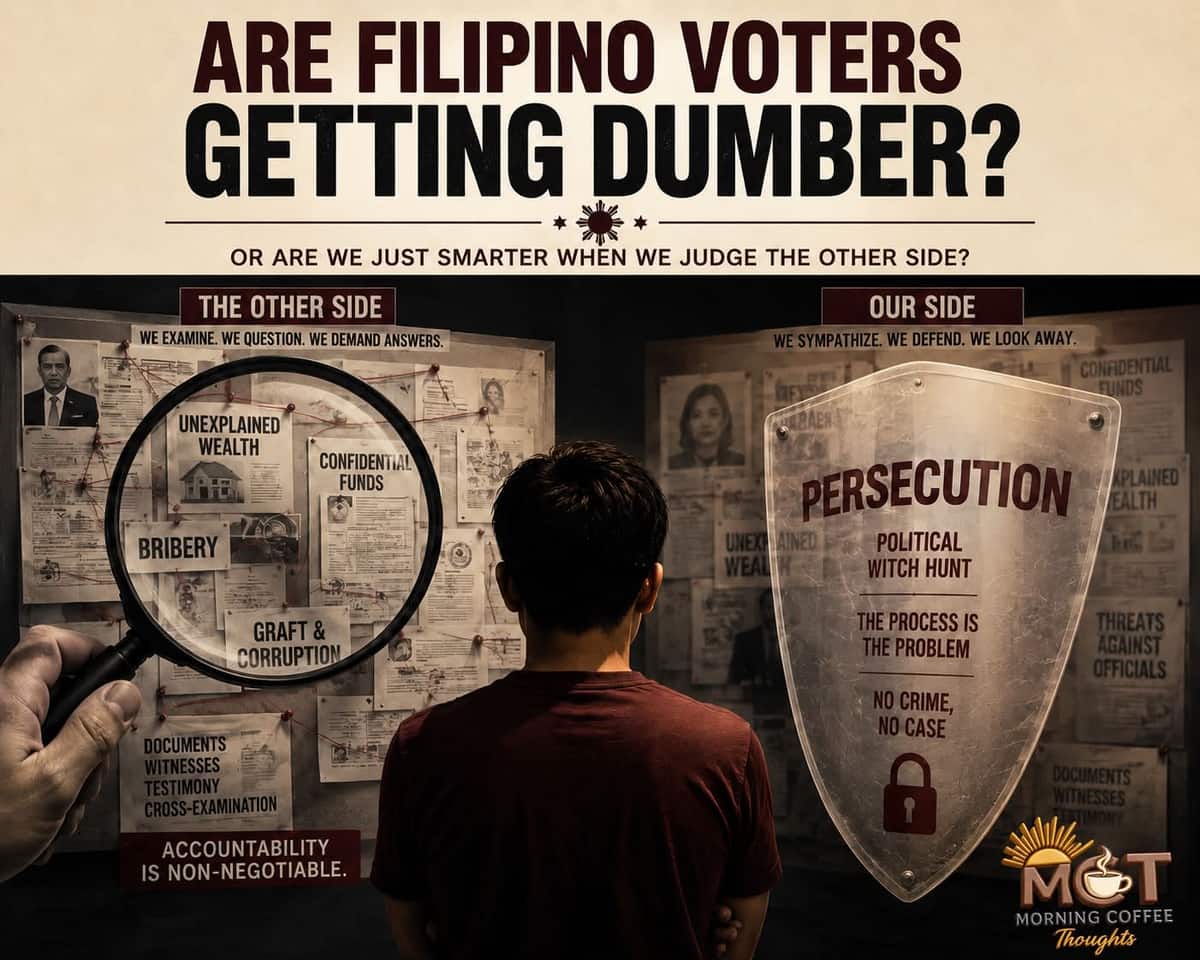
I know how harsh that question sounds. I did not start out wanting to ask it.
It came to me while looking at the surveys surrounding Vice President Sara Duterte and her impeachment trial. She faces serious allegations involving confidential funds, unexplained wealth, bribery, and threats against the President and other officials. She denies the accusations, and the Senate impeachment court exists to hear the case, examine the evidence, listen to the defense, and decide whether the charges have been proven.
Yet Duterte remains politically strong.
That is the part I have been trying to understand.
A voter does not have to dislike Sara Duterte to want answers. Distrusting the House does not prevent anyone from supporting a fair trial. You can even believe that the prosecution will eventually fail and still agree that allegations this serious against the Vice President deserve to be examined before anyone declares her innocent or guilty.
That should be ordinary citizenship.
And the surveys actually show that the Filipino public may be more complicated than either political camp wants to admit.
In June 2025, a Social Weather Stations survey found that 66 percent of respondents agreed that Duterte should face the impeachment court and answer the allegations against her. More recent polling, however, shows her maintaining strong public support and leading presidential preference surveys for 2028.
Those findings do not automatically contradict each other.
A person can support Duterte politically and still want her investigated. Someone can believe she is being treated unfairly while also believing she should answer the charges. A voter may even conclude that she committed wrongdoing and still prefer her over every other presidential candidate being offered.
That possibility changes the question.
Perhaps Filipinos are not refusing to think about the allegations. Perhaps political loyalty has become strong enough that allegations which would normally damage a politician no longer carry the same political cost.
And that, to me, is more worrying than the original question.
THE QUESTION GOT SWAPPED
One of the most common defenses of Duterte asks a simple question: What crime has she committed?
It sounds reasonable until you remember what impeachment is.
Article XI of the 1987 Constitution says public office is a public trust. It lists betrayal of public trust among the grounds for impeachment, alongside culpable violation of the Constitution, treason, bribery, graft and corruption, and other high crimes.
An impeachment trial is therefore different from a criminal prosecution.
The Senate impeachment court does not decide whether Duterte should be sent to prison. Its job is to decide whether the charges against her justify removing her from office and, depending on the judgment, disqualifying her from holding public office. Any criminal prosecution supported by evidence would belong in the regular justice system.
So when someone asks, “What crime has she committed?” that question does not settle the impeachment case.
The prosecution still has to prove its case. Duterte has every right to challenge the evidence, attack weak arguments, question witnesses, and defend herself fully. But the absence of a criminal conviction does not automatically answer whether an impeachable offense occurred.
Somewhere along the way, however, these two questions started getting mixed together.
“No criminal conviction” becomes “no wrongdoing.”
“No final court judgment” becomes “nothing to answer.”
And before the Senate has even finished examining the case, some people have already reached a conclusion that the trial itself is proof of persecution.
That is where political loyalty begins interfering with the test that impeachment was created to perform.
THE POWER OF BEING THE VICTIM
Pulse Asia President Ronald Holmes has linked Duterte’s continued political strength to her camp’s repeated claim that she is being politically persecuted.
That should be treated as an interpretation of the polling, not proof that persecution messaging alone caused her numbers. Polls showing political preference cannot, by themselves, tell us exactly what is happening inside every voter’s head.
Still, the explanation deserves attention because political psychology has documented something very similar.
Once people become deeply attached to a political figure, allegations against that person can create an uncomfortable problem.
Imagine spending years defending someone. You argued for them online. You fought relatives over them. You called critics liars. You attached part of your political identity to that person’s success.
Then serious accusations appear.
Accepting that the accusations might be true now comes with a personal cost. You may have to admit that someone you trusted failed you. Worse, you may have to admit that the people you spent years attacking had a point.
Psychologists call part of this cognitive dissonance, the discomfort people feel when new information clashes with beliefs they already hold.
There is also confirmation bias. People naturally give more weight to information that supports what they already believe and become more skeptical when information threatens those beliefs.
Then there is belief perseverance, where an existing belief survives even after the evidence supporting it becomes weaker.
You do not need a psychology degree to recognize the pattern. Most of us have probably done some version of this in our own lives.
Politics simply gives it bigger consequences.
A loyal supporter confronted with damaging allegations has several choices. They can examine the evidence and risk changing their mind. They can admit the possibility that their preferred leader made serious mistakes. Or they can find a reason to reject the entire process before dealing with the evidence itself.
The persecution claim offers an easy escape.
Once you believe your leader is being targeted, every accusation can become further proof that the targeting is real.
An investigation looks like harassment. A subpoena looks like abuse. Another witness looks like another attacker. A damaging document can be dismissed as part of the campaign against her.
The accusation itself stops being the problem.
Now the people asking questions become the problem.
That is an extremely powerful political position because it can turn scrutiny into sympathy.
And Sara Duterte did not invent it.
Researchers have studied how political figures use claims of victimhood to strengthen loyalty and deepen distrust toward institutions. Political communication scholars have examined similar strategies involving leaders such as Viktor Orbán and Donald Trump, where scandal or investigation is presented to supporters as another attack by hostile political forces.
The names and countries change. The psychological appeal is familiar.
You no longer have to defeat every accusation individually if you can convince supporters that the entire system asking the questions cannot be trusted.
THE TRIAL STILL HAS TO DO ITS JOB
None of this means the impeachment process is automatically fair.
The House can act politically. Senators can have their own interests. Prosecutors can make mistakes. Procedures can be violated. Evidence can turn out to be weak. Witnesses can be unreliable.
Every one of those possibilities deserves scrutiny.
But legitimate questions about procedure should lead to better procedure. They should not erase the allegations themselves.
This distinction becomes especially important when senators raise legal or procedural objections during the trial. They have every right to do so, and some objections may be valid. The danger comes when the public hears so much about procedural disputes that the original accusations disappear from view.
A technical flaw in one part of the process does not tell us whether confidential funds were properly spent. A disagreement over procedure does not explain disputed financial records. It does not answer allegations involving threats or other conduct included in the impeachment case.
Those questions still need answers.
Due process protects the rights of the person accused while allowing the case to be tested fairly. Turning due process into a reason to stop asking questions defeats the purpose of having a process at all.
THE SAME STANDARD TEST
There is a simple way to test how much political loyalty influences our judgment.
Change the politician.
Take the allegations against Sara Duterte and imagine that the name attached to them belongs to someone you strongly dislike.
Would you still say there should be no impeachment trial because the politician claims persecution?
Would you accept strong survey numbers as evidence that the allegations should be ignored?
Would you demand a criminal conviction before agreeing that Congress should even examine possible betrayal of public trust?
You do not have to tell anyone your answer.
Just answer honestly.
That is the standard Filipinos should be worried about losing.
Political disagreement is normal. Different voters can look at the same evidence and reach different conclusions. One person may find a witness credible while another sees weaknesses. One voter may believe the prosecution proved its case while another thinks reasonable doubts remain.
The problem begins when the identity of the politician decides whether we are willing to look at the evidence in the first place.
Healthy skepticism asks hard questions about the prosecution and the defense. It demands documents. It checks testimony. It refuses to convict someone based only on political hatred.
Denial works differently. The conclusion comes first, and everything else is arranged around protecting it.
That difference is becoming harder to see in Philippine politics because almost everyone now claims to be skeptical.
THE POLL IS NOT A VERDICT
Duterte’s political strength deserves attention, but a survey cannot tell the Senate whether she committed an impeachable offense.
A presidential preference survey asks voters whom they currently prefer for president. It does not examine bank records, authenticate documents, cross-examine witnesses, or determine whether betrayal of public trust occurred.
This is why Duterte’s strong numbers and the earlier finding that 66 percent wanted her to answer the impeachment allegations can exist at the same time.
Some Filipinos may want accountability without abandoning political support.
Others may believe the charges are political but still want them tested.
Some may simply prefer Duterte over the available alternatives regardless of the impeachment case.
And yes, there will also be supporters who have already decided she is innocent without examining the evidence.
Those groups should not be treated as one identical block of voters.
Still, the political benefit of portraying Duterte as a victim cannot be ignored. A persecution claim gives supporters an emotionally satisfying explanation for every attack against their preferred leader. It requires far less effort than reading financial records, studying constitutional rules, or following hours of testimony.
Sympathy is easy.
Evidence takes work.
THE REWARD FOR NOT ASKING
Philippine politics has another problem feeding all of this: cynicism.
People have heard so many corruption allegations that some have stopped caring who is accused. Every politician is corrupt anyway, they say. Every investigation is political. Everyone steals. Everyone lies.
It sounds worldly and skeptical.
In practice, that attitude gives politicians more room to escape accountability.
Once voters decide that everyone is equally corrupt, evidence loses political value. The politician with the strongest following, the loudest machinery, or the most successful claim of victimhood gains an advantage because supporters no longer ask whether the allegations are true.
They only ask why their politician is the one being investigated.
That is a dangerous place for any democracy.
Selective accountability eventually becomes no accountability at all.
ARE WE GETTING DUMBER?
So, are Filipino voters getting dumber?
I do not think so.
Filipinos are perfectly capable of examining difficult information. We do it every day in our jobs, businesses, families, and personal lives. We calculate risks. We detect lies. We recognize when someone is trying to take advantage of us.
Politics seems to activate a different weakness.
We become strict investigators when the accused politician belongs to the other camp. When the politician is ours, suddenly we become defense lawyers.
The intelligence did not disappear.
The standard changed.
That is what worries me.
Sara Duterte may be innocent of the allegations against her. The prosecution may fail to prove its case. The Senate may eventually conclude that the evidence is insufficient.
Those are possible outcomes, and a fair process must leave room for them.
But innocence should come from the evidence surviving examination, not from popularity. Acquittal should follow a failed case, not a successful sympathy campaign. Political loyalty should never become a substitute for asking what actually happened.
Filipinos do not need to agree about Sara Duterte.
We do need to be willing to use the same standard when judging politicians we love and politicians we hate.
That is the real test.
Because the danger is not that Filipino voters suddenly lost the ability to think.
The danger is that we have become very good at thinking critically about everyone except our own side.
SOURCES
- 1987 Constitution of the Republic of the Philippines, Article XI, https://www.ombudsman.gov.ph/docs/republicacts/Article_XI_1987_Philippine_Constitution.pdf
- University of the Philippines College of Law, Impeachment Primer and FAQs, https://law.upd.edu.ph/wp-content/uploads/2025/02/UP-Law-Impeachment-Primer-and-FAQs-Feb-7-2025.pdf
- Reuters, https://www.reuters.com/world/asia-pacific/philippine-lawmakers-impeach-vp-sara-duterte-set-stage-senate-trial-2026-05-11/
- Al Jazeera, https://www.aljazeera.com/news/2026/7/6/philippine-vice-president-dutertes-impeachment-trial-begins-what-we-know
- Philstar, https://www.philstar.com/headlines/2026/07/06/2540270/sara-duterte-trial-recap-july-6-fiery-openings-settled-questions
- Philstar, https://www.philstar.com/headlines/2025/07/16/2458277/66-want-sara-address-impeachment-charges-sws
- GMA News, https://www.gmanetwork.com/news/topstories/nation/952632/sws-66-agree-sara-duterte-impeachment-trial-stratbase/story/
- GMA News, https://www.gmanetwork.com/news/topstories/nation/995468/pulse-asia-marcos-trust-rating-drops-to-28-sara-duterte-steady-at-58/story/
- Supreme Court decision, G.R. No. 278353, https://lawphil.net/judjuris/juri2025/jul2025/gr_278353_2025.html
- Proceedings of the National Academy of Sciences, https://www.pnas.org/doi/10.1073/pnas.1912440117
- PsyPost, https://www.psypost.org/cognitive-dissonance-helps-explain-why-trump-supporters-remain-loyal-new-research-suggests/
- PubMed Central, “Why Me? The Role of Perceived Victimhood”, https://pmc.ncbi.nlm.nih.gov/articles/PMC7778419/
- Cambridge University Press, “Strategically Hijacking Victimhood”, https://www.cambridge.org/core/journals/perspectives-on-politics/article/strategically-hijacking-victimhood-a-political-communication-strategy-in-the-discourse-of-viktor-orban-and-donald-trump/435833A2666B1F4B714ACD262B0812CF
- Taylor & Francis, “Claims of Victimhood Shield Politicians from Political Scandals”, https://www.tandfonline.com/doi/full/10.1080/10584609.2026.2619865