
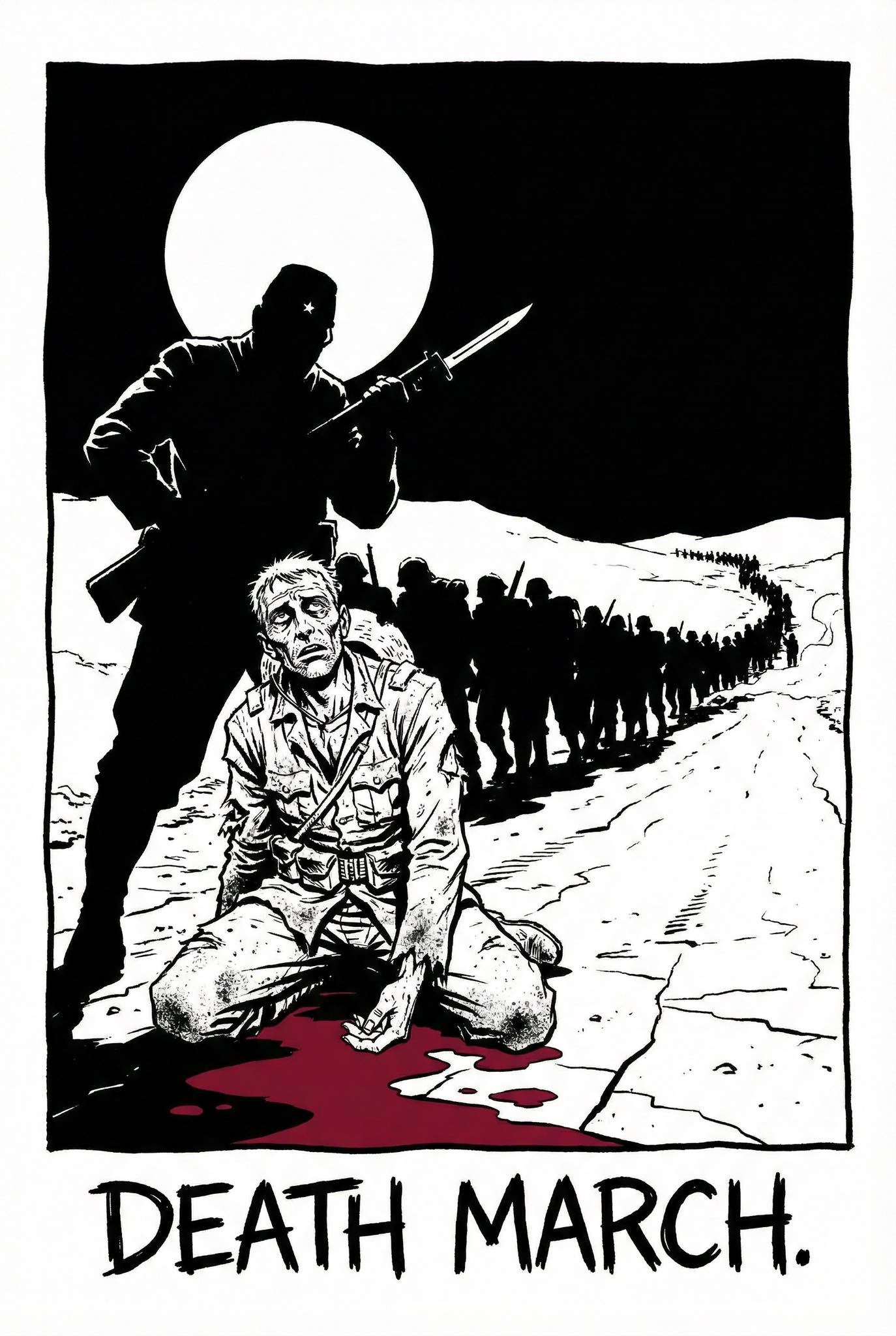
[A note before you read: This is an imagined first-person account built entirely from documented historical fact — drawn from the testimonies of survivors including Maj. Richard M. Gordon, Lt. Col. William E. Dyess, Lester Tenney, Paul Kerchum, Marine Pfc. Irvin Scott, Capt. Pedro Felix, Maj. Eduardo Vargas, and Capt. Alberto Abelada. Every scene, every detail, every act of brutality described here has been verified through firsthand accounts, military records, and war crimes trial testimony. This is not fiction. It is history, told from the inside.]
We laid down our rifles at 12:30 in the afternoon.
Not because we wanted to. Because Gen. King told us to. He said, "You men remember this. You did not surrender. You had no alternative but to obey my order." I heard those words. I held onto them for years.
I'm not sure they ever stopped hurting.
Three months we had held the line. By March we were eating monkeys. We slaughtered the carabaos of the farmers near our positions and told ourselves it wasn't stealing.
The quinine ran out. Men stumbled at their posts with fevers of 103. We waited for a convoy from America.
The convoy never came.
On April 9, the largest army ever surrendered under American command laid down its arms.
Seventy-five thousand of us. Sixty-four thousand Filipino. Ten thousand American. All of us now property of the Imperial Japanese Army.
THE FIRST HOURS
They took everything first.
Watches. Lighters. Wallets. Anything Japanese in your pocket — photographs, coins, paper — and you were finished. Not arrested.
Not questioned. Finished.
I watched them pull a man out of the column, find a Japanese coin on him, and walk him behind the treeline. I did not hear a shot. I don't know why I remember that — the not hearing.
They hit us with rifle butts as they searched us. Not in anger. Efficiently. Like they were hammering fence posts.
That first night they crowded us into an open field. So many men you could not find room to lie down.
There was an open ditch at the edge serving as a latrine, and all through the night the sick made their way there and back, over and over, through the bodies of men trying to sleep.
The smell was copper and rot and the sweetness you get from a body that has been in heat too long. It got into your chest. It is still there.
I did not sleep.
DAY ONE: THE ZIG ZAG TRAIL
They put us on the road the next morning. No food. No water.
The first leg was the Zig Zag Trail, climbing out of southern Bataan. Men who had been sick for weeks began to fall within the first hour.
I saw a sergeant I knew sitting against a concrete wall, his back straight, like he was resting between sets of exercises.
He had taught me to ride a motorcycle just before the war. He was covered in white powder, entirely still — his face, his eyelashes, the creases of his knuckles all filled with it. He looked like the Lincoln Memorial.
I almost stopped.
I kept moving.
Anyone who stopped was shot. Anyone who fell was bayoneted, shot, or left for the "buzzard squads" — the rear guards who swept the road and finished what the heat started.
The guards walking alongside us did not rage. They worked.
The Japanese believed surrender was dishonorable, and by their logic we had no right to still be breathing.
They treated us accordingly — not with hatred, which would have required acknowledging us as human. With the flat, bored efficiency of men disposing of something.
THE SUN TREATMENT
On the second day they sat us down in a field in the full heat of early afternoon.
They made us remove our hats. Then the guards walked to the shade of a mango grove to eat their lunch.
We sat in open sun, no cover, no water, in the worst heat the Philippine day could produce.
An hour. Two. Lt. Col. Dyess called it "the sun treatment."
The artesian wells were right there — I could see the water catching light from where I sat.
A man three rows ahead of me stood up and walked toward one. The guard did not shout a warning. He raised his rifle and the man went down into the grass.
Nobody else moved.
The man beside me was crying without knowing it. The tears cut clean lines through the grime on his face. His eyes were still open, still looking straight ahead, not at anything. His mouth slightly open. He looked like a man on a bus ride home.
I looked away from him.
I looked at the ground.
Dyess watched a Japanese soldier take his canteen, give the water to a horse, and throw the canteen into the ditch.
That story went up and down the column for days. Men kept telling it to each other. I think we told it because we needed something to be angry about instead of just thirsty.
WHAT YOU SAW ON THE ROAD
The sides of the road became a timeline.
A duffel bag with a name stenciled on it. A day later, the man's riding boots beside the trail.
A day after that, the man himself — flat on his back, face to the sky, already grey with it. The things we hold onto, even at the end. The things that weigh us down until they don't.
Japanese tanks moved south toward Corregidor while we marched north.
When they hit bodies in the road, they did not slow down.
By the third day you could tell where the column had walked the day before by what was left on the road surface.
Pfc. Irvin Scott described the bodies crushed by the tanks: “We walked over men who were a few inches thick."
Trucks going the opposite direction — soldiers in the back reached out with clubs and hit the men in the outside column.
Paul Kerchum learned fast. He pushed himself into the middle line, put his eyes down, and kept them on the boots in front of him. Watch the boots. Move. That was all there was.
Near the Pantingan River, a Japanese colonel named Tsuji gave an order.
Several hundred Filipino officers and NCOs were pulled out of the column, marched to the riverbank, and tied together with telephone wire — wrist to wrist, group to group.
Then the soldiers came at them with swords and bayonets. Most of them were beheaded.
Two officers survived.
At the war crimes trial four years later, Capt. Pedro Felix and Maj. Eduardo Vargas walked to the front of the courtroom and removed their army uniforms to show the court their bayonet wounds. The commission went quiet.
They had been left for dead by the river, two men in a field of telephone wire and bodies, and they had lived anyway.
THE CIVILIANS
Not everyone on the road was killing us.
Filipino civilians came out of the barrios with whatever they had — women with rice balls pressed between both palms, children holding out water jugs with both arms, old men reaching through the column.
The guards beat them back. In some stretches they were killed for it.
Capt. Alberto Abelada, who survived the march and testified at the war crimes trial, said the roadside killings were done with such disregard that calling them executions would dignify the act.
Once, he testified, a large car stopped beside the column. Inside: General Homma, and a Japanese woman. Homma looked out at what was happening on the road, shook his head slowly, and the car moved on.
The rice balls kept coming anyway. The hands through the column kept reaching.
One soldier, Amado Ante of the Philippine Scouts, had hidden a small amount of sugar under his belt for the march.
By the fifth day his feet were so swollen the skin had split. On a guard rotation change, his comrades pushed him into the bushes and told him to stay down until dark. That night, civilians found him. They hid him for three months.
Pakikisama. That word. That impulse to stand with someone even when standing costs you.
It saved lives on that road.
NINE DAYS WITHOUT FOOD
By day three, the hunger stopped demanding and started just existing.
It settled somewhere below the ribs as a hollow weight — not pain exactly, more like an absence that had learned to press. By day nine it had become background, the same way the heat had. What replaced it was smell.
A Japanese cookfire two hundred meters off the road — rice and fish and smoke — hit the column like a physical thing. Men's heads turned toward it without their permission.
Some men threw themselves at the puddles along the roadside.
Brown water, filmed with oil, corpses somewhere upstream. They drank anyway. The ones who did were dead within the week — not from the road, but from what they swallowed on it.
I took sips from my canteen and held the water in my mouth before swallowing. I made myself wait. Make it last to the next stop. Make it last.
Lester Tenney said: "It wasn't a march. It was a trudge. Most of the men were sick — they had malaria, they had a gunshot wound."
He saw a man fall near him. The guard did not shout.
"The man fell down, the Japanese took a bayonet and put it in him. I mean, two seconds."
Paul Kerchum: "I could hear the shots. I could hear the screams."
That's all there is to say about the sounds.
LUBAO: THE TIN WAREHOUSE
In Lubao they pushed us into a sheet-metal warehouse the size of a football field.
The sun had been on that tin roof all day. Inside: 120 degrees, maybe more.
So many men packed in that you could not sit. You stood shoulder to shoulder in the dark, your face in the sweat-soaked back of the man in front of you, and you breathed what was already breathed, and you listened to the men who were dying do it slowly.
No water. The doors locked from outside.
By morning, dozens of men had died standing up. They were carried out, left along the road, and we started walking again.
SAN FERNANDO: THE BOXCARS
At San Fernando they promised food.
There was no food. Instead: steel boxcars, designed for 40 men, 100 pushed inside each one.
Doors locked. No windows.
Floors layered in filth from the men loaded before us. Dyess counted 115 men in his car.
The heat sealed us in as the doors closed and the air went immediately thin and wrong.
When Filipino civilians threw food through the slats as the train slowed at crossings, the men near the doors ate everything they caught. Nothing was passed back.
My car — seven men unloaded dead at Capas. Then we walked the last seven miles to Camp O'Donnell.
WHAT REMAINED
Of the 80,000 who began the march, only 54,000 reached the camp. Between 7,000 and 10,000 men died on the road. The Japanese kept no records.
At Camp O'Donnell, Scott spent his days digging graves.
“I was one of only three men in the whole barracks who was able to work," he said. "We dug a continuous grave and carried men and put them in. We could dig them only about three feet deep. Usually I wouldn't get three hours of sleep. That's what life was."
He paused. Then: "It was a hell of a lot better than the men I was carrying out dead."
Maj. Richard Gordon said, before the last survivors began to go: "Less than 1,000 survivors of Bataan are alive today. In perhaps 10 years, they will all be gone. Most, if not all, would like to leave behind them the truth that was Bataan. To do less would dishonor those men who died."
No one knows what freedom means until one loses it.
Those men paid for it with their bodies, on a road 65 miles long, through the Philippine summer, in the spring of 1942. Filipino and American soldiers, side by side, on the same road, under the same sun.
April 9 is the anniversary of their surrender.
Today.
SOURCES
- HistoryNet — Maj. Richard M. Gordon Interview, https://historynet.com/world-war-ii-interview-with-major-richard-m-gordon-bataan-death-march-survivor/
- Wikipedia — Bataan Death March, https://en.wikipedia.org/wiki/Bataan_Death_March
- Wikipedia — Pantingan River Massacre, https://en.wikipedia.org/wiki/Pantingan_River_massacre
- National WWII Museum — Lester Tenney, https://nationalww2museum.org/war/articles/bataan-death-march-survivor-lester-tenney-dies-age-96
- DAV — Paul Kerchum, https://dav.org/learn-more/news/2022/how-dav-member-former-pow-survived-the-bataan-death-march/
- HistoryNet — Homma War Crimes Trial, https://historynet.com/was-bataan-death-march-war-crimes-trial-fair/
- New York Times — Filipino Survivors Tell of Slaughter, https://nytimes.com/1946/01/11/archives/filipino-survivors-tell-of-slaughter-400-captives-killed-on-bataan.html
- VA.gov — Marine Pfc. Irvin Scott, https://news.va.gov/70565/bataan-death-march-marine-corps-survivor-irvin-scott/
- VA.gov — Amado Ante, https://news.va.gov/43677/philippine-scout-army-veteran-shares-story-of-his-escape-from-bataan-death-march/
- Time Magazine — Lt. Col. Dyess Account, https://time.com/archive/6782183/the-nature-of-the-enemy/
- U.S. Army — History of the Bataan Death March, https://army.mil/article/290116/history_of_the_bataan_death_march
- Fold3 — Bataan Death March Begins April 9 1942, https://blog.fold3.com/bataan-death-march-begins-april-9-1942/
- Duty to Country — Bataan Explainer, https://dutytocountry.org/wp-content/uploads/2021/09/3-THE-BATAAN-DEATH-MARCH.pdf
- Soldiers Angels — Bataan Death March Legacy, https://soldiersangels.org/bataan-death-march-wwii-legacy/
- USO — Surrender at Bataan, https://uso.org/stories/122-surrender-at-bataan-led-to-one-of-the-worst-atrocities-in-modern-warfare