
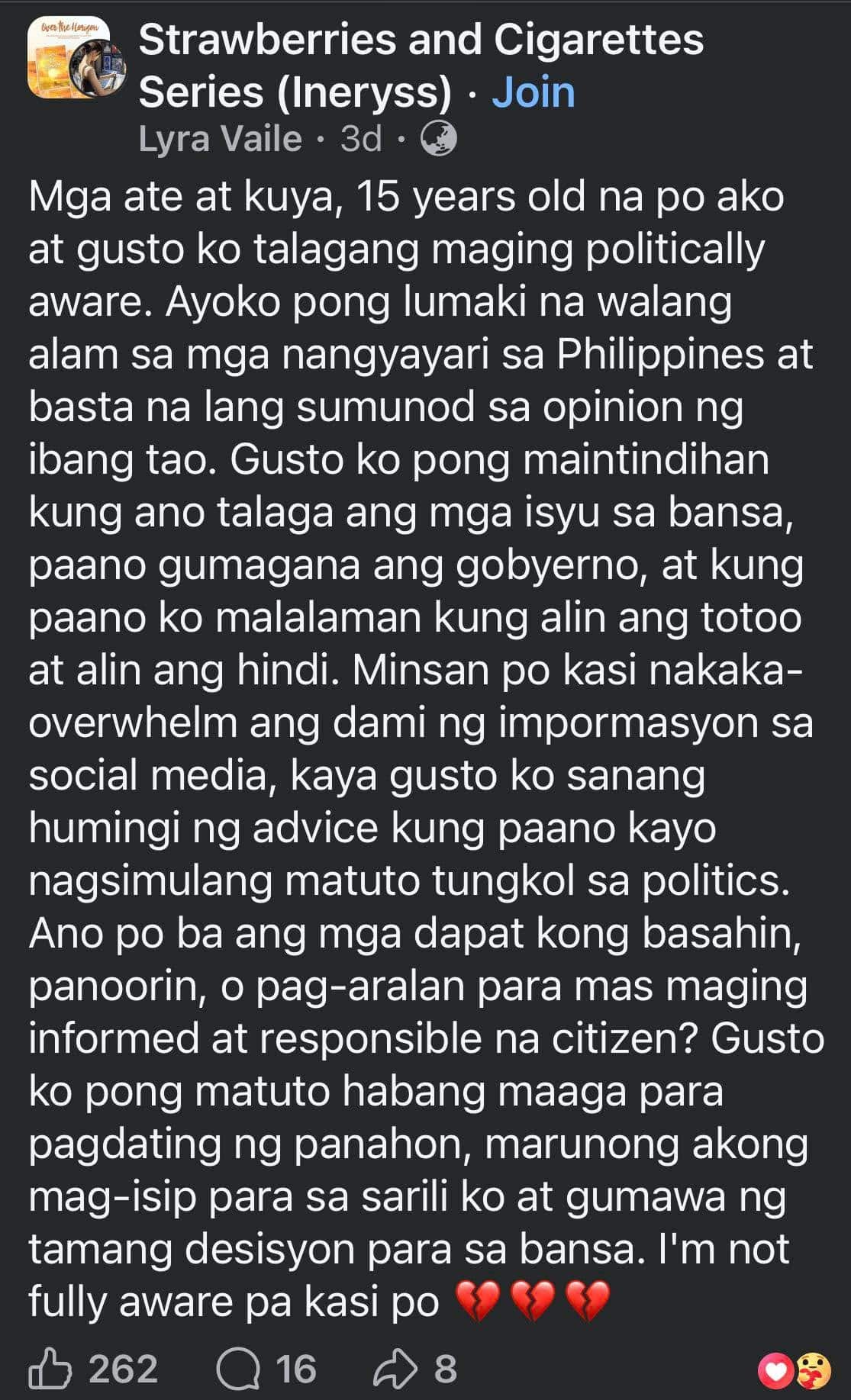
Lyra, I saw your post and I had to stop scrolling.
Not because it was shocking. Not because it was controversial. But because a fifteen-year-old just said something that most adults in this country still haven't figured out: that being uninformed is a choice, and she refuses to make it.
That kind of clarity is rare at any age.
So I'm writing back to you — not as someone with all the answers, but as a political blogger who has been sitting with the same questions for years and is still learning. Because you deserve a real response. Not a pat on the head. Not a "good for you." A real one.
AWARENESS IS JUST THE BEGINNING
Here's something no one tells you early enough: awareness alone can be turned against you.
You can spend hours on social media, read every headline, follow every page — and still walk away more confused, more manipulated, more certain about things that aren't true. That's not an accident. Platforms are engineered to keep you engaged, and engagement doesn't always mean enlightenment. Sometimes it just means outrage.
Awareness is the door. Critical thinking is what you do once you're inside.
One opens. The other protects you.
BE PRO PHILIPPINES — NOT PRO POLITICIAN
Write this somewhere you'll see it every day:
Your loyalty belongs to the country. Never to the person.
Politicians are not the Philippines. They are employees — temporary, replaceable, and accountable to you. The moment you start defending a politician's honor instead of demanding that they do their job, you've handed them something they haven't earned: your unconditional trust.
This country has bled enough for leaders who smiled at cameras while signing documents that hurt people. It has mourned enough for promises that dissolved the morning after the election.
Be pro Philippines. Be pro democracy. Be pro good governance, honesty, integrity, and accountability. These aren't ideals reserved for textbooks. They are the minimum. The floor. The non-negotiable baseline of what public service is supposed to look like.
Hold everyone to them. No exceptions.
STANDARDS FOR PUBLIC OFFICE
You asked what to look for. Here it is — not as a suggestion, but as a standard worth keeping for the rest of your life:
- A documented record of actual work, not just a record of promises - Integrity under pressure — the real kind, when honesty cost them something - Financial transparency that doesn't require a detective to uncover - Consistency between what they say in speeches and what they sign into law - Respect for democratic institutions — the courts, a free press, the right to dissent - No history of treating public funds as personal resources - The courage to break from their party when the right thing demands it - How they treat people who can do nothing for them
These aren't high standards. These are just what the job requires. We've been so conditioned to be grateful for scraps of competence that we've forgotten what we were actually supposed to be getting.
STUDY THE PATTERN, NOT THE SPEECH
Politicians are professional communicators. The best ones can make you feel hope, urgency, belonging — all in the span of three minutes. That's the craft. Don't be moved by the craft.
Be moved by the record.
Look at who funds them. Look at who they protect when things get difficult. Look at who they go quiet for. Read what they said five years ago and hold it against what they're saying now. Study their votes on the things that matter — budget allocations, human rights legislation, press freedom, anti-corruption measures.
Speeches are written to be believed. Patterns are too consistent to hide.
FACTS VS. OPINION — KNOW THE DIFFERENCE
This is one of the most important skills you will ever build, and almost no one teaches it formally.
A fact is verifiable. An opinion is a perspective. Both exist, both matter — but they are not the same thing, and confusing the two is how propaganda works.
When someone says "the administration created two million jobs," that's a claim. Find the source. Check who measured it and how. When someone says "this is the greatest president in Philippine history," that's an opinion. Ask what it's grounded in.
The most dangerous sentence in politics is an opinion wearing a fact's clothes. Learn to undress it. Ask always: where does this come from, and who benefits if I believe it?
SIT WITH WHAT YOU DON'T KNOW
When you encounter a word you don't understand, a concept that confuses you, a statement that doesn't sit right — don't let it pass. Don't let it just live in your head unresolved. Give it your time. Sit down. Research. Ruminate. Turn it over until it makes sense to you, in your own words, on your own terms.
Don't outsource your understanding to anyone.
Because here's the thing about asking other people what something means: you don't just get the definition. You get their version of it. Everyone carries a bias — shaped by their upbringing, their politics, their fears, their loyalties. That's human. That's normal. But bias absorbed without awareness doesn't stay theirs. It becomes yours. And bias you don't recognize is the most dangerous kind, because it feels like common sense.
Find the primary source. Read the actual bill, not just the article about it. Read the actual speech transcript, not just the quote someone pulled from it. Read the actual study, not just the headline. The original document will always tell you more than the summary someone else chose to write.
This is how you build a mind that belongs to you.
LEARN TO READ DATA — YOUR REALITY DEPENDS ON IT
Get comfortable with numbers. With graphs. With charts and percentages and survey results. Not because you need to become a statistician, but because data is the language politicians use to tell stories — and if you can't read it, someone else will read it for you.
A government can say "we reduced poverty" and show you a graph that is technically accurate and completely misleading at the same time. It depends on which years they chose to show. Which definition of poverty they used. What the sample size was. Who conducted the survey and who funded it.
When you see a statistic, ask: how was this measured? By whom? Over what period? Compared to what? These aren't complicated questions. They're the questions that separate someone who understands what's happening from someone who's just been shown a slide.
The most powerful lies in politics come dressed in data. Learn to undress those too.
USE YOUR TOOLS — BUT NEVER BLINDLY
I grew up going to libraries. Actual libraries — with the Dewey Decimal System, index cards organized in wooden drawers, typewriters, and books so heavy and dusty they felt like artifacts. Finding one piece of information meant hours of searching. Getting it wrong meant starting over.
You live in a different world entirely. You have the sum of human knowledge at your fingertips, available in seconds, in the palm of your hand.
Use it.
Use search engines to trace claims back to their sources. Use AI to help you understand complex concepts, to summarize long documents, to explain things in simpler language — but always, always doubt the output unless it points you to a fully verified, credible source. AI can be wrong. AI carries the biases of the data it was trained on. It is a tool, not an authority. Treat it like a smart assistant, not a final answer.
The internet gives you access. Critical thinking is what you do with that access.
KNOW YOUR FACT-CHECKERS
There are people whose entire job is to verify what's true — and in the Philippines, some of them are among the bravest journalists working today.
Know them. Trust them — not blindly, but as a verified floor to stand on when everything else feels uncertain.
Vera Files. Rappler's fact-check desk. The Philippine Center for Investigative Journalism. These organizations have track records, methodologies, and the kind of accountability that anonymous Facebook pages and viral posts do not. When something feels off, when a claim seems too convenient or too outrageous, go to them first.
They are not perfect. No institution is. But they have standards — and standards are what separate journalism from noise.
TROLL COMMENTS VS. REAL PEOPLE
The Philippines has one of the most documented troll farm operations in the world. This isn't conspiracy — it's been investigated, reported, and confirmed. Knowing how it works is part of your education now.
Trolls don't argue. They flood. They repeat. They attack the person instead of the point. They show up in waves on posts that threaten someone powerful. Their accounts are often new, faceless, and suspiciously active.
Real people have texture. They disagree with specifics. They change their minds mid-conversation. They have bad days and good takes and complicated feelings.
You don't have to respond to every comment. You do have to learn which ones are real and which ones are paid to exhaust you.
NEVER TAKE ANY OFFICIAL'S WORD AT FACE VALUE
Question everyone.
Not out of bitterness. Not out of cynicism. But because democracy only works when citizens refuse to be passive recipients of whatever story power decides to tell.
Question the president. Question the opposition. Question the general, the bishop, the businessman, the influencer with two million followers who suddenly has opinions about the election. Question me.
Every time you hear something, ask: what is their interest here? What do they gain if I believe this? What would I have to ignore to accept this as true?
This is the habit. Not distrust — discernment. There's a difference, and that difference is everything.
FIND YOUR PEOPLE — BUT KEEP YOUR OWN MIND
Don't do this alone. Find people who also question, who push back on your ideas, who make you sharper — not people who only confirm what you already believe.
There is a difference between a community and an echo chamber. A community challenges you. An echo chamber flatters you. One makes you grow. The other makes you brittle.
And when you discover that something you believed was wrong — and this will happen, more than once — don't run from that feeling. Sit with it. That discomfort is not failure. That is your thinking getting better. Unlearning is not weakness. It is one of the bravest things a mind can do.
THE CURSE OF SEEING CLEARLY
Here's the part no one warns you about: being aware, being a critical thinker — it's a curse as much as it is a gift.
Most of the time, you will see things that need to change and have no immediate power to change them. You will watch incompetence rewarded. You will watch corruption defended. You will watch people vote against their own interests because a politician smiled the right way or said the right phrase or promised the thing they've been promising for thirty years.
You will feel helpless. You will feel angry. You will feel exhausted.
Do not give up.
The more frustrated you are, the more you keep going. Name how you feel. Write it down. Say it out loud. Express your thoughts and tell people what they're missing. Your voice matters more than you think — not because one post will change the system, but because the system only changes when enough people refuse to stay silent.
PRAISE LOUDLY, CRITICIZE RELENTLESSLY
When someone in power does something right — truly right, not performatively right — say so. Praise them. Give credit where it's earned. Good governance deserves to be recognized, because recognition is one of the few incentives honest public servants actually have.
But when they fail, when they lie, when they betray the public trust — criticize them. Heavily. Unrelentingly. Do not soften it. Do not both-sides it. Do not let it go after one post because you're tired or because people in the comments are angry or because it feels like shouting into a void.
Keep going back to it. Keep reminding people. Keep asking the same questions until someone is forced to answer. The powerful rely on our short attention spans. They count on you getting exhausted. They wait for the news cycle to move on.
Don't let it.
Accountability only works when someone refuses to forget.
MAINTAIN YOUR CREDIBILITY — IT'S ALL YOU HAVE
Integrity will not make you rich. It will not get you a briefcase full of cash or invitations to private dinners with the powerful. It will not make you popular with people who benefit from the status quo.
But it will make you a fighter for your country.
Your credibility is the only currency that matters in this work. Protect it. Don't exaggerate. Don't spread rumors. Don't claim something is fact when it's still unverified. Admit when you're wrong. Correct yourself publicly when you make a mistake. Be meticulous. Be fair. Be honest — even when honesty costs you.
Because the moment you compromise that, you lose the one thing that makes your voice worth listening to.
People will try to buy you. People will try to intimidate you. People will try to exhaust you into silence. The only defense you have is a reputation built on truth — one post, one question, one refusal to look away at a time.
Guard it like your life depends on it. In a way, it does.
TO YOU, LYRA
You said you don't want to grow up not knowing what's happening in your own country.
Hold that. Protect it. Because the world will try to talk you out of it — through exhaustion, through noise, through people who will tell you that caring this much is naive, that the system is too broken, that one person doesn't move anything.
Don't believe them.
I grew up in a Philippines where information was hard to find and even harder to verify. You are growing up in a Philippines where everything is available — and that is both a gift and a responsibility. You have tools that took my generation decades to build access to. Use them with intention. Use them with love. Use them like someone who knows what's at stake.
You are growing up in a country that has survived dictatorship, that has stood in EDSA with nothing but flowers and prayers, that has produced some of the most fearless journalists and lawyers and teachers and ordinary people who refused to look away.
You come from that. You are made of that.
More than knowing — learn to understand. More than understanding — learn to question. More than questioning — learn to demand. And when you demand, demand with love — not the soft kind that forgives everything, but the fierce kind that refuses to settle.
Pagdating ng panahon, ikaw ang magbibigay ng boses sa mga taong walang boses. You will be the one in the room asking the question no one else dares to ask. You will be the one who remembers. You will be the one who holds the line.
That is not just awareness.
That is what it means to love your country.
Sincerely,
Morning Coffee Thoughts