
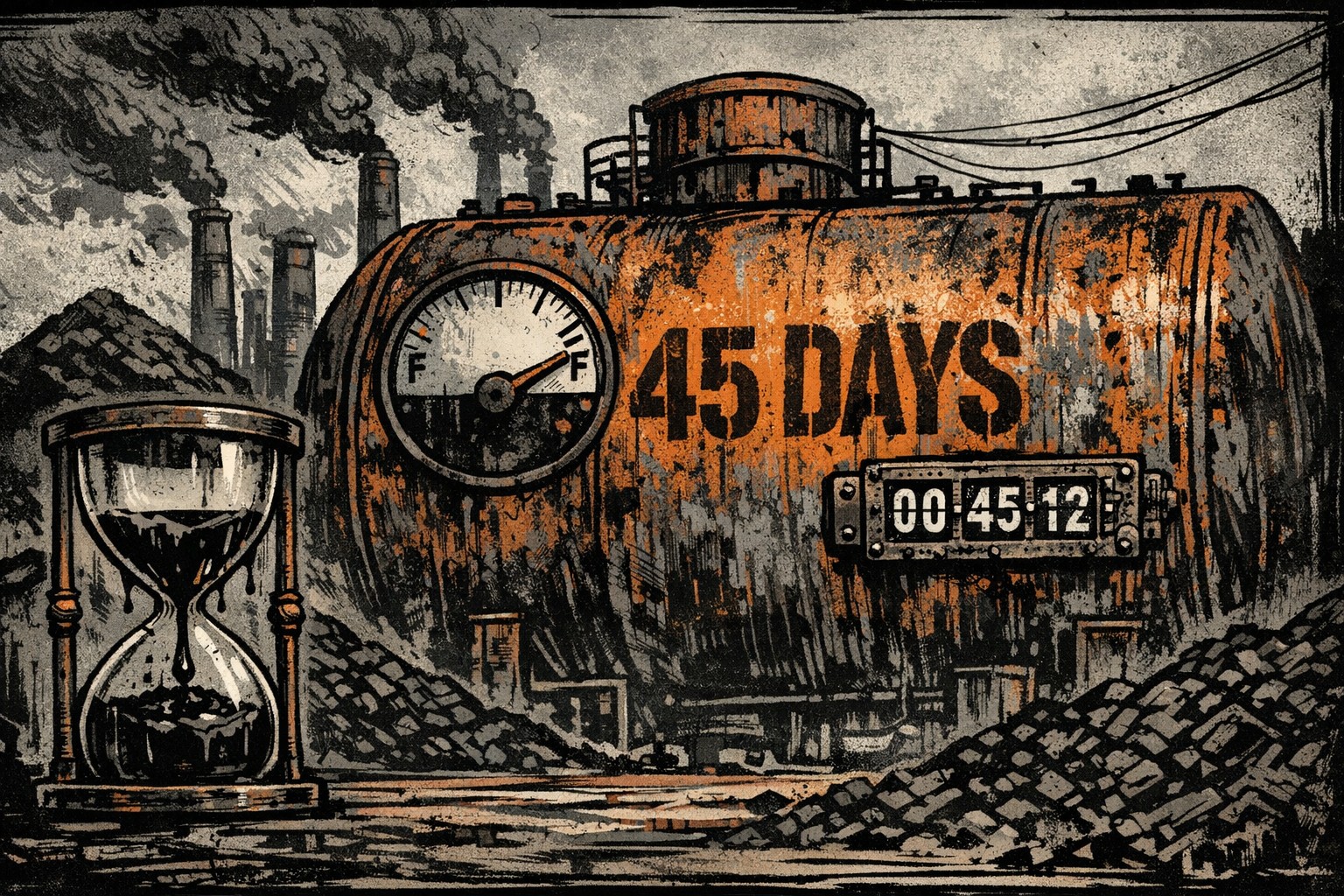
"The worst case is we run dry. This country runs dry."
Energy Secretary Sharon Garin said that out loud — at a Senate hearing, on the record — on March 24, 2026.
She was responding to a question from Senator Sherwin Gatchalian about what happens if the Strait of Hormuz stays closed. Her answer left no room for ambiguity.
The Philippines had, on average, about 45 days of fuel supply as of March 23. Some products had less. Gasoline: 39 days. Diesel: 42 days. LPG: 33 days. Jet fuel: 37 days.
Those numbers sound like a buffer. They are not. They are a countdown.
THE CLOCK STARTED IN EARLY MARCH
The Strait of Hormuz handles roughly 20% of the world's oil supply. It is the narrow passage between Iran and Oman that connects the Persian Gulf to the open sea. Most of the oil and liquefied natural gas produced by Saudi Arabia, Iraq, Kuwait, Qatar, Bahrain, and the United Arab Emirates passes through it.
When Iran closed the strait in early March 2026, the effect was immediate.
The Philippines imports nearly all of its crude oil and petroleum products. About 70% of those imports come from the Middle East. We do not have a strategic petroleum reserve large enough to absorb a prolonged disruption.
The government has been trying to diversify supply. Energy officials have talked to the United States, Malaysia, Indonesia, Brunei, and other countries. Some shipments have been arranged. More are being negotiated.
But alternative supply is not instant. Tankers need contracts, loading slots, shipping time, insurance, and safe routes. The farther the source, the longer the delivery.
The 45 days are not 45 days of guaranteed normal life. They are the average stock already in the system, being consumed every day while replacement cargoes become harder and more expensive to secure.
THE NUMBER IS ALREADY UNEVEN
National averages hide local shortages.
Metro Manila may have fuel while an island province runs low. One company may have a shipment coming while another is rationing inventory. Diesel may last longer than LPG. Aviation fuel may become tight before gasoline.
The Department of Energy has already acknowledged that some areas and products could run out earlier than the national average.
That is why the warning matters now, not on day 44.
Fuel shortages do not arrive as one dramatic national blackout. They show up first as longer lines, purchase limits, closed pumps, delayed deliveries, cancelled flights, higher transport costs, and sudden price spikes.
Then the effects spread into food, electricity, manufacturing, public transport, and household budgets.
WHAT THE GOVERNMENT IS DOING
The Marcos administration has declared a national energy emergency. It has suspended fuel taxes in stages, ordered conservation measures, restricted some government travel, and directed agencies to reduce energy use.
The DOE has required oil companies to submit inventory and supply data. Authorities have warned against hoarding and profiteering. The government is also seeking emergency supply arrangements abroad.
These steps can slow the damage. They cannot manufacture fuel.
Tax cuts reduce the retail price but also reduce government revenue. Conservation stretches existing supply but does not replace it. Enforcement can punish hoarding but cannot force a tanker through a closed strait.
The central problem remains physical: the country consumes imported fuel faster than new supply can be guaranteed.
WHAT HAPPENS IF THE STRAIT STAYS CLOSED
The first consequence is price.
Global oil prices rise because a fifth of world supply is trapped or rerouted. Shipping and insurance costs increase. The peso comes under pressure because the country needs more dollars to buy the same amount of fuel.
The second consequence is availability.
Oil companies begin prioritizing essential customers and high-demand markets. Smaller distributors and remote areas feel the shortage first. Airlines cut flights. Transport operators reduce trips or raise fares. Power plants using diesel or bunker fuel face higher operating costs.
The third consequence is economic slowdown.
Factories pay more to operate. Farmers pay more for irrigation, fertilizer transport, and machinery. Food prices rise because every stage of production and delivery depends on fuel.
The fourth consequence is political pressure.
Governments can absorb public anger for high prices only for so long. Subsidies, tax cuts, and cash aid become more expensive as revenue falls and borrowing costs rise.
That is what "this country runs dry" means. It does not mean every gas station empties on the same day. It means the system loses enough fuel, in enough places, that normal economic activity becomes impossible to maintain.
Forty-five days is not a prediction of collapse. It is the amount of time the country has to prevent one.
The clock is already running.
SOURCES
- GMA News, https://www.gmanetwork.com/news/topstories/nation/982304/philippines-run-dry-fuel-hormuz-energy-secretary/story/
- ABS-CBN News, https://www.abs-cbn.com/news/nation/2026/3/24/philippines-has-45-days-of-fuel-supply-on-average-doe-1634
- Inquirer.net, https://newsinfo.inquirer.net/2199042/philippines-fuel-supply-45-days-doe
- Philippine Star, https://www.philstar.com/headlines/2026/03/25/2515203/doe-philippines-has-45-day-fuel-buffer
- Manila Bulletin, https://mb.com.ph/2026/03/24/philippines-has-45-day-fuel-supply-buffer-doe
- BusinessWorld, https://www.bworldonline.com/top-stories/2026/03/25/741675/philippines-fuel-buffer-seen-lasting-45-days/
- Philippine News Agency, https://www.pna.gov.ph/articles/1270260
- Philippine Information Agency, https://pia.gov.ph/news/doe-assures-public-of-adequate-fuel-supply-amid-hormuz-crisis/
- Department of Energy Philippines, https://legacy.doe.gov.ph/press-releases/doe-assures-public-country-has-sufficient-fuel-inventory
- Department of Energy Philippines, https://legacy.doe.gov.ph/press-releases/doe-intensifies-fuel-supply-security-measures-amid-global-oil-disruptions
- Reuters, https://www.reuters.com/business/energy/philippines-seeks-alternative-fuel-supplies-hormuz-closure-2026-03-23/
- Bloomberg, https://www.bloomberg.com/news/articles/2026-03-23/philippines-says-fuel-stockpile-can-last-about-45-days
- Nikkei Asia, https://asia.nikkei.com/Politics/International-relations/Philippines-scrambles-for-fuel-as-Hormuz-closure-bites
- Channel News Asia, https://www.channelnewsasia.com/asia/philippines-fuel-supply-strait-hormuz-closure-energy-crisis-5019821
- Al Jazeera, https://www.aljazeera.com/economy/2026/3/24/philippines-warns-fuel-could-run-dry-if-hormuz-remains-closed
- U.S. Energy Information Administration, https://www.eia.gov/todayinenergy/detail.php?id=65564
- International Energy Agency, https://www.iea.org/reports/oil-market-report-march-2026
- World Bank, https://www.worldbank.org/en/news/press-release/2026/03/20/oil-shock-threatens-import-dependent-economies
- Asian Development Bank, https://www.adb.org/news/adb-warns-prolonged-hormuz-disruption-hit-asian-economies
- Bangko Sentral ng Pilipinas, https://www.bsp.gov.ph/SitePages/MediaAndResearch/MediaDisp.aspx?ItemId=7598
- Department of Finance Philippines, https://www.dof.gov.ph/government-unveils-fuel-tax-relief-measures-amid-global-energy-crisis/
- Official Gazette of the Philippines, https://www.officialgazette.gov.ph/2026/03/18/proclamation-no-1246-s-2026/
- Presidential Communications Office, https://pco.gov.ph/news_releases/pbbm-orders-government-wide-energy-conservation-measures/
- Senate of the Philippines, https://legacy.senate.gov.ph/press_release/2026/0324_gatchalian1.asp
- House of Representatives Philippines, https://www.congress.gov.ph/press/details.php?pressid=13285